The Invisible War: The Human Cost Inside Israel That the World's Narrative Is Not Reporting
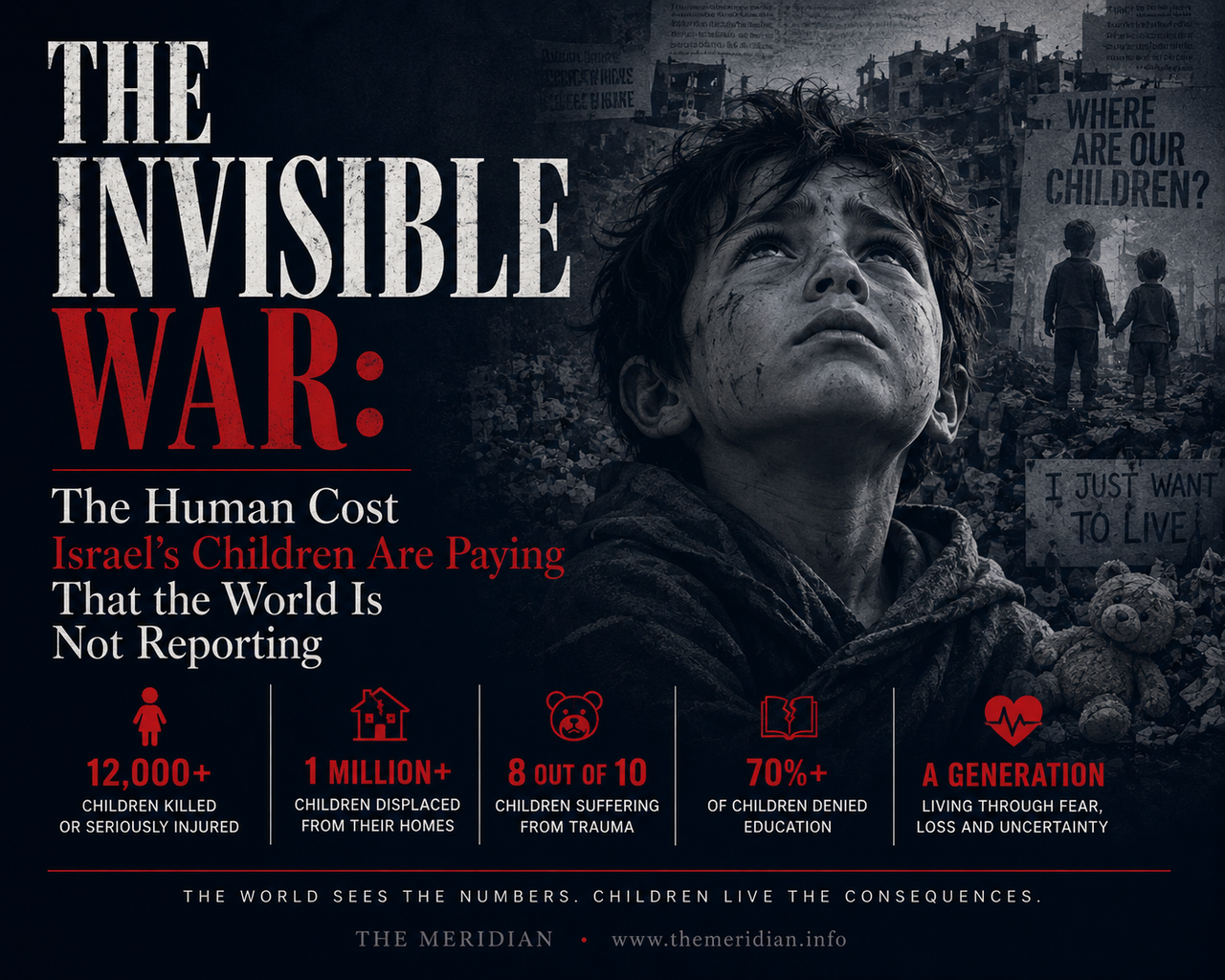
The international conversation about Israel and the war is conducted through two dominant frames: the military and security frame, which discusses operations and strategy, and the humanitarian frame, which focuses on Gaza. Neither frame asks what is happening to Israeli civilians, particularly children and families, who are living through sustained trauma, displacement, food insecurity, a collapsed mental health system and a fiscal squeeze that is cutting civilian spending to pay for defence. The Tel Aviv stock market is up 20 per cent this year. More than a quarter of Israeli families cannot reliably access enough food. The Meridian breaks the taboo.
There is a particular kind of invisibility that comes not from silence but from noise. The war in Israel and Gaza has generated more international media coverage, more UN Security Council sessions, more NGO reports and more social media engagement than almost any conflict in recent history. And yet within that enormous volume of coverage, one story has been almost entirely absent: the story of what is happening to ordinary Israeli families, to children in border communities who have not slept through a full night in years, to reservists whose businesses collapsed while they served, to households that cannot absorb VAT increases on top of rising food prices on top of lost income, to a mental health system that the Israeli state comptroller officially declared had collapsed on the first day of the war. The noise of the international debate has made these Israelis invisible. The Meridian reports what is documented, verified and largely unreported.
Israel Journal of Health Policy Research Dec 2025
Including ~1 million children. Latet Report Dec 2025
Finance Ministry accountant general Jan 2026
730 hospitalised, mostly children. Taub Center 2026
Including those not directly affected. Univ. of Haifa
Due to financial hardship. Latet Report Dec 2025
Israel human cost war narrative gap international coverage GDP stock market civilians
The international narrative about Israel in the current war period has two dominant registers. The first is economic and financial: the Tel Aviv 35 index up 20 per cent since the start of 2026, building on a 51.6 per cent rally in 2025. The IMF forecasting GDP growth of 3.5 to 4.8 per cent. Record foreign investment deals in cybersecurity. Israeli tech exports strong. Defence tech start-ups booming. This register is accurate as far as it goes. Israel's high-tech sector, which employs approximately 11 per cent of the workforce and generates approximately 64 per cent of exports, has remained resilient and has even benefited from global demand for battle-proven defence technologies.
The second register is humanitarian, focused exclusively on Gaza. The scale of suffering in Gaza is documented and real. The Meridian does not dispute it and does not minimise it. But the exclusive focus on Gaza in the humanitarian register has created a perverse invisibility: the assumption that because Israel's financial markets are performing well and because the humanitarian crisis is framed as being in Gaza rather than in Israel, there is no human cost being paid inside Israel itself by ordinary Israeli civilians. That assumption is factually wrong, and the data that disproves it comes from Israeli institutions — the Israeli state comptroller, the Taub Center for Social Policy Research, the Latet nonprofit organisation, peer-reviewed Israeli academic journals — not from external critics.
Israeli children PTSD trauma October 7 war mental health adolescents peer reviewed 2025
The most comprehensive peer-reviewed evidence of the war's impact on Israeli children comes from a study published in the Israel Journal of Health Policy Research in December 2025, drawing on a cross-sectional digital survey of 744 Israeli adolescents aged 14 to 18 conducted between October and December 2024. The study found that 41.9 per cent of participants met the probable diagnostic threshold for post-traumatic stress disorder. Gender was a significant predictor of symptom severity, with female adolescents showing higher rates. Economic status deterioration and direct war impact emerged as the strongest predictors of PTSD among direct exposure factors. The study concluded there was an urgent need for action and that evidence-informed mental health policies and government interventions were required, particularly financial and housing support for families displaced, rendered homeless or facing unemployment.
The trauma does not begin at age 14. A study published in Research in Child and Adolescent Psychopathology in April 2025, drawing on 220 treatment-seeking children aged 3 to 12 and their parents, documented high prevalence of trauma symptoms across both preschoolers aged 3 to 7 and school-aged children aged 8 to 12. The most common behavioural symptoms in young children include sleep disorders, low tolerance of frustration and an inability to self-regulate. Maternal PTSD is a compounding factor documented across multiple studies: children's trauma is significantly linked to their mothers' trauma, creating what researchers describe as intergenerational stress patterns that will shape Israeli society for decades beyond the military events that triggered them.
A University of Haifa study found approximately 60 per cent of Israelis who were not directly affected by the war developed severe acute stress disorder, which is a recognised risk factor for developing full PTSD. One in four Israelis used more drugs and medications after October 7, according to the Israel Center for Addiction. The Israeli state comptroller, in a formal February 2025 report on the institutional response to October 7, concluded that the mental health system, which had difficulty functioning even before October 7, collapsed in the first days of the war. Nonprofit organisations including NATAL, ERAN, ENOSH and the Israel Trauma Coalition have stepped into the breach left by the overwhelmed state system, providing services that the public health infrastructure could not sustain. These are not the observations of external critics. They are the findings of the Israeli state's own accountability mechanism.
41.9 per cent of Israeli adolescents meet the threshold for PTSD. The mental health system collapsed on October 7. 60 per cent of Israelis not directly affected by the war developed acute stress disorder. These are the findings of Israeli institutions about Israeli children. The world is not reporting them.
Israel food insecurity poverty war poor families Latet report 2025 hunger children
Israel is classified by the World Bank as a high-income economy. Its GDP per capita places it among the wealthiest countries in the world by this measure. And yet Latet's 2025 Alternative Poverty Report, published December 2025 by the nonprofit aid organisation with staff on the ground working with 17 partner organisations across Israel, found that more than a quarter of Israeli families struggle to access enough food. Specifically, 28.1 per cent of Israelis suffer from food insecurity for economic reasons. Of these, more than 40 per cent are considered to be living with severe hunger. Approximately one million Israeli children are included in this figure. About 9 per cent of Israelis forgo medical treatment due to financial hardship. About 4.7 per cent skip a hot meal at least once every two days.
The report identified what it termed a new class of war poor: families pushed into financial crisis after October 7 whose household budgets could not absorb the compounding pressures of the war economy. Latet calculated that the minimum cost of living in Israel in 2025 stands at approximately NIS 5,589 per person per month, or NIS 14,139 for a household of two adults and two children. Against this baseline, the government raised VAT from 17 to 18 per cent. Food costs for low-income households have nearly doubled since the war escalated, according to a December 2025 assessment that found nearly 60 per cent of government aid beneficiaries reported a deterioration in their financial situation. Labour shortages in agriculture caused by mass mobilisation and restrictions on Palestinian and foreign workers disrupted planting and harvesting cycles, pushing fruit and vegetable prices further out of reach for lower-income households.
The households most severely affected are those that fall just above the official poverty line but below the threshold at which they can absorb economic shocks. Families of reservists whose business income stopped while they served. Families from border communities who were evacuated to hotels and temporary accommodation, losing access to their normal employment, their children's schools and their social networks simultaneously. Single parents in southern and northern communities who have been managing missile threat routines for their children for over two years. The official poverty statistics do not fully capture these households because they measure income rather than expenditure under crisis conditions. The Latet data captures what the official statistics miss: that being above the poverty line in peacetime does not mean being above it during a sustained multi-front war whose costs are being distributed unequally across the population.
Israel healthcare crisis measles outbreak children deaths 2025 medical workforce shortage Taub Center
In April 2025, a measles outbreak swept through Israel, resulting in approximately 2,000 reported cases. Of the 730 patients hospitalised, the majority were children. Twelve children died. This was not a major international news story. It did not generate Security Council debate. No NGO published a landmark report about it. Twelve Israeli children died of a vaccine-preventable disease during a period in which the healthcare system was under extraordinary pressure, and the world largely did not notice.
The Taub Center for Social Policy Research, in its 2025 health system overview published in March 2026, documented the structural conditions that made the outbreak possible and lethal. Israel's healthcare system operates as what the Taub Center calls a national paradox: despite one of the lowest levels of national investment among high-income countries, the system has historically achieved outstanding outcomes including a life expectancy of 83.8 years, placing Israel fourth among high-income countries. But this paradox has limits. Israel has 3.5 active physicians per 1,000 population compared to an OECD average of 3.9, and only 5.57 active nurses per 1,000 population compared to an OECD average of 9.5. The measles outbreak spread through communities with low vaccination rates and high population density, demonstrating precisely the vulnerability that chronic underinvestment in public health infrastructure creates when it intersects with a healthcare system simultaneously managing wartime demands.
The war compounded these structural deficiencies in specific, documented ways. The mass mobilisation of reservists removed physicians, nurses and paramedics from civilian healthcare. The trauma load on the mental health system exceeded its capacity from the first days of the war. The Taub Center noted that a reform introduced in 2019 disqualifying foreign medical schools not meeting World Federation for Medical Education standards, set to take full effect in 2026, is expected to create a 40 per cent shortage in the number of physicians available to the Israeli system in the short to medium term. The intersection of wartime demand, chronic underinvestment, workforce shortages and a public health system that was already operating at the margins of its capacity is the context in which twelve children died of a disease for which an effective vaccine has existed since 1963.
Israel war economy fiscal cost civilian spending cuts VAT debt GDP 2025 2026 IMF
Israel spent approximately NIS 91 billion ($29 billion) on military, defence and civil needs in 2025 to support the war effort, according to a first estimate by the Finance Ministry's accountant general published January 2026. This figure covers 2025 alone. The Bank of Israel estimated total war-related costs from 2023 through 2025 at approximately $80 billion. Government debt rose from 60 per cent of GDP in 2022 to 68.6 per cent by end-2025, according to IMF data. The government budget deficit in 2025 was 4.7 per cent of GDP at approximately NIS 98.6 billion ($31.5 billion).
The IMF, in its February 2026 Article IV mission concluding statement on Israel, found that the 2026 budget of NIS 144 billion leaves little room for civilian needs, making it much harder for the government to tackle the high cost of living, the housing shortage and chronic underinvestment in transport, healthcare, education and social welfare. The VAT increase from 17 to 18 per cent and the elimination of various tax exemptions are already squeezing the middle class and slowing domestic consumption. Defense spending at 8 per cent of GDP is double its pre-war level and remains permanently elevated even under the most optimistic projections. The Nagel Commission is expected to require an additional NIS 20 to 30 billion annually in security spending for the coming years.
The distributional impact of this fiscal restructuring is not neutral. VAT is a regressive tax: it takes a higher proportion of the income of lower-income households than of higher-income households. A family spending 80 per cent of its income on consumption pays VAT on 80 per cent of its income. A family in the tech sector spending 30 per cent of its income on consumption pays VAT on 30 per cent of its income. The 1 percentage point VAT increase therefore falls most heavily on the households that can least afford it, including the one million Israeli children already living with food insecurity documented by Latet. The cuts to education, higher education and transportation budgets proposed in the 2025 and 2026 fiscal planning reduce the public services that lower-income households depend on disproportionately, while the defense technology sector that has produced record investment deals and stock market performance is populated primarily by high-income earners whose livelihoods are not diminished by the war and in some cases are enhanced by it.
The Tel Aviv stock market is up 20 per cent. One million Israeli children are living with food insecurity. Both of these statements are sourced, verified and true. The international narrative reports the first. It largely ignores the second. That is the narrative gap The Meridian is breaking today.
Israeli families displaced border communities Gaza Lebanon reservists business collapse 2024 2025
Tens of thousands of Israelis were evacuated from communities along the Gaza border following October 7 and from northern communities near Lebanon following the escalation of Hezbollah rocket fire. Kibbutzim along the Gaza border, some of which were the sites of the October 7 massacres themselves, have been partially or entirely emptied of their civilian populations. Families from these communities have been living in hotels, in temporary accommodation, in the homes of relatives and in purpose-built temporary housing for periods measured not in weeks but in months and years. Many returned to communities that remain under rocket threat, to homes that were damaged or destroyed, to social structures that were shattered when neighbours were killed, taken hostage or traumatised beyond the capacity to reconstruct normal community life.
The economic cost of displacement is layered and compound. Reserve soldiers called up for extended service saw their businesses collapse while they served. The government provided approximately $8,000 per month in salary replacement for reservists, totalling about $18 billion as of mid-2025, but this replacement did not cover the loss of business relationships, client contracts, investment pipelines or the simply irreplaceable accumulation of economic activity that stops when a business owner is in uniform for a year rather than at their desk. The construction and agriculture sectors remained in semi-paralysis due to the ongoing exclusion of Palestinian workers from Israel and the failure of foreign labour programmes to fill the gap rapidly enough, pushing housing starts down and housing prices back up in early 2026 despite high interest rates that were themselves a constraint on household purchasing power.
The increased rate of emigration from Israel is described by academic analysts as the single most important development of Israel's post-October 7 political economy that, if not checked, will signal that educated, secular, cosmopolitan Israelis do not envisage a future in which they wish to remain. The pattern of emigration predates October 7 and was intensified by the judicial reform crisis of 2023, but the war has added a further layer of push factors for those with the qualifications and international networks to relocate. This is the human geography of a society under sustained existential pressure: a stock market performing at record levels for those with assets, and a growing underclass of war poor, traumatised children, displaced families and emigrating professionals for those without them.
Israel civilians accountability international narrative human rights war children PTSD food insecurity
The Meridian publishes this article from a position that has defined its approach to every human rights question in this edition: the suffering of civilians in conflict is not a competitive category. The documented suffering of children in Gaza and the documented suffering of children inside Israel are not in a hierarchy. They do not cancel each other out. They do not require the minimisation of one to acknowledge the other. A commitment to human rights that is conditional on the identity of the child suffering is not a commitment to human rights. It is a political position wearing human rights language as a costume.
The international community's accountability to Israeli children and families is not primarily a matter of sympathy. It is a matter of intellectual honesty. When institutions, governments and media organisations apply the humanitarian frame selectively — documenting suffering in Gaza with rigour and ignoring the documented suffering inside Israel with equal rigour — they are not being neutral. They are making an editorial and political choice that shapes the global understanding of the conflict and distorts the conditions for any eventual resolution. A peace process, if one ever begins, will have to address the trauma of both populations simultaneously. It cannot do so if one population's trauma has been systematically documented and the other's has been systematically ignored.
The data The Meridian has reported in this article comes from Israeli institutions. The Latet Alternative Poverty Report. The Israel Journal of Health Policy Research. The Taub Center for Social Policy Research. The Israeli state comptroller. The University of Haifa. The Finance Ministry. The Bank of Israel. The IMF's Article IV mission. These are not external critics of Israel. They are Israel's own accountability mechanisms, documenting what is happening to Israel's own people, for the record. The world has not been reading them. The Meridian has. And what they document is a society paying an enormous human price that the GDP and stock market numbers do not capture and that the international debate has not yet found the political space to acknowledge. That space must be found. For the children who are not sleeping. For the families that cannot feed themselves. For the twelve children who died of measles. For the 41.9 per cent of adolescents who are carrying the weight of a war inside them that no one outside Israel is talking about.
Add comment
Comments