The Pension Pyramid: How Mauritius Built a Democracy That Votes for Itself at the Expense of Its Children
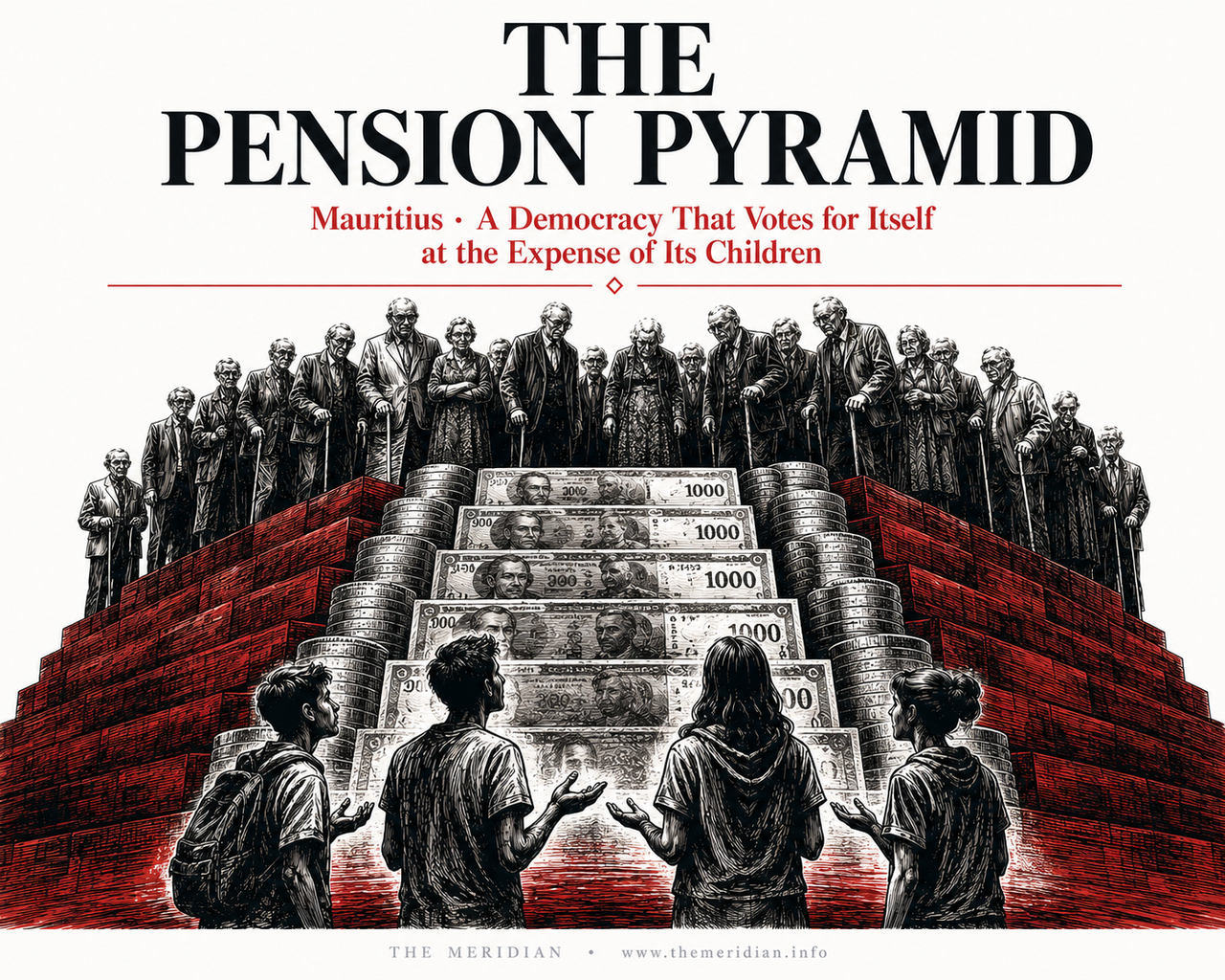
In 2024-25, the Government of Mauritius spent over Rs55 billion on the Basic Retirement Pension. The BRP has more than doubled since 2019. Public debt stands at Rs642 billion, representing 90 per cent of GDP. The fertility rate is 1.34. Youth unemployment is 16.61 per cent. The over-60 population has grown from 186,400 in 2015 to over 257,600 today and is projected to surpass 300,000 by 2027. The elderly vote. Gen Z emigrates. The pension is non-contributory, funded from general taxation paid by the working population. Every rupee paid to an elderly recipient is extracted from the generation that was never asked and never chose this arrangement. The Meridian names what this is: a democratic pension pyramid. And asks what happens to the island that built it when the mathematics finally breaks it apart.
A pension pyramid is a specific kind of political economy failure. It is not the same as a Ponzi scheme, which collapses when new participants stop joining. It is more insidious than that. A pension pyramid is a democratic mechanism: a large, reliable voting bloc extracts transfers from the state, the state finances those transfers by taxing the smaller, less organised working population and by borrowing against the future productivity of a generation that has not yet voted, and the political actors who design the system are rewarded with reelection precisely because their primary constituency receives what it voted for. The scheme works as long as the demographic arithmetic allows it. In Mauritius, the arithmetic has failed. The pyramid has hit its mathematical wall. And the generation that built it has now done something extraordinary: it has raised the pension eligibility age from 60 to 65 rather than raise taxes on the young again. It has, for the first time in the island's political history, taken something away from the elderly voting bloc rather than giving them more. The Supreme Court is being asked to rule on whether this is constitutional. That is the measure of how deeply the pyramid has been embedded in the social contract of a democracy that voted for itself.
More than doubled since 2019. PM Statement June 2025
90% of GDP. PwC Budget Brief 2025. IMF Article IV
Up from 186,400 in 2015. Projected 300,000+ by 2027
Well below replacement rate of 2.1. Statistics Mauritius
vs 3.4% budgeted. Rs43bn shortfall. PwC analysis
Ages 15-24. World Bank ILO modelled estimate
Mauritius elderly voting bloc BRP pension increase election democracy gerontocracy political economy
The relationship between Mauritius's pension system and its electoral system is not coincidental. It is causal, direct and documented in the trajectory of BRP expenditure relative to election cycles. The BRP is universal — every Mauritian resident over the eligibility age receives it regardless of prior income, employment history or contribution record. It is non-contributory — recipients pay nothing in advance and receive it as a right of age and residency. And it is funded from the Consolidated Fund — meaning it competes directly with every other claim on government expenditure, including education, healthcare, infrastructure and the debt service costs of the borrowing required to fund it when tax revenues fall short.
The over-60 population has grown from approximately 186,400 in 2015 to over 257,600 today and is projected to surpass 300,000 by 2027. Elderly Mauritians vote at significantly higher rates than the young in every democracy for which comparable data exists, and there is no reason to believe Mauritius is an exception. They are also more likely to be settled in the communities where electoral organisation occurs, more likely to have the social networks through which political mobilisation operates and less likely to be living abroad when the ballot box opens. Gen Z, conversely, is shrinking as a share of the electorate through two simultaneous mechanisms: a fertility rate of 1.34 that produces fewer young Mauritians to enter the electorate each year, and emigration that removes existing young Mauritians from the island and therefore from the electoral register before they accumulate the political weight to challenge the system that is extracting from them.
A rational political actor in this environment does exactly what every Mauritian government across party lines has done for the past two decades: maximise the BRP, minimise political risk by keeping the elderly comfortable and borrow the difference when revenue falls short. BRP benefits more than doubled between 2019 and 2025, according to the IMF's own Article IV Consultation. The cost reached Rs55 billion in 2024-25. The budget deficit reached 9.8 per cent of GDP — nearly three times the 3.4 per cent that had been budgeted, representing a shortfall of approximately Rs43 billion. The public debt reached Rs642 billion at 90 per cent of GDP. The pyramid had consumed the margin available for any other use of public money. The political elite, in the words of one analytical summary of the crisis, had simply run out of other people's money.
The elderly vote. The pension rises. The debt grows. The young pay taxes they did not vote to impose on themselves, to fund a pension they will receive five years later than their parents, if they stay long enough to collect it at all. This is not a welfare state. It is a demographic extraction mechanism wearing the costume of one.
Mauritius Gen Z millennials five layer extraction pension healthcare education conglomerate political
The pension pyramid is the most visible layer of the intergenerational extraction that Mauritius has built over the past two decades. But it is not the only one. The full architecture of extraction operates through five simultaneous mechanisms, each compounding the others.
Rs55 billion per year from the Consolidated Fund for a non-contributory universal pension. The working generation did not vote for the BRP increases that produced this figure. The elderly did. The Finance Act 2025 has raised the eligibility age from 60 to 65, meaning Gen Z must work five more years than their parents to receive what their parents received at 60 — while simultaneously paying the taxes and carrying the debt that funded the system as it existed for the generation before them. The IMF notes this amounts to significant intergenerational redistribution from the younger to the older generation. The Supreme Court is being asked to rule on whether this correction is constitutional. That is the measure of how deeply the pyramid has been embedded in the social contract.
Public hospital infrastructure, polyclinic services and the allocation of healthcare capital expenditure in Mauritius are disproportionately oriented toward the needs of an ageing population: geriatric care, chronic disease management, cardiac services, orthopaedics, diabetes management. These services consume the bulk of public health expenditure because the voting population that drives political priorities requires them. Mental health services for young people are chronically underfunded. Substance dependency services are overwhelmed. Adolescent psychiatry is barely visible in the public health system. When 41.9 per cent of Israeli adolescents are documented as meeting PTSD criteria — a figure The Meridian reported this month — it raises a direct question about what comparable data would show for young Mauritians navigating unemployment, displacement and the absence of economic opportunity in a system that was not built for them. The data does not exist in published form. The healthcare system was not designed to generate it.
Investment in digital economy infrastructure, technical education quality, university research capacity and the skills formation that would make young Mauritians competitive in a global knowledge economy has been consistently deferred in favour of social transfers to the elderly voting bloc. The result is a generation educated enough to be acutely frustrated by what the economy offers them but not equipped with the specific technical skills the global economy rewards most generously. The gap between what a young Mauritian graduate is capable of and what the local labour market offers is not a market failure. It is the product of two decades of educational underinvestment relative to social welfare transfers, compounded by an imported labour policy that removes even the low-wage jobs that might otherwise create a domestic skills ladder.
Documented in detail elsewhere in this edition, but directly relevant here. IBL generated Rs94.8 billion in revenue in nine months from 40,000 employees. NMH generated Rs16.9 billion in revenue from 5,050 employees at or near minimum wage. The EBITDA per employee at NMH is Rs950,495 — 4.5 times the minimum annual wage. The conglomerates import cheap foreign labour to suppress the wage floor, preventing the market pressure that would otherwise force wages upward to levels at which educated young Mauritians would accept hospitality, retail and construction jobs rather than emigrate. By keeping wages low enough that Gen Z votes with its passport, the conglomerates simultaneously eliminate the domestic pressure for economic transformation and maintain the cost structure on which their margins depend. The elderly, who own the shares and sit on the boards, collect the dividends. The young, who serve at the tables and pack the shelves, collect the minimum wage. Or leave.
Mauritius's politics is organised around communal, family and factional loyalties that predate independence and have been reinforced by every successive government's use of public resources as patronage. Contracts, appointments, licences, work permits, land use permissions: these flow to political allies and are withheld from political opponents as a matter of documented practice. Gen Z has no established place in this patronage network. It has not yet accumulated the economic or social capital that buys political protection. It cannot access the patronage because it has nothing yet to offer. It cannot effectively challenge the system because its most capable members leave before they can organise. Parliamentary sessions are consumed by political vendettas between rival factions of the same gerontocratic elite, while the structural questions of wage policy, pension sustainability, water infrastructure, education investment and youth employment go unanswered across electoral cycles because answering them would require taking resources from the voters who are already captured and giving them to the voters who have already left.
Mauritius Finance Act 2025 pension age 65 Supreme Court debt 90 percent GDP IMF fiscal crisis
The Finance Act 2025 is the most important piece of legislation passed in Mauritius in a generation — not because it solves the structural problem but because it acknowledges it. Section 39 of the Act amends the National Pensions Act 1976 to raise the BRP eligibility age from 60 to 65 over a ten-year phased period beginning September 2026. The Income Tax Act was simultaneously amended to introduce an income support scheme for those aged 60 to 65 who lose BRP eligibility in the transition, providing MUR10,000 per month for eligible individuals and MUR20,000 for couples below specified income thresholds. The reform was described by Prime Minister Dr Navin Ramgoolam as courageous but unpopular, and as necessary to address the inherited financial situation. The IMF Article IV Consultation endorsed the reform explicitly, noting that an alignment in the BRP eligibility age would help make the pension system more sustainable while containing intergenerational inequalities.
The constitutional challenges filed in the Supreme Court are the system defending itself. Individuals who planned their financial lives around receiving the BRP at 60 have a legitimate grievance: the rules were changed after they arranged their affairs around them. That grievance is real and deserves respect. It does not change the arithmetic. The old-age dependency ratio is projected to double in Mauritius over the next thirty years. The fertility rate is 1.34. Youth emigration continues. The working-age tax base that funds the non-contributory BRP is shrinking in absolute and relative terms. The IMF projects that fiscal consolidation would be required to bring public debt below 83 per cent of GDP by June 2031, assuming annual GDP growth of approximately 4 per cent. Without the pension reform, that trajectory is materially worse. The previous government chose not to act because the electoral arithmetic did not permit it. The new government acted because the fiscal arithmetic left no alternative.
Mauritius youth investment future economic reform pension age Gen Z structural transformation 2026
The pension age increase is necessary but insufficient. It reduces the rate at which the pyramid consumes the future. It does not redirect the resources freed by that reduction toward the generation that needs them. For that reallocation to occur, the political economy of who votes and for what would need to change. Three possible futures present themselves.
The first is genuine structural reorientation: the savings from pension reform are invested in the digital economy infrastructure, technical education quality, wage policy reform and public health investment that would make Mauritius a place where Gen Z might stay rather than leave. This requires a government willing to make the same electoral sacrifice on the spending side that it has already made on the pension eligibility side — that is, to invest in voters who may not yet be here to vote rather than transfers to voters who are already committed. It is politically difficult. It is structurally necessary. Barbados, documented in this edition, is the model: proactive, forward-looking institutional investment that builds resilience before the crisis rather than after it.
The second is a new extraction mechanism: the resources notionally freed by pension reform are absorbed by new forms of political patronage, by the debt service costs of Rs642 billion already borrowed, or by the next electoral promise to a constituency that votes reliably. The political economy of Mauritius has proved its capacity for creative extraction across multiple electoral cycles. There is no structural guarantee that the same logic will not simply find a new vehicle once the BRP has been restrained.
The third is the external shock: the Iran war oil premium, the reservoir crisis, the accumulating fiscal pressure and the climate trajectory converge into a crisis severe enough to force the reallocation that the political system will not make voluntarily. This edition of The Meridian has documented that trajectory across fifteen articles on Mauritius alone. The Company Town. The Beachcomber Equation. The Mauritian Miracle's limits. The water crisis. The foreign labour paradox. The Barbados comparison. All of it points toward the same structural endpoint: a small island that has been consuming its future for two decades and is running out of future to consume.
When the last young Mauritian with options has left for London or Melbourne or Dubai, who will be left to vote? And who will there be left to tax? The pension pyramid is not merely a fiscal problem. It is a civilisational question about what kind of society Mauritius intends to be for the generation it has been extracting from since birth. The answer cannot come from the elderly voting bloc that built the pyramid. It can only come from the young people who are still here, who have not yet left and who are watching the Supreme Court rule on whether raising the pension age is constitutional while their own future remains as uncertain as the water level in Mare-aux-Vacoas. They deserve a better answer than the one the pyramid has given them.
Add comment
Comments