Can Central Banks Actually Control Inflation? The Evidence From the Iran War Says No
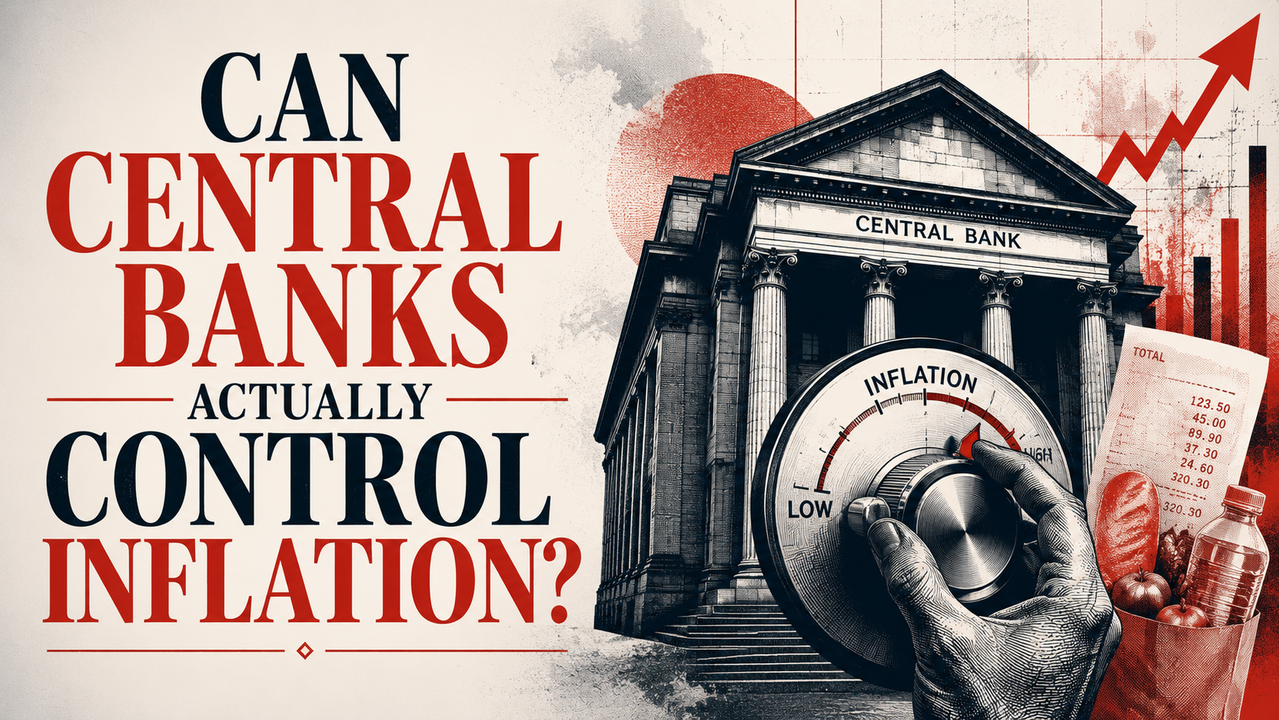
Brent crude is above $110 per barrel. The Strait of Hormuz has been closed since February. Suez Canal revenues fell 61 per cent in 2024. The Egyptian pound lost 10.4 per cent of its value in weeks. Mauritian diesel rose 20 per cent in six weeks. Inflation is rising across advanced and developing economies alike, driven by a war, a closed strait and broken supply chains rather than by households spending too freely. Yet central banks are reaching for interest rates. The Meridian Intelligence Desk asks the question that matters more than the rate decision itself: can the tool actually fix the problem? And who pays when it cannot?
There is a specific kind of policy failure that is more dangerous than incompetence. It is the failure that occurs when an institution applies the right tool to the wrong problem with great technical precision and institutional authority. The diagnosis is confident. The instrument is deployed correctly. The underlying cause is untouched. And the side effects of the treatment fall on the patients least able to absorb them. This is where central banks stand in May 2026. The US Federal Reserve and the Bank of England have spent much of 2025 and 2026 framing their decision to hold interest rates steady as an exercise in prudence, data dependence and the responsible management of an economy navigating between inflation and recession risk. The real issue is not whether to hold or raise. The real issue is whether the instrument being debated can address the inflation currently being experienced. The evidence from the Iran war, assembled by The Meridian across fifteen articles this month, says it cannot. And the Global South, which did not cause the inflation and cannot influence the rate decision, pays the price of the mismatch twice.
Up from ~$75 pre-war. $35 war premium
$10.2bn to $4bn. Canal Authority Chairman
EGP 47.9 to 52.9. CBE trading rates May 2026
Rs58.95 to Rs71.25. Two successive PPC decisions
demand pull inflation cost push inflation central banks interest rates supply shock monetary policy
Central bank interest rate policy was designed to address a specific type of inflation. Demand-pull inflation occurs when spending in an economy grows faster than the economy's capacity to produce goods and services. Too much money pursuing too few goods pulls prices upward. The remedy is straightforward in principle: raise interest rates, which increases the cost of borrowing, reduces household and business spending, cools demand and relieves the price pressure. This is the model that underpins the inflation-targeting framework adopted by the Bank of England in 1997, the US Federal Reserve's dual mandate framework and the European Central Bank's price stability mandate. It is a coherent and evidenced approach to a specific type of inflationary pressure.
Cost-push inflation is a different problem entirely. It occurs when the costs of production rise independently of demand, through higher energy prices, disrupted supply chains, commodity price spikes, geopolitical events or structural shifts in the availability of key inputs. When oil costs $35 per barrel more than it did three months ago because a state has closed the world's most important energy strait, the price of almost everything in a modern economy rises — food production, manufacturing, transport, electricity generation, heating — because oil is an input cost for all of them. No interest rate decision by the Bank of England, the Federal Reserve or the Reserve Bank of Australia can reduce that oil price premium. The strait is closed by a geopolitical actor whose decisions are entirely unaffected by the cost of a thirty-year fixed mortgage in Leeds or a business loan in Ohio. The inflation is real. The monetary policy tool cannot address its cause.
Carolina Alves, Associate Professor in Economics at UCL's Institute for Innovation and Public Purpose and a fellow at Cambridge's Girton College, published an analysis in Project Syndicate on 11 May 2026 making precisely this argument. Inflation is once again rising across advanced economies, driven by geopolitical turmoil, surging energy prices and fragile supply chains rather than excess demand. Yet policymakers continue to treat it as a monetary problem, relying on a tool that cannot address the underlying causes. She argues that using the wrong tool to manage price growth fuelled by war and structural shifts is a political choice rather than a technical necessity. The Meridian extends her argument from its London dateline to the Global South, where the cost of that political choice is paid most acutely by the economies least responsible for making it.
Raising interest rates cannot reopen the Strait of Hormuz. It cannot rebuild Suez Canal transit volumes. It cannot repair Mauritius's water pipes, restore Egypt's tourism revenues or reduce the war premium on a barrel of Brent crude. It can make borrowing more expensive for the households, governments and small businesses already struggling with all of the above.
central bank interest rates Global South transmission currency depreciation dollar debt emerging markets
When the Federal Reserve holds rates at an elevated level or signals a future hike in response to supply-side inflation, the transmission to the Global South is immediate, automatic and severe. It operates through three simultaneous channels that compound each other in the same self-reinforcing logic that The Meridian documented in its analysis of Egypt's three-channel squeeze earlier this month.
The first channel is dollar-denominated debt servicing. The majority of developing country sovereign debt is denominated in US dollars. When US rates rise or remain elevated, the yield required to attract investors to dollar assets rises, and the cost of rolling over or issuing new dollar-denominated debt increases. Governments that are already running fiscal deficits inflated by the supply-side oil price shock — including Egypt, Mauritius, Sri Lanka, Pakistan and dozens of others across the Global South — face an additional fiscal squeeze on top of the energy import bill. The debt gets more expensive precisely when the government is least able to absorb the cost.
The second channel is capital flight. When dollar yields are high, capital flows from emerging markets to dollar assets in search of superior risk-adjusted returns. The Egyptian pound's 10.4 per cent depreciation since the Iran war began, the Mauritian rupee's 23 per cent loss against the dollar over a decade, Sri Lanka's 2022 crisis — all of these currency collapses have a common structural feature: they occur when external conditions, partially driven by advanced economy monetary policy, make holding local currency assets less attractive than holding dollar assets. The capital that leaves is the capital that would otherwise fund the investment in renewable energy, water infrastructure and economic diversification that would reduce the structural vulnerability in the first place.
The third channel is import cost amplification. When the local currency depreciates against the dollar because capital has fled toward higher-yield dollar assets, every import denominated in dollars becomes more expensive in local currency terms. For a country like Mauritius — which imports 100 per cent of its petroleum, the vast majority of its food and most of its manufactured goods — a 10 per cent currency depreciation adds 10 per cent to the local currency cost of every import regardless of what the global dollar price does. The inflation that arrives in Mauritius or Egypt or Pakistan is therefore double: the global supply shock price increase, transmitted in dollar terms, multiplied by the additional local currency depreciation caused by monetary policy decisions made in Washington and London. The Global South pays the supply shock twice. Once as a global price event. Once as a local currency event driven by monetary policy calibrated for an advanced economy demand problem.
Iran war inflation evidence 2026 Mauritius Egypt Global South supply shock monetary policy mismatch
The Meridian has spent May 2026 documenting, article by article, the real-world transmission of a supply-side inflationary shock through economies that had no hand in creating it and no institutional capacity to address its cause. The evidence assembled this month is the most concrete available illustration of why interest rates cannot control this inflation.
In Mauritius, diesel rose from Rs58.95 to Rs71.25 per litre in two successive increases of 10 per cent each over six weeks, because the Price Stabilisation Account could not absorb the war premium on imported petroleum. The Central Electricity Board raised tariffs by 15 per cent from 1 May 2026. Government inspectors raided Tribeca Mall to turn off LED advertising screens. The Bank of Mauritius setting its repo rate at any level between zero and ten per cent would not have changed any of these outcomes. The inflation was not caused by Mauritian households borrowing too much. It was caused by a geopolitical event 4,000 kilometres away.
In Egypt, Brent above $110 added approximately $2.4 billion to the potential energy deficit according to Morgan Stanley's analysis. Suez Canal revenues were already running at $4 billion per year rather than the $10.2 billion achieved in 2023. Between $6 and $10 billion in hot money fled the Egyptian market. The pound hit nearly EGP 53 per dollar. The Central Bank of Egypt allowed the pound to depreciate rather than burn reserves, which was the correct decision — but the depreciation itself added a further layer of import cost inflation on top of the global energy price shock. The IMF's Extended Fund Facility provided an institutional anchor. It did not reduce the price of oil.
In Sri Lanka, Pakistan, Zambia and Cuba — documented in The Meridian's Dollar Trap analysis earlier this month — the same transmission mechanism operates with different specific parameters but identical structural logic. The supply shock arrives in dollars. The local currency absorbs additional pressure from advanced economy monetary policy. The fiscal deficit widens. The debt servicing cost rises. The government cuts the public services that lower-income households depend on to stay within the fiscal targets that multilateral lenders require. The households that are poorest absorb the compounded cost of an inflation they did not cause, managed by a monetary policy designed for an economy they do not live in, transmitted through a currency system they cannot influence.
The Bank of England cannot fix the Strait of Hormuz. The Federal Reserve cannot rebuild the Suez Canal. No central bank can resolve a supply-side crisis with a demand-side tool. The only question is who pays for the attempt. The evidence of May 2026 answers it clearly: the Global South pays first and pays most.
supply side inflation solutions strategic reserves renewable energy supply chain diversification Global South
Supply-side inflation requires supply-side solutions. This is not a radical position. It is the straightforward application of economic logic to the actual cause of the price pressure being experienced. The Meridian sets out four categories of response that address the cause rather than the symptom.
Strategic energy reserves are the most immediate instrument. A country that holds a 90-day petroleum reserve absorbs an oil price spike over 90 days rather than transmitting it directly to the pump price in week one. Mauritius has no strategic petroleum reserve. Barbados's Atlantic energy supply chain with zero Hormuz exposure is a structural equivalent. Building the physical buffer that insulates domestic prices from a geopolitical closure requires capital investment and political will, not a rate decision. It is a supply-side solution to a supply-side problem.
Renewable energy investment reduces structural oil dependency over the medium term. Every megawatt of solar or wind capacity that replaces an oil-fired generator is a megawatt that does not need to be imported through a strait controlled by a geopolitical actor. The war premium on Brent crude is, in effect, a tax on every economy that has not yet made this investment. Reducing that tax requires the investment, not the rate decision. Barbados is building toward a fossil-free electricity sector precisely because its leadership understands that energy independence is the supply-side answer to energy price volatility.
For the Global South specifically, the IMF's Resilience and Sustainability Fund, the debt-for-nature swap mechanisms used by Barbados and the Maldives, and targeted fiscal transfers to protect the most vulnerable households from import cost inflation are the appropriate instruments. They address the transmission of the supply shock to the poorest households without imposing the additional burden of currency depreciation caused by capital flight in response to advanced economy rate decisions. They are harder to design, harder to finance and harder to implement than a rate decision communicated in a two-page monetary policy statement. They are also the tools that can actually help.
The question Carolina Alves posed on 11 May 2026 — whether inflation targets should still define success for the Bank of England when 3 million UK households are skipping meals — is the advanced economy dimension of a question The Meridian has been asking from the Global South all month. When the tool cannot fix the problem and the side effects fall on those least able to absorb them, the responsible question is not how long to hold rates. It is whether the rate is the right instrument at all. The evidence of May 2026 provides a clear answer. It says no.
Add comment
Comments