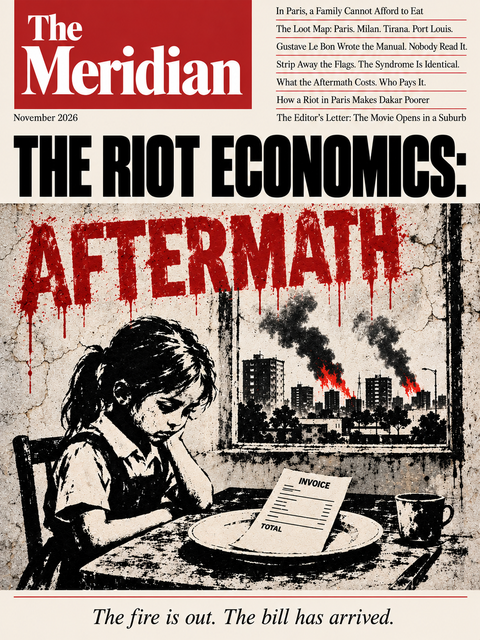
The Meridian The Riot Economics: Aftermath · November 2026
1 Article · Live · November 2026
When the Economics of Survival Runs Out Editor's Letter November 2026 The Meridian Vayu Putra
● Editor’s Letter · November 2026Start Here · The Riot Economics · Vayu Putra

When the Economics of Survival Runs Out

Protests broke out simultaneously across nine countries with almost nothing in common. I investigated the economics of why. The answers went from macro to micro, and the pattern was the same everywhere.

01 / 01
THE MERIDIAN
Global South Political Economy · November 2026
November 2026
The Riot Economics: Aftermath. · November 2026 · From Paris to Port Louis to Buenos Aires · Picture Abhi Baaki Hai · The Picture Is Not Over Yet
Riot Brief
France Debt€3.596 trillion · 119% of GDP · OAT-Bund spread 152bp · widest since 2011 · November 5 protests called Global Protests107+ significant protests · 57+ countries · 12 months to September 2026 · Carnegie Global Protest Tracker Real WagesNegative real wage growth for a decade across 23 of 35 OECD economies · OECD Employment Outlook 2026 Russia Diesel BanExport ban in force · refineries struck at Saratov, Ryazan, Tuapse · global diesel supply shock independent of crude price European WinterLNG at spot prices · Nord Stream gone · storage under pressure · households at cost-of-living limit entering heating season Hormuz & Bab el-Mandab35% of global seaborne crude · both under pressure simultaneously · Cape rerouting adds $1.5m per voyage SIDS ExposureTourism 20%–60% of GDP · food import-dependent · no refinery capacity · no monetary tools · maximum exposure, minimum agency AI DisplacementMiddle-income jobs at highest structural risk · logistics, admin, paralegal, junior analyst · the desk after the riot MauritiusEight days of civil unrest · October 2026 · water infrastructure failure · energy-fiscal transmission in a SIDS economy Youth UnemploymentFrance 18.2% · Spain 26.4% · Italy 20.1% · Greece 23.8% · Eurostat Q2 2026 · the generation locked out Venezuela OilWashington negotiates with New Delhi to refine Venezuelan crude · sanctions architecture meets refinery reality Saudi ArabiaAnnounces civilian nuclear programme · world's largest oil exporter no longer trusts its own domestic energy security ···The Meridian · November 2026 · The Riot Economics: Aftermath · Picture Abhi Baaki Hai
The Riot Economics Aftermath November 2026 The Meridian Vayu Putra
The Riot Economics: Aftermath · November 2026 · The Meridian · Picture Abhi Baaki Hai
The Riot Economics Aftermath Editor's Letter November 2026 The Meridian Vayu Putra
Start Here · November 2026

The Riot Economics: Aftermath

The riots are not the crisis. They are the discovery. Sixteen analyses examine what produces them, who profits from them, what the energy-war complex has already decided for those in the streets, and what arrives after they are suppressed.

Read the Edition →
The Riot Economics: Aftermath · November 2026 How to Read This Edition
I Economics of Protest· II The Fiscal Trap· III Riot as Pretext· IV Global South· V The Coming Storm· VI Reform or Repeat
16Articles
6Layers
57Countries
November Dispatch
The Meridian · Start Here · November 2026 Editor’s Letter · The Riot Economics: Aftermath
Vayu Putra · Editor-in-Chief
The Meridian · Layer I · November 2026 The Economics of Protest · What Produces a Riot
Publishing
Publishing Soon
Layer I · Article 1 · November 2026

The Price Index of a Revolution: How Inflation Becomes the Ignition Point

When the cost of bread, fuel, and rent rises faster than wages for three consecutive years, the street does not merely protest — it calculates. An analysis of the inflation triggers behind 2026’s largest urban uprisings.

Publishing Soon
Layer I · Article 2 · November 2026

Wage Stagnation and the Politics of the Falling Floor

Forty-three of the fifty-seven countries with significant unrest in 2025–26 share a common feature: real wages below their 2019 level. This is not coincidence. It is a mechanism.

Publishing Soon
Layer I · Article 3 · November 2026

The Youth Unemployment Premium: Who Joins a Riot and Why

Economies that cannot absorb their educated young do not simply waste human capital. They create the organisational capacity for mass mobilisation that governments cannot anticipate and cannot contain.

The Meridian · Layer II · November 2026 The Fiscal Trap · The Bill That Arrives After
Publishing
Publishing Soon
Layer II · Article 1 · November 2026

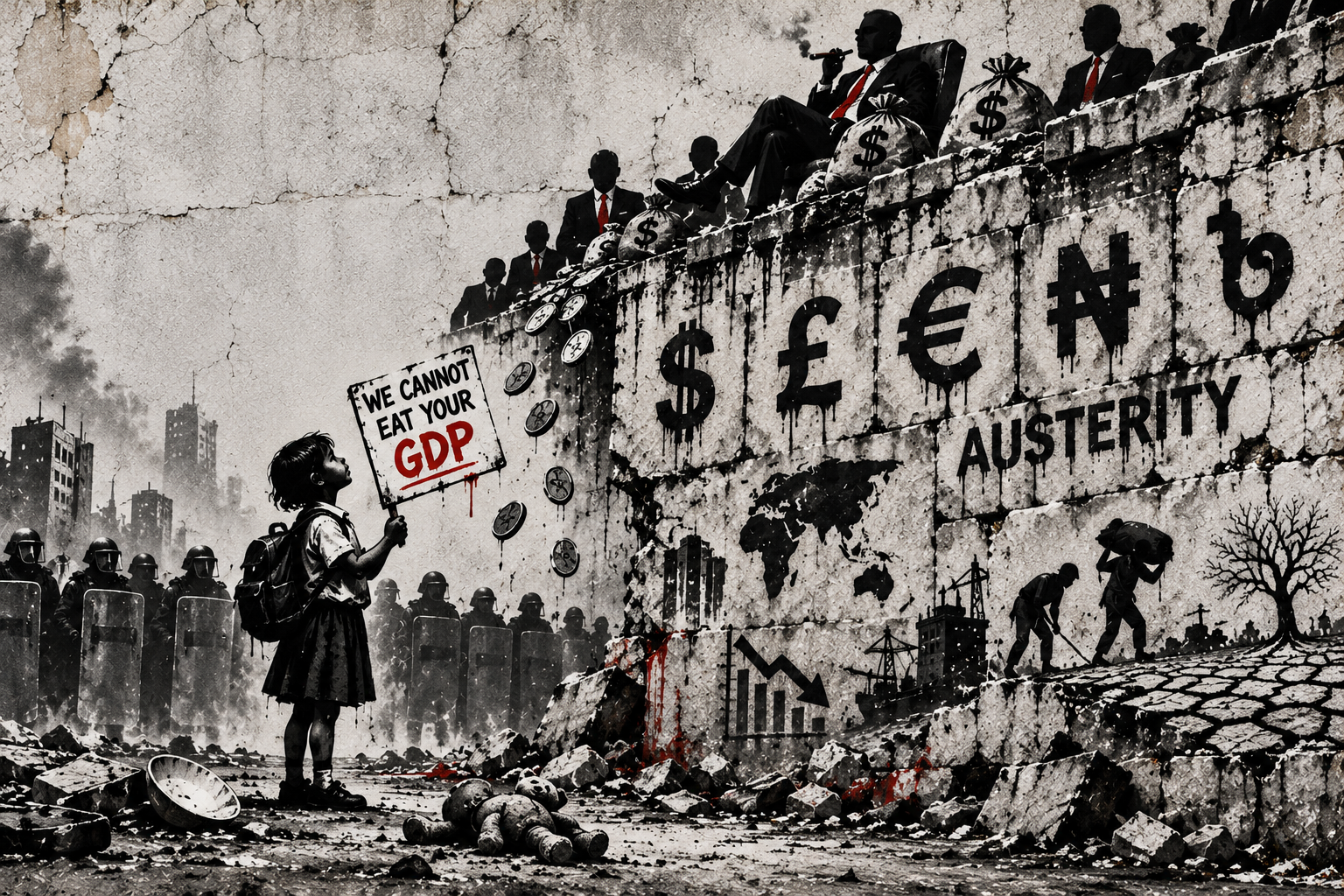
The Bailout Economy: Sovereign Debt, IMF Conditionality, and the Austerity Spiral

Every structural adjustment programme contains within it the conditions for the next round of unrest. The bill that arrives after a riot is invariably paid by those who rioted.

Publishing Soon
Layer II · Article 2 · November 2026

Emergency Spending and the Debt That Follows: Who Bears the Fiscal Cost of Unrest

Property damage, police overtime, lost tax revenue, credit rating downgrades: the fiscal arithmetic of a riot falls, systematically, on the populations least able to absorb it.

Publishing Soon
Layer II · Article 3 · November 2026

Bond Markets in an Age of Unrest: How Investor Risk Pricing Deepens the Trap

When a country riots, its borrowing costs rise. When borrowing costs rise, governments cut services. When services are cut, the conditions for the next riot are set. This is the loop.

The Meridian · Layer III · November 2026 Riot as Pretext · Who Uses the Unrest
Publishing
Publishing Soon
Layer III · Article 1 · November 2026

The Emergency Powers Playbook: Twelve Countries, One Script

Curfews, internet shutoffs, detention without charge, fast-tracked legislation: the mechanisms of repression have standardised across jurisdictions in 2026 with striking uniformity.

Publishing Soon
Layer III · Article 2 · November 2026

Who Benefits: Capital, Contracts, and the Political Economy of Disorder

Not every actor with an interest in unrest opposes it. A forensic examination of who profits from the emergency economies, security contracts, and legislative windows that follow mass protest.

Publishing Soon
Layer III · Article 3 · November 2026

Manufactured Consent for Crackdown: How Governments Frame the Narrative

The first casualty of a riot is the context that produced it. An analysis of state communication strategies and the systematic erasure of economic causation from the official record.

The Meridian · Layer IV · November 2026 The Global South Dimension · Maximum Exposure, Minimum Agency
Publishing
Publishing Soon
Layer IV · Article 1 · November 2026

Maximum Exposure: Why the Global South Absorbs the Shock It Did Not Create

Dollar-denominated debt, commodity price dependence, imported inflation: the structural conditions that make Global South economies uniquely vulnerable to economic triggers they have no power to prevent.

Publishing Soon
Layer IV · Article 2 · November 2026

The Small State Problem: Mauritius, Island Economies, and the Limits of Sovereignty

Small island economies occupy a particular position in the global riot economy — too small to absorb shocks, too interconnected to insulate, too dependent on external capital to respond autonomously.

Publishing Soon
Layer IV · Article 3 · November 2026

Minimum Agency: Why the Solutions Recommended Are Never Available

The policy prescriptions offered by international institutions to riot-affected developing economies presuppose fiscal space and political autonomy that those economies structurally do not have.

The Meridian · Layer V · November 2026 The Coming Storm · What Has Not Transmitted Yet
Publishing
Publishing Soon
Layer V · Article 1 · November 2026

The Contagion Map: Which Economies Are Next and Why the Data Already Knows

Five leading indicators — real wage trajectory, youth unemployment rate, food import dependency, external debt service ratio, political legitimacy index — predicted 2026’s unrest. They are already flashing elsewhere.

Publishing Soon
Layer V · Article 2 · November 2026

What Has Not Transmitted Yet: The Delayed Mechanisms of Economic Crisis

Interest rate effects on household debt, energy price adjustments pending political approval, food price inflation yet to clear supply chains: the riots of 2027 are already baked in to the current data.

The Meridian · Layer VI · November 2026 · Meridian Signature Reform or Repeat · The Questions No Government Will Ask
Publishing
Publishing Soon
Layer VI · Article 1 · Meridian Signature · November 2026

The Structural Reform That Will Not Happen: A Political Economy of Inaction

The reforms that would address the conditions producing 2026’s unrest are technically straightforward and politically impossible. An honest accounting of why governments will not do what they know they should.

Publishing Soon
Layer VI · Article 2 · Meridian Signature · November 2026

What a Real Response Would Look Like: The Policy Architecture of Prevention

If a government genuinely wished to address the economic conditions that produce mass protest — rather than manage their political consequences — this is what it would do. None of it is happening.