The Emergency Powers Playbook: Twelve Countries, One Script
Curfews, internet shutoffs, detention without charge, fast-tracked legislation: the mechanisms of repression have standardised across jurisdictions in 2026 with striking uniformity. This is the playbook, country by country.
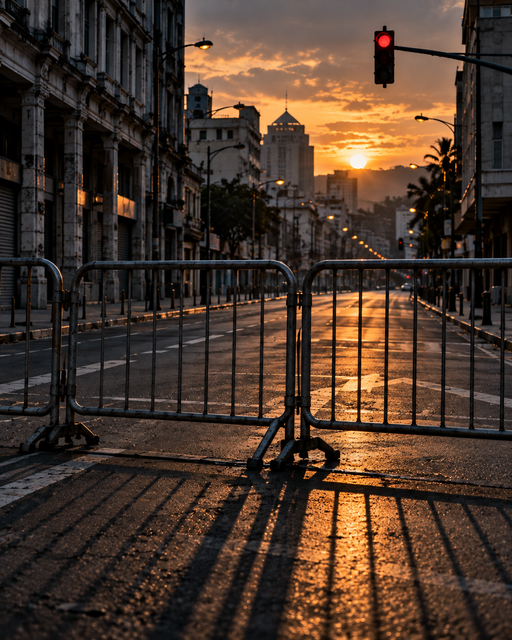
When governments reach for emergency powers, the instinct is to treat each case as singular: a particular city, a particular grievance, a particular government’s particular response. But something different is happening in 2026. Across twelve countries on four continents, the sequence of measures deployed in response to mass civil unrest has become so consistent, so similarly ordered, and so similarly worded in enabling legislation that it is no longer accurate to call these responses improvised. They are not improvised. They are iterated. Governments are running the same playbook, and it is worth reading it in full.
The playbook has four moves. The first is the curfew: a time-limited restriction on movement, declared under emergency decree, often extended progressively. The second is the communications shutdown: restrictions on mobile data, social media platforms, or the broader internet, framed as public order measures. The third is pre-charge detention: the power to hold individuals for extended periods without bringing charges, typically extended beyond normal limits by emergency decree. The fourth is fast-tracked legislation: the use of the crisis atmosphere to pass laws that would face significant resistance under normal parliamentary scrutiny. The four moves are rarely introduced simultaneously. They arrive in sequence, each one normalising the next.
The Curfew Returns to Democratic Constitutions
The curfew was the instrument of colonial administration. It was the tool by which British district officers controlled populations in Kenya, by which French administrators managed movement in Algeria, by which apartheid-era South Africa separated racial geographies at night. Its rehabilitation in the language of democratic emergency management is one of the more striking features of the current cycle of unrest.
France imposed nighttime curfews in four departments following the banlieue unrest of June 2023 and reintroduced variants of the measure in 2025. Senegal declared curfews in Dakar and three secondary cities during the February 2024 protests against the postponement of presidential elections. Bangladesh imposed a nationwide curfew in July 2024 following student-led protests against public sector quotas; the curfew was enforced with military presence in Dhaka and held for nine days. Kenya declared curfews in Nairobi’s central business district and several western counties during June 2024 protests over the Finance Bill, accompanied by live fire that killed at least thirty-nine confirmed protesters. Ecuador activated curfew provisions in Quito during October 2024 unrest linked to fuel prices. In each case, the curfew was presented as a temporary measure. In none of these cases was its lifting celebrated as a restoration of normal governance.
Bangladesh, July 2024: Nationwide curfew for nine days; military deployed in Dhaka. Over 200 killed in protests before and during the curfew. Mobile internet shut down for eleven days. Source: Amnesty International; Al Jazeera.
Kenya, June 2024: Curfew in Nairobi CBD and seven counties. 39 confirmed deaths (Kenya National Commission on Human Rights). Finance Bill withdrawn under protest pressure. Source: KNCHR; Standard Media Kenya.
Senegal, February 2024: Curfew in Dakar and three secondary cities following election-postponement protests. Opposition leaders detained without charge. Source: Human Rights Watch.
Ecuador, October 2024: State of exception declared; curfew in Quito centre. Emergency decree held for 60 days. Source: Inter-American Commission on Human Rights.
The Internet Shutdown Is Now a First-Response Tool
If the curfew is the oldest instrument in the playbook, the internet shutdown is the newest, and it is spreading fastest. The organisation Access Now documented 283 deliberate internet shutdowns globally in 2023 (a record at the time), rising to 296 in 2024, a new record. The overwhelming majority occurred in the Global South, and the overwhelming majority were triggered by, or coincided with, episodes of civil unrest.
The mechanics vary. Some governments impose total shutdowns, cutting mobile data at the network level through directives to telecoms providers. Others target specific platforms: X (formerly Twitter), Facebook, WhatsApp, and TikTok are the most commonly restricted. A third category involves deliberate throttling, reducing bandwidth to speeds that make video streaming and image sharing impossible without technically cutting the network. Ethiopia, which has deployed all three variants in different episodes, has pioneered what might be called the graduated shutdown: throttling first to disrupt coordination, platform-specific blocks to suppress viral documentation, total shutdown only if the preceding measures prove insufficient.
Bangladesh’s government cut mobile internet nationally for eleven days during the July 2024 crisis, restoring it in stages. Nigeria restricted Twitter for 222 days in 2021 following presidential criticism of the platform; restrictions were lifted only after Twitter agreed to open a local office and comply with government content requests. Pakistan blocked X in February 2024 during election-related unrest and has maintained intermittent restrictions since. India has conducted more internet shutdowns than any other democracy in the world: 116 in 2023 alone, concentrated in Manipur, Jammu and Kashmir, and regions of the north-east during periods of ethnic and political conflict.
The internet shutdown is not a communications restriction. It is an evidence suppression mechanism. Governments do not switch off the internet to prevent coordination. They switch it off to prevent documentation.
This distinction matters because the stated justification for shutdowns, namely the prevention of misinformation and coordination of violence, does not explain the timing. In almost every documented case, shutdowns occur not at the moment of maximum unrest but at the moment when footage of government conduct is beginning to circulate. In Kenya in June 2024, the slowdown in mobile data preceded the most violent day of the crackdown by approximately six hours. In Bangladesh, the shutdown was imposed the morning after videos of police opening fire on students reached international news agencies. The shutdown is not a response to disorder. It is a response to visibility.
Detention Without Charge Is Being Extended by Decree
Most constitutional democracies maintain a legal threshold for pre-charge detention: the period during which a person can be held by authorities without a court appearance or formal charge. In the United Kingdom that threshold is twenty-four hours for ordinary offences, extendable to ninety-six hours for terrorism offences. In France it is twenty-four hours, extendable to forty-eight. In South Africa it is forty-eight hours. In Kenya it is twenty-four hours under ordinary law.
Emergency powers have become the mechanism by which these thresholds are temporarily suspended. During the 2023 and 2024 protest cycles, legal observers documented cases of protesters held for between five and fourteen days without charge across Nigeria, Senegal, Tunisia, and Morocco, in each case under emergency or anti-terrorism provisions that exist alongside the ordinary criminal law. In Bangladesh, Amnesty International documented cases of individuals detained for up to three weeks following the July 2024 crackdown, with families denied information about their location. In the United Kingdom, following the August 2024 riots, magistrates courts were kept open overnight to process charges, but the Metropolitan Police applied for, and received, authority to extend detention periods for individuals suspected of online incitement, a category broad enough to encompass sharing posts that originated elsewhere.
The extension of pre-charge detention is not merely an emergency measure. It functions as an intelligence collection mechanism. The days during which a person can be held without charge are days during which they can be questioned, their devices examined, their associations mapped. In several West African jurisdictions, legal observers have noted that many detained protesters are never charged at all: they are released after five to ten days, with no formal record of detention and no legal recourse. The detention itself was the sanction.
Fast-Tracked Legislation Arrives Before the Smoke Clears
The fourth and most consequential move in the playbook is the one that outlasts the crisis that generated it. Emergency legislation, introduced under the justification of restoring order, has in jurisdiction after jurisdiction been used to make permanent changes to the legal landscape governing assembly, speech, and political organisation.
In the United Kingdom, the Public Order Act 2023 introduced serious disruption prevention orders, gave police powers to stop and search without suspicion in specified areas, and restricted the right to protest in ways that the House of Lords attempted to block on three occasions before the Commons overrode the amendments. The legislation was introduced following Just Stop Oil protests and the Sarah Everard vigil, not a riot; it was subsequently used against climate protesters, anti-monarchy demonstrators, and journalists. In France, the post-2023 riot legislative package introduced drone surveillance provisions and expanded police powers of preventive detention. In Uganda, Ethiopia, and Tanzania, the legislative windows opened by protest cycles in 2022 and 2023 produced cybercrime and computer misuse amendments that effectively criminalised online criticism of government.
The pattern is consistent across constitutional types. Whether the government is a parliamentary democracy, a presidential republic, or a hybrid authoritarian system, the use of crisis legislation to make permanent changes to the space available for dissent has become standard practice. The Kenyan government’s withdrawal of the 2024 Finance Bill under pressure from protesters did not reverse the communications controls deployed during the protests. Those controls were subsequently codified into telecommunications regulations. The unrest was defeated. The instruments used to defeat it were retained.
The Standardisation Is Not Accidental
Why has the playbook become so uniform? Partly because governments learn from one another. Policing conferences, intelligence-sharing arrangements, and bilateral security cooperation agreements distribute best practice across jurisdictions with different political systems. The United States government’s domestic surveillance frameworks influenced counterpart legislation across the Commonwealth. The Israeli military’s crowd control doctrine has been exported, through training programmes and equipment sales, to police forces in at least thirty countries. The French gendarmerie’s model of riot management has influenced police architecture from Morocco to Senegal to Haiti.
But the standardisation also reflects something more structural. Governments across the political spectrum face the same underlying problem: populations experiencing economic deterioration are increasingly willing to take to the streets, and the traditional mechanisms of co-optation, namely growth, employment, and incremental welfare provision, are no longer available at the scale required. In that context, the investment in control is rational from the government’s perspective. The playbook is not evidence of a global conspiracy. It is evidence of a global consensus: that the most reliable response to the political consequences of economic failure is to narrow the space in which those consequences can be expressed.
The four instruments of the playbook do not operate with equal intensity across all jurisdictions. In high-income democracies, curfews face legal challenge within days, internet shutdowns attract international sanctions pressure, and pre-charge detention is subject to judicial oversight. The playbook’s most extreme applications occur where those countervailing pressures are weakest: in lower-income economies dependent on bilateral security assistance, in states where judicial independence is structurally compromised, and in countries whose debt obligations make Western capital-market relationships too important to risk through diplomatic friction over domestic repression.
This is not a coincidence of geography. It is a function of leverage. The countries in which emergency powers operate with fewest constraints are the same countries in which economic conditions are most likely to produce the unrest that triggers them. The playbook runs hardest where it is needed most and contested least. In Sub-Saharan Africa, South Asia, and across the arc from North Africa to Central Asia, the pattern this analysis documents is not the exception. It is the norm.
The twelve countries examined here (Bangladesh, Kenya, Senegal, Ecuador, France, Nigeria, Pakistan, India, Ethiopia, Uganda, Tanzania, and the United Kingdom) are a representative sample of a much larger set. The mechanisms they have deployed are available, with minor modifications, to every government that faces the combination of fiscal stress, real wage decline, and an educated, connected, and angry population. That combination describes most of the world in 2026.
The twelve countries this analysis has traced are not outliers. They are a representative sample of a much larger set. The mechanisms they have deployed are available, with minor modifications, to every government that faces the combination of fiscal stress, real wage decline, and an educated, connected, and angry population. That combination describes most of the world in 2026. The playbook will be used again.
- Access Now, #KeepItOn: Shrinking Democracy, Growing Violence: Internet Shutdowns in 2023 (283 documented); KeepItOn 2024 Annual Report (296 documented). accessnow.org
- Amnesty International: Bangladesh: Deadly Crackdown on Student Protests, August 2024; detention without charge documentation. amnesty.org
- Article 19: Kenya: Digital Rights and the Finance Bill Protests, July 2024. article19.org
- Human Rights Watch: Senegal: Crackdown on Opposition and Protest, March 2024. hrw.org
- Kenya National Commission on Human Rights (KNCHR): 39 confirmed deaths, 361 injured during Finance Bill protests, June 2024. Standard Media Kenya.
- Freedom House: Freedom on the Net 2024: The Repressive Power of Artificial Intelligence. freedomhouse.org
- UK Parliament: Public Order Act 2023: Explanatory Notes and Lords Amendments Record. legislation.gov.uk
- NetBlocks: Real-time internet disruption reports for Bangladesh (11-day shutdown confirmed), Kenya, Pakistan, and Ethiopia, 2023–2024. netblocks.org
- Al Jazeera: Bangladesh restores mobile internet after 11-day blackout to quell protests, 28 July 2024. aljazeera.com
© The Meridian 2026. All rights reserved. This article is published under The Meridian’s standard editorial terms. Reproduction in full or in part requires written permission. Analysis and editorial judgements are those of the author. All statistical data is sourced and attributed. The Meridian is an independent publication.
© Copyright Protected
This article is the intellectual property of The Meridian. Reproduction in full or in part requires written permission from the Editor-in-Chief. All rights reserved.
For permissions: themeridian.info