Who Benefits: Capital, Contracts, and the Political Economy of Disorder
Not every actor with an interest in unrest opposes it. Between June and December 2024, governments across four continents opened emergency procurement channels for private security vendors, surveillance technology firms, and legislative consultants within weeks of significant civil disorder. This is the forensic examination of who those actors are and what they collected.
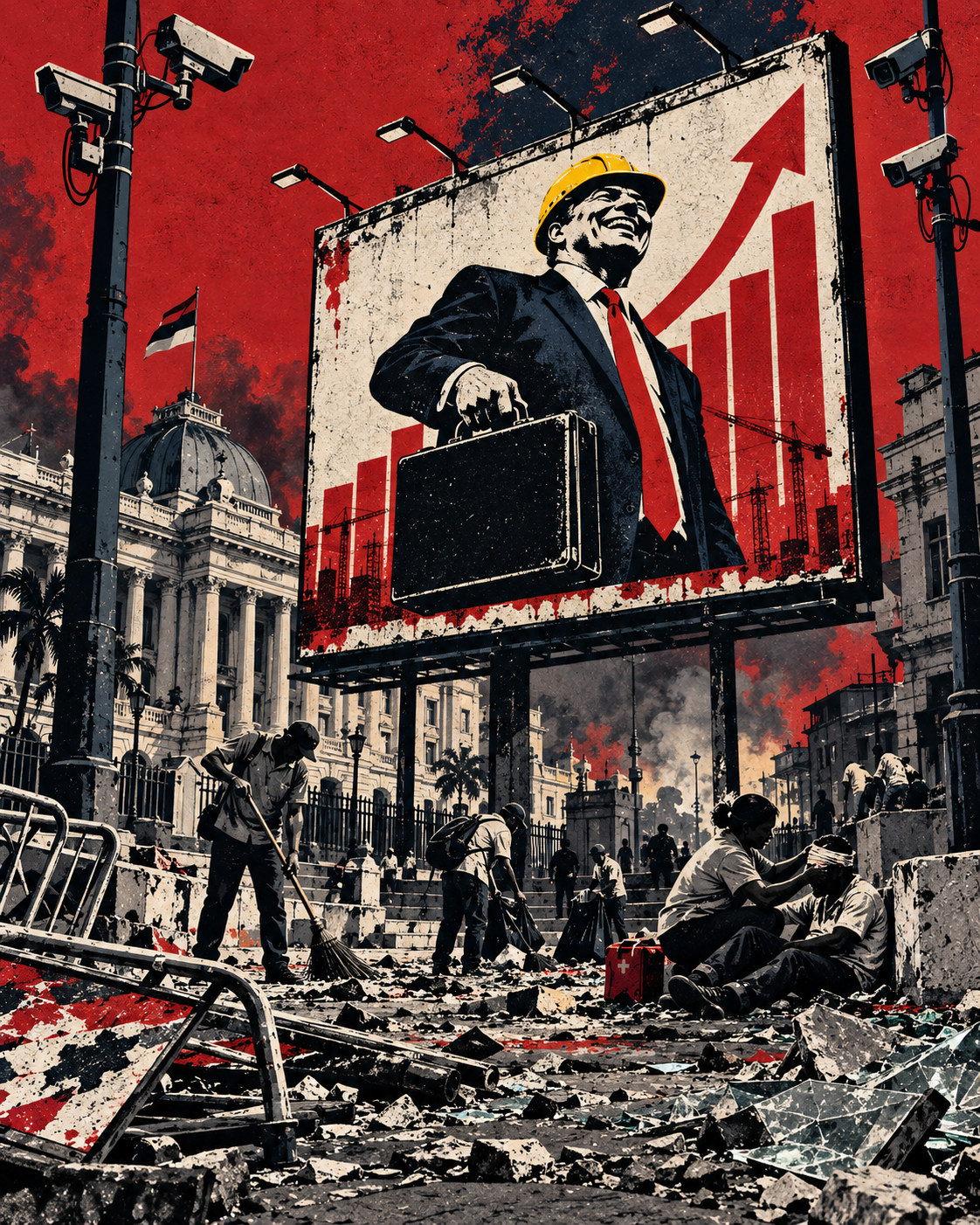
Between June and December 2024, governments across four continents declared states of emergency, invoked special security provisions, or activated emergency procurement rules in response to civil unrest. Each declaration was presented as a defensive measure: a response to disorder, a protection of citizens. Each also opened, without public announcement and without parliamentary scrutiny, a procurement channel that private security companies, technology vendors, and legislative consultants had positioned themselves to access. The preparation for this moment was not hidden. The lobbying expenditure is disclosed in public registers. The proposed legislation had been circulating in ministerial briefings for months before the protests arrived. What had been missing was the political moment to move it. The protests provided one.
The private security industry is among the fastest-growing sectors of the global economy. The market was valued at approximately USD 352 billion in 2023. By 2030, analysts project it will exceed USD 500 billion. The growth is not distributed evenly across the industry. The fastest-growing categories are not physical guarding and alarm systems, which formed the traditional core of the sector. They are crowd management technology, predictive policing software, biometric identification systems, and mass surveillance infrastructure. These are precisely the products that governments managing populations in sustained civil unrest require. For these subsectors, 2024 and 2025 were years of exceptional commercial performance.
In the United Kingdom, the Security Industry Authority reported that the number of licensed private security operatives rose from approximately 350,000 in 2019 to over 430,000 in 2024, a 23 per cent increase across five years. This growth predates the most severe episodes of recent unrest. It reflects not a domestic emergency but a global market in which British firms are positioned as exporters of security services, crowd control expertise, and emergency response planning. When governments require these services at scale, on short notice, under emergency conditions, they engage existing vendor relationships. Those relationships were built before the crisis. They are the reason the vendor's call is taken when the crisis arrives.
The Surveillance Economy
Among the most visible beneficiaries of the security state's expansion is Palantir Technologies, the data analytics company founded in 2003 with early capital from In-Q-Tel, the Central Intelligence Agency's venture arm. Palantir's government division holds contracts with the US Department of Homeland Security, the UK Home Office, and intelligence agencies across Europe and the Middle East. The company's revenues grew by 36 per cent in 2023. Its core product is the aggregation and cross-referencing of large datasets for law enforcement and intelligence purposes. When a government needs to identify the organisational structure of a protest movement, map the movement of crowds in real time, or monitor social media at scale for organising activity, Palantir's platforms are among the tools of choice. The company's annual reports describe its mission as one of protecting democratic societies. Its government contracts describe specific capabilities in population monitoring and predictive threat assessment.
Palantir operates in the public market and is subject to shareholder accountability and some degree of regulatory oversight. Other vendors in the surveillance economy operate with considerably less visibility. NSO Group, the Israeli cybersecurity company responsible for the Pegasus spyware system, has sold its product to the security services of at least 45 governments, including several with documented records of deploying it against journalists, lawyers, opposition politicians, and protest organisers. The reported price for a Pegasus deployment targeting ten individuals is approximately USD 650,000. The Citizen Lab at the University of Toronto and Amnesty International's Security Lab have documented Pegasus's use in at least fourteen countries where civil unrest was occurring at the time of deployment. The relationship between civil disorder and surveillance technology sales, in NSO Group's case, is not speculative. It is documented in forensic analysis of the devices of those who were targeted.
When governments shut down the internet during periods of unrest, as Access Now documented in 187 cases globally in 2023, they simultaneously degrade the communications capacity of protest movements and create immediate downstream demand for the monitoring tools that allow states to surveil what remains of network traffic. The shutdown is not only a repressive act. It is a procurement trigger. Each shutdown generates demand for circumvention detection technology, satellite surveillance alternatives, and the forensic tools that reconstruct communications during outage periods. The companies that manufacture these products have no commercial incentive to lobby against internet shutdowns. Several have actively assisted governments in implementing them.
The question is not whether disorder has a cost. It does, and it falls on the public. The question is whether it also has a beneficiary. It does, and they are not the same people.
The most durable benefit that civil unrest delivers to certain interests is not a security contract. It is a legislative window. When a government is managing sustained public disorder, its legislative programme accelerates. Measures that would ordinarily face months of parliamentary scrutiny, extensive public consultation, and sustained lobbying resistance are presented as emergency necessities and moved accordingly. The window of political opportunity is narrow, but the interests positioned to exploit it have prepared the legislative text in advance. When the moment arrives, the bill is already drafted.
The United Kingdom's Public Order Act 2023 passed during a period of sustained protest activity involving environmental campaign groups and cost of living demonstrations. The Act expanded police powers to impose conditions on protests before they begin, introduced new criminal offences of locking on and causing serious disruption, and extended stop-and-search powers exercisable without individual suspicion. These provisions had circulated in successive Home Office briefing papers for several years prior to enactment. They had not previously reached legislation because the political conditions did not support them. The protest period provided those conditions. The organisations that had advocated for expanded police powers did not produce the protests. But they were prepared to use them when the protests arrived, and they did.
Emergency Procurement and the Audit Gap
The relationship between crisis and unaccountable procurement is most extensively documented not in the context of civil unrest but in the COVID-19 emergency, which established the model that subsequent crises have reproduced. The UK National Audit Office reported in November 2021 that four billion pounds in personal protective equipment contracts had been awarded without competitive tender during the pandemic. A high-priority lane had been created for suppliers with connections to government ministers or officials. The Comptroller and Auditor General's report did not conclude that all such contracts had been improperly awarded. It concluded that the speed and bypass of normal accountability processes made systematic evaluation impossible after the fact. The emergency created the urgency. The urgency removed the scrutiny. The absence of scrutiny was not a failure of the system. It was a feature that the system, as designed, produced.
Emergency procurement provisions exist in the legislation of virtually every signatory to international government procurement agreements. They permit governments to dispense with competitive tendering requirements, publication obligations, and post-award audit timelines when urgency demands it. The definition of urgency, and the duration for which emergency provisions apply, is determined by the government awarding the contracts. There is no independent threshold governing when the emergency ends and normal accountability resumes. By the time an audit occurs, the procurement landscape has been transformed. The contracts are signed. The vendor relationships are established. The follow-on work, which does not require emergency justification, is already under negotiation.
Private security market: USD 352bn (2023); projected USD 500bn by 2030. Source: Allied Market Research / Mordor Intelligence.
UK licensed security operatives: 350,000 (2019) to 430,000+ (2024). A 23% increase in five years. Source: Security Industry Authority.
Palantir Technologies: Revenue grew 36% in 2023. Government division includes contracts with US DHS and UK Home Office. Source: Palantir SEC Filing 2023.
NSO Group Pegasus: Deployed in 45+ countries; reported price USD 650,000 per 10-target installation; documented deployment during unrest in 14 countries. Source: Citizen Lab / Amnesty International.
Internet shutdowns: 187 globally in 2023. Each generates downstream surveillance technology procurement. Source: Access Now "#KeepItOn" 2023.
UK emergency procurement (COVID-19): £4 billion in contracts without competitive tender. Source: National Audit Office, November 2021.
US defence and security lobbying: USD 139 million in 2023. Source: OpenSecrets.
US police budgets 2021–23: Average 9% increase following 2020 protest wave, despite “defund” movement. Source: National League of Cities / Vera Institute.
The Riot as Market Event
The beneficiary argument does not require that any actor caused or orchestrated the civil unrest in order to profit from it. What it requires is that a defined set of actors with commercial interests in the expansion of security infrastructure have positioned themselves, through lobbying, through the cultivation of procurement relationships, and through the pre-preparation of legislative proposals and contract frameworks, to benefit from the political conditions that disorder creates. This preparation is not concealed. The lobbying expenditure appears in statutory registers. The draft legislation was circulating in ministerial networks before the protests that provided the pretext for its passage. The vendor relationships were documented in government contracts signed before the emergency that activated the no-tender provisions. The preparation was systematic. The profit was the point.
The most counterintuitive data point in this analysis is the trajectory of police budgets in the United States in the years following the 2020 protest wave. The demonstrations of that summer were the largest in American history by estimated participation and geographic spread. Their central demand, articulated in the slogan adopted by the movement, was a reduction in police funding and a reallocation of resources to social services. Between 2021 and 2023, average police budgets in American cities increased by 9 per cent. The protest produced the opposite of its stated objective. The security infrastructure that was the explicit target of the movement emerged from the period of maximum political pressure stronger than it had entered it. This outcome is explicable when the political economy is examined. The institutions that benefit from security expenditure maintain continuous, well-resourced relationships with the legislators who authorise budgets. The protesters maintained those relationships for the duration of the protests. The legislators maintained the other relationships indefinitely.
The people who occupy the streets do so because they have calculated that the cost of protest is lower than the cost of continued silence about wages, food prices, debt, and unemployment. They are responding to material conditions documented throughout this series. They are not, in most cases, considering that their presence also constitutes a market signal: that it activates procurement channels, accelerates legislative timelines, and delivers revenues to industries whose business model is served by the continuation of precisely the conditions that produced the protest. The riot is simultaneously a demand for economic justice and a commercial opportunity for those who have nothing to lose from its persistence. Identifying who those actors are, and what they collect when the street moves, is not an addendum to the economic analysis. It is the analysis completed.
- Allied Market Research / Mordor Intelligence: Global private security market valuation and projections 2023–2030. USD 352bn (2023); projected USD 500bn by 2030. alliedmarketresearch.com
- Security Industry Authority (UK): Annual Report 2024. Licensed security operatives data 2019–2024. sia.homeoffice.gov.uk
- Palantir Technologies: SEC Annual Report (Form 10-K) 2023. Revenue growth 36%; government division contract portfolio. palantir.com
- Citizen Lab, University of Toronto: NSO Group Pegasus deployment research. 45+ countries documented. citizenlab.ca
- Amnesty International Security Lab: Pegasus spyware forensic investigations. Deployment during civil unrest documented in 14 countries. amnesty.org
- Access Now: “#KeepItOn” Annual Report 2023. 187 internet shutdowns globally. accessnow.org
- UK National Audit Office: “Investigation into government procurement during the COVID-19 pandemic.” November 2021. £4 billion in contracts without competitive tender. nao.org.uk
- OpenSecrets: US defence and security sector lobbying expenditure, 2023 election cycle. USD 139 million. opensecrets.org
- National League of Cities / Vera Institute of Justice: Municipal police budget trajectories 2021–2023. Average 9% increase following 2020 protest wave. nlc.org
- Liberty UK: Analysis of the Public Order Act 2023. Expanded protest restrictions and police powers. libertyhumanrights.org.uk
© The Meridian 2026. All rights reserved. This article is published under The Meridian's standard editorial terms. Reproduction in full or in part requires written permission. Analysis and editorial judgements are those of the author. All statistical data is sourced and attributed. The Meridian is an independent publication.
© Copyright Protected
This article is the intellectual property of The Meridian. Reproduction in full or in part requires written permission from the Editor-in-Chief. All rights reserved.
For permissions: themeridian.info