The Riot Was the Plan All Along
From Tsarist Russia's Okhrana to Italy's Years of Lead to the Philippines' faked ministerial ambush of 1972, the historical record is consistent: governments do not only respond to civil unrest. They manufacture it, amplify it, and exploit it. The three-step mechanism -- crisis, emergency decree, permanent restructuring -- recurs across jurisdictions and centuries with a uniformity that makes it a template, not a coincidence.
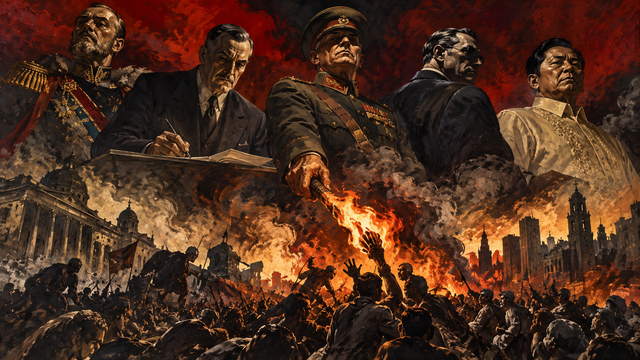
Political scientists draw a distinction that public debate rarely makes. State capture describes the process by which private interests -- corporations, oligarchs, criminal networks -- infiltrate state institutions to serve their own ends. The strategy of tension describes something different and more disturbing: the deliberate manufacture or amplification of public disorder by state actors themselves, to generate the demand for order that justifies emergency power. The distinction matters because the strategy of tension does not require a coup. It operates entirely within constitutional frameworks, using the emergency provisions that democratic constitutions build in for genuine crises, bending them toward manufactured ones. The government that does this does not overthrow the law. It uses the law. This is what makes it repeatable, durable, and difficult to prevent.
The historical record of the twentieth century is a record of this mechanism being used, documented after the fact, and then used again.
State capture and the strategy of tension are related pathologies of governance but they differ in origin and method. State capture is driven from outside: private interests insert themselves into state machinery. The strategy of tension is driven from within: state actors use the instruments of the state to manufacture the conditions that justify expanding those instruments. A captured state serves private interests through its existing powers. A state employing the strategy of tension manufactures a crisis in order to acquire powers it does not yet have.
Constitutional democracies contain within them a provision for their own suspension. Emergency clauses designed for wartime, natural disaster, or genuine existential threat are the hinge on which the strategy of tension operates. Constitutional theorists, following Carl Schmitt's formulation and Giorgio Agamben's later elaboration, describe this as exploiting the "state of exception" -- the legal zone in which sovereign authority acts outside the normal legal order in order, ostensibly, to preserve it. The mechanism's power lies in its formal legality. Each step is individually defensible. A government can claim, at each stage, that it is responding to disorder rather than producing it. The proof of manufacture arrives, when it arrives at all, years or decades after the institutional restructuring it enabled is complete and its reversal is itself politically costly.
The 1905-1907 case of Tsarist Russia is the earliest well-documented instance in the modern record. The Okhrana -- Russia's secret police -- deployed agents provocateurs systematically within opposition groups. The most notoriously documented was the double agent Yevno Azef, who operated as both the head of the Socialist-Revolutionary Party's combat organisation and an Okhrana informant, instigating violent attacks that the regime then used to justify martial law and the dissolution of the early Dumas under Article 87 of the 1906 Fundamental Laws. The Azef affair was not an improvisation. It was institutional policy.
The 1933 German case is the textbook instance and remains the most consequential in its effects. Prior to consolidating power, the Nazi paramilitary wing conducted widespread street violence designed to make the Weimar Republic appear ungovernable. Following the Reichstag fire in February 1933 -- which historians continue to debate as either an opportunistically exploited lone act or a state-staged operation -- the government passed the Reichstag Fire Decree within 24 hours, suspending civil liberties. The Enabling Act followed five weeks later, granting Hitler's cabinet the power to enact laws without parliamentary consent. From fire to total executive authority: eleven weeks.
"From Reichstag fire to total executive authority: eleven weeks. The emergency was the method, not the occasion."
The 1955 Istanbul pogrom followed a state-orchestrated false-flag operation: a fabricated bombing of the Turkish consulate in Thessaloniki, birthplace of Mustafa Kemal Ataturk. State tactical units coordinated with organised networks to direct the subsequent riots, which left Greek, Armenian and Jewish communities in Istanbul devastated. Prime Minister Adnan Menderes declared martial law and moved against political opposition. The Yassıada trials, conducted after the 1960 military coup that overthrew Menderes, formally documented the government's organisational role in instigating the violence. The evidence arrived five years after the event. By then the political use of the riots was historical.
Italy's "Years of Lead" between 1969 and the mid-1980s provides the most extensively documented European case. Later parliamentary inquiries and court proceedings established that elements of Italian military intelligence (SID) and clandestine networks -- operating under the umbrella of what became known as Operation Gladio, a NATO-linked stay-behind structure -- collaborated with both far-right and far-left extremist groups to generate bombings and public disorder. The objective, as established by the subsequent record, was to sustain public panic at a level that justified security legislation and prevented the Italian Communist Party from entering government through democratic means. The strategy ran for over a decade before the documentary record was sufficiently assembled to name it.
The Philippines in 1972 provides the most explicit admission in the historical record. Ferdinand Marcos, facing constitutional term limits that would have ended his presidency in 1973, cited a wave of bombings and urban unrest in Metro Manila -- alongside a motorised ambush on Defence Minister Juan Ponce Enrile's motorcade -- to declare Martial Law under Proclamation No. 1081 and subsequently abolish Congress. In 1986, fourteen years later, Enrile publicly stated at a press conference that his ambush had been staged to provide the pretext Marcos required. The admission came after Marcos had fallen. The institutional changes that resulted from the declared emergency had governed the Philippines for fourteen years before the fabrication was admitted.
The three-step sequence is consistent across cases and jurisdictions. First, crisis is created or amplified: security forces stand down, agents provocateurs turn peaceful demonstrations violent, or attacks are staged and attributed to political opponents. Second, emergency declarations invoke constitutional clauses designed for genuine crises, temporarily suspending judicial review, freedom of assembly, and parliamentary oversight. Third, while opposition is sidelined under emergency rules, the ruling faction passes constitutional amendments or enabling acts that permanently transfer lawmaking authority to the executive. The emergency expires. The institutional restructuring does not.
11 weeks -- time from the Reichstag fire (February 1933) to Hitler's cabinet holding full legislative authority via the Enabling Act (March 1933)
14 years -- gap between Philippines Martial Law declaration (1972) and Enrile's public admission that the triggering ambush was staged (1986)
3 steps -- consistent constitutional sequence: crisis manufacture or amplification, emergency declaration, permanent institutional restructuring
5 jurisdictions -- cases where post-facto investigations formally documented state involvement: Russia (1905-07), Germany (1933), Turkey (1955), Italy (1969-80s), Philippines (1972)
10+ years -- average gap between the strategy being deployed and its formal documentation in each of the five cases
The mechanism's durability lies in this temporal gap. Between the deployment of the strategy and its formal documentation lies a period during which the institutional restructuring proceeds unopposed, the emergency measures are normalised, and the political conditions that might have challenged them are themselves reorganised under the new regime. By the time the Yassıada trials documented the 1955 pogrom, Menderes had been hanged. By the time parliamentary inquiries named Italy's Years of Lead, the Cold War strategic context that enabled them was ending. By the time Enrile spoke, Marcos was in exile. In each case, the admission of manufacture arrived after the manufactured emergency had done its work.
The contemporary iteration of the strategy of tension operates at reduced theatrical intensity. No Reichstag fires. No faked ministerial ambushes. The current version uses more legible instruments: internet shutdowns that prevent the documentation of state violence during civil unrest; fast-tracked legislation passed while protest fills the streets and parliamentary attention is divided; emergency detention orders targeting the organisational infrastructure of opposition movements rather than their visible public faces. The 2026 protest wave documented in earlier articles in this edition involved twelve countries. In several of them, emergency measures were introduced with a speed -- hours rather than days -- that existing parliamentary procedures could not have accommodated in normal circumstances.
"The contemporary version uses more legible instruments. The constitutional architecture is identical. Emergency clauses designed for one purpose are being used for another."
The speed with which emergency measures can now be legislated has compressed the third step of the sequence significantly. Digital communications allow emergency decrees to be drafted, distributed to legislatures and voted upon within a single news cycle. Internet shutdowns create the information blackout that in earlier eras required curfews and press censorship. The instruments have modernised. The constitutional architecture is identical. Emergency clauses designed for genuine crises are being used for manufactured or amplified ones, and the resulting institutional changes are being made while the normal mechanisms of accountability are suspended.
The strategy of tension requires a population already primed for crisis: one whose economic circumstances have generated enough ambient grievance that manufactured disorder is credible, and whose institutional trust has eroded enough that the government's account of events is not automatically interrogated. High political risk, declining real wages, compressed fiscal space, and weakened institutional legitimacy are not only the conditions that produce genuine unrest. They are the conditions in which manufactured or amplified unrest is least distinguishable from the real thing.
The economic indicators described in the previous article -- a global political risk index at 41.1 percent, record debt service ratios, youth unemployment at structural highs, food import dependency compressing household margins -- are not only predictors of spontaneous social rupture. They are the enabling conditions for the strategy of tension. An executive facing a population with those baseline conditions has both the motive and the operational environment to use disorder rather than merely respond to it. The Okhrana's agents provocateurs operated in the same structural conditions: a population whose economic position was deteriorating, whose institutional channels for expressing that deterioration were narrowing, and whose collective anger was available for direction.
The historical record suggests this is not a theoretical possibility. It is a documented tendency that recurs wherever the enabling conditions are present and institutional constraints are insufficient to prevent it. The 2026 protest wave is not over. The economic conditions that produced it have not resolved. The governments that faced it have observed what emergency powers achieved for their counterparts. The template is available, tested, and legal. Whether any government now considering it will be documented doing so depends on who survives to conduct the inquiry -- and how long after the fact they get to ask the questions.
- Giorgio Agamben, State of Exception (University of Chicago Press, 2005) -- on constitutional theory of emergency powers and the "state of exception"
- Daniele Ganser, NATO's Secret Armies: Operation Gladio and Terrorism in Western Europe (Frank Cass, 2004) -- on Italy's Years of Lead and SID involvement
- Yassıada trial records, 1960-61 -- documenting Turkish state role in the 1955 Istanbul pogrom
- Juan Ponce Enrile, press statement, February 1986 -- public admission of the staged ambush used to justify Philippines Martial Law
- Coface Political Risk Index 2025, reported in CIR Magazine, December 2025 -- cirmagazine.com
Analysis and editorial production: The Meridian Desk. All data verified against primary sources at time of publication. November 2026.