Manufactured Consent for Crackdown: How Governments Frame the Narrative
The first casualty of a riot is the context that produced it. Across every major episode of civil unrest examined here, governments followed a near-identical communications sequence: remove the economic cause from the official explanation, insert a criminal or foreign actor in its place, and frame the crackdown as the restoration of order. A forensic examination of the playbook and its structural limits.
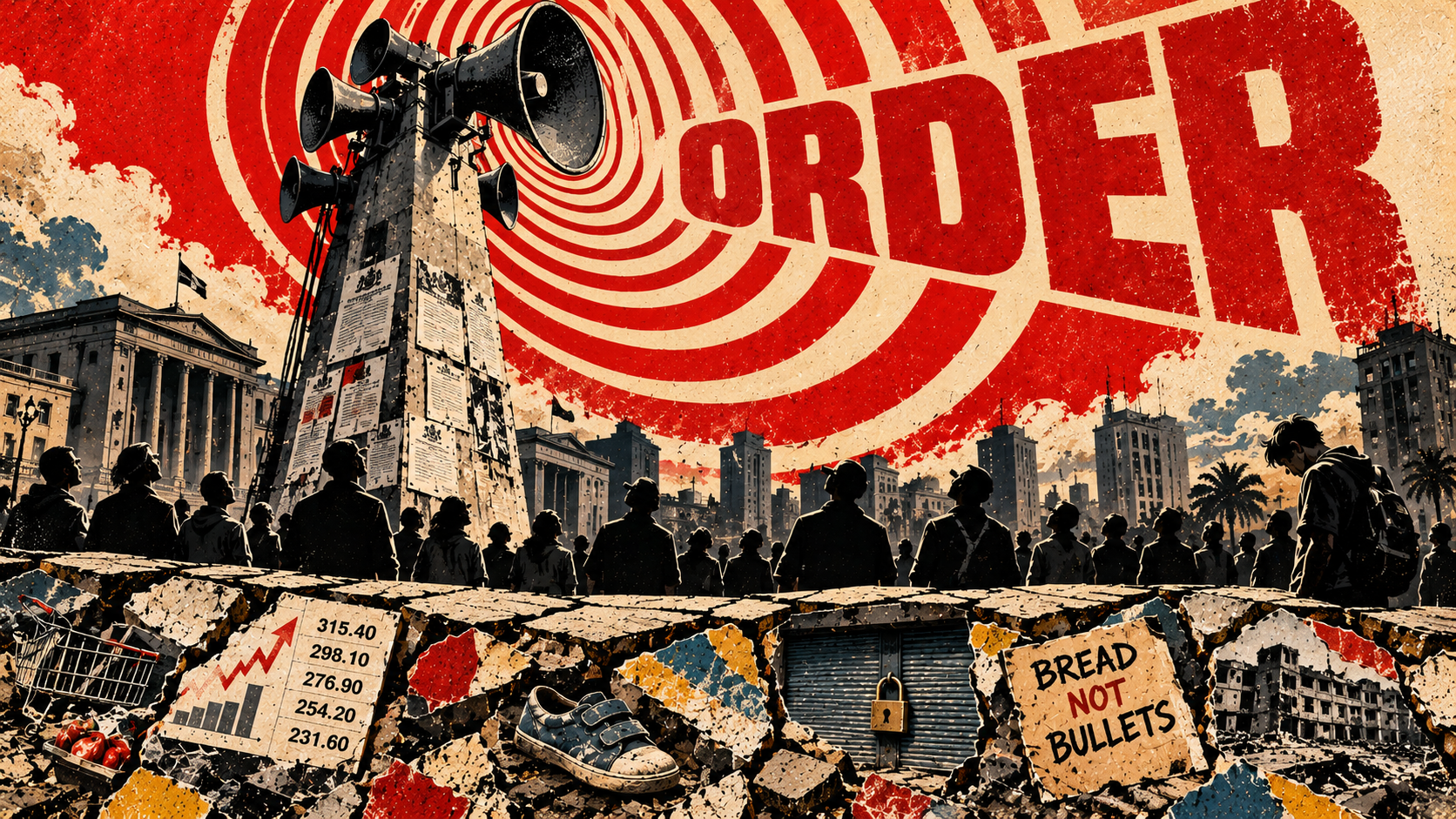
There is a script. It does not vary significantly by continent, ideology, or the specific grievance that brought people into the street. When a government faces mass unrest rooted in economic conditions it has permitted or produced, the communications apparatus follows a sequence so consistent across jurisdictions that it is less a political strategy than a reflex. Step one: remove the economic cause from the official explanation. Step two: insert a criminal, foreign, or ideological actor as the operative cause. Step three: frame the state response as the restoration of order rather than the suppression of legitimate grievance. The script is not new. Its language is.
Edward Herman and Noam Chomsky identified the structural filters through which mass media systematically favour elite interests in their 1988 analysis of propaganda models. What has changed since then is that governments no longer rely exclusively on compliant media to carry the message. They issue it directly, at volume, through ministerial statements, presidential addresses, state press offices, and social media accounts with millions of followers. The manufactured narrative now has distribution infrastructure that 1988 could not have imagined. Its content, however, is recognisably the same.
85% of 270 England rioters cited poverty and deprivation as causes in the LSE/Guardian study. Government framing: "criminality pure and simple."
283 internet shutdowns documented across 39 countries in 2023, most occurring during or immediately before protest events. (Access Now)
30 pesos — approximately USD 0.04 — the Santiago metro fare increase that prompted President Piñera to declare: "We are at war against a powerful enemy." (Chile, 2019)
The reframe operates on a simple and powerful principle: the public narrative about a riot does not need to be accurate in order to be effective. It needs only to be louder, faster, and better distributed than the counter-narrative, and to activate the existing instinct among centrist and conservative publics to prioritise social order over the claims of people who have broken windows. The economic grievance, which is usually the accurate explanation, requires context. The criminality frame requires only a photograph of burning debris.
The speed asymmetry is decisive. Governments control the first 72 hours of a news cycle. They issue statements before independent investigations, before academic analysis, before the voices of participants are amplified at scale. Those first 72 hours establish the interpretive frame within which all subsequent coverage, however accurate, must operate. A correction issued four days later does not undo a frame. It competes with it, and competing with a frame that has already been repeated globally is a losing position.
"The economic grievance requires context. The criminality frame requires only a photograph of burning debris."
The mechanisms of reframing can be categorised into three types. The first is criminalisation: the protest is attributed not to structural conditions but to criminal organisations, drug networks, or opportunistic looters. The second is externalisation: the protest is attributed to foreign funding, outside agitators, or foreign intelligence services, which simultaneously removes domestic legitimacy and activates national security powers. The third is trivialisation: the protest is attributed to social media, video games, celebrity influence, or generational dysfunction, a framing that is particularly popular in wealthy democracies where acknowledging structural failure is politically costly.
England, 2011. Following five days of riots across England in August 2011, Prime Minister David Cameron told parliament the events were "criminality pure and simple" and explicitly rejected structural explanations. The London School of Economics and The Guardian subsequently conducted the most comprehensive study of participant experience in any British civil disorder. Of 270 rioters interviewed, 85% cited poverty and deprivation as causal factors. 81% cited policing practices. The government's frame and the participants' testimony described different events. The government's frame won the news cycle. The LSE's data entered academic literature.
Chile, 2019. On 18 October 2019, the Chilean government increased Santiago metro fares by 30 pesos, approximately USD 0.04. Within days, protests had spread across the country. President Sebastian Piñera declared a state of emergency, deployed the military, and stated on national television: "We are at war against a powerful, implacable enemy who does not respect anything or anyone." The enemy was not named. The 30-peso increase was not mentioned. Over the following weeks, 74 people were killed, more than 10,000 were arrested, and the National Human Rights Institute documented 3,765 individuals with injuries inflicted by state agents. The government eventually called a referendum on a new constitution, a direct response to the structural political demands that had been defined, in the first week, as terrorism.
France, 2023. Following the police killing of 17-year-old Nahel Merzouk in Nanterre in June 2023, riots spread across France. Interior Minister Gerald Darmanin attributed the unrest to social media and video games, stating publicly that the youth had been "anaesthetised" by digital culture. 45,000 police officers were deployed. Approximately 3,500 arrests were made. No official government communication in the first 72 hours of the unrest cited housing segregation in the banlieues, where youth unemployment in some designated urban zones exceeds 40%, the documented pattern of police violence against young men of North African and sub-Saharan descent in the Paris metropolitan area, or the 2005 Stasi report on integration failures that successive governments had declined to implement. The minister's video game hypothesis attracted significant media commentary. The structural data attracted a fraction of the coverage.
Bangladesh, 2024. When students launched the quota-reform protests in July 2024, Prime Minister Sheikh Hasina publicly called protesters "razakars," a term that in Bangladeshi political culture means collaborators with the Pakistani military during the 1971 Liberation War, in which an estimated three million Bangladeshis were killed. The word was not an accusation of a specific act. It was a delegitimisation instrument: a mechanism for converting economic and governance grievance into an association with historical treason. More than 300 people were killed in the subsequent crackdown. Hasina fled to India on 5 August 2024, conceding by flight what the reframe had tried to prevent her from conceding in fact.
Kenya, 2024. When Kenya's Gen Z protesters rose against the Finance Bill 2024, which proposed new taxes on basic goods, the government of President William Ruto initially characterised the movement as "foreign-funded," "organised by criminals," and driven by "drug addicts." After protesters entered parliament on 25 June 2024 and at least 22 people were killed, Ruto withdrew the Finance Bill in its entirety. The reversal was a structural concession to the demands the government had spent two weeks describing as criminal. The phrase "foreign-funded" was not mentioned in the withdrawal statement.
Beyond the messaging apparatus, governments have developed a parallel infrastructure whose function is not to tell a different story but to prevent the accurate story from being told at all. The internet shutdown is the most direct instrument. Access Now's 2023 annual report documented 283 internet shutdowns across 39 countries, the majority occurring during or immediately before protest events. India recorded 84 shutdowns in 2023 alone. Sudan cut internet access for 68 consecutive days during the 2019 transition following Omar al-Bashir's removal, a period during which the Transitional Military Council oversaw the dispersal of a sit-in at a cost of more than 100 lives. The shutdown did not prevent the killing. It prevented the international documentation of the killing in real time.
Ecuador's 2022 uprising illustrates the interaction of messaging and suppression simultaneously. When the Confederation of Indigenous Nationalities of Ecuador led a national strike over fuel prices and food security in June 2022, President Guillermo Lasso declared a state of emergency in six provinces and publicly stated the protests were "infiltrated by narco-terrorism." The CONAIE, one of the most established indigenous rights organisations in Latin America, with decades of documented civic engagement, was characterised as a front for drug traffickers. After 18 days of protest and six deaths, the Lasso government signed a comprehensive agreement with CONAIE on the economic demands that had, until that morning, been defined as the programme of narco-terrorism. The agreement was detailed. The reframe was not mentioned in its preamble.
Every major instance of state narrative reframing examined here contains the same structural contradiction. The government insists that the protest is criminal, foreign-sponsored, or trivially motivated. The government then, in most cases, meets some or all of the original demands. Chile held a constitutional referendum. Kenya reversed its finance bill. Ecuador signed an economic agreement with CONAIE. Bangladesh's quota system was reformed after Hasina's departure. The United Kingdom, in the decade following the 2011 riots, produced successive government reports on deprivation in precisely the areas where the riots occurred.
"The concession is the admission. When a government removes a tax it said was not the issue, the reframe is exposed. Not in the press release. In the parliamentary vote."
The concession is the admission. When a government removes a tax, reverses a policy, holds a referendum, or deploys a commission to study the very conditions it said were irrelevant to the disorder, it confirms in action what it denied in language. The reframe is a delay mechanism, not a settlement. It buys time, dissipates immediate pressure, authorises the use of force, and creates a political space in which concession can eventually be repackaged as reform rather than capitulation. It does not resolve the underlying conditions. Those conditions produce the next cycle.
The reframe's afterlife is in legislation. Emergency powers declared during unrest are rarely fully repealed. The United Kingdom's Public Order Act 2023 expanded police powers over protest following years of civil unrest and organising. France's security legislation has broadened steadily since 2015, with each expansion anchored in the framing of disorder as a security problem rather than an economic one. The legal architecture built to manage protest becomes the legal architecture that defines the space available for the next protest, which is produced by the conditions that produced the last one and that no amount of emergency legislation has yet addressed.
The governments that are most practised at the reframe are also, in most cases, the governments with the longest records of unaddressed structural economic failure. This is not a coincidence. The sophistication of a government's narrative apparatus is a reasonable proxy for the depth of the conditions it is trying not to acknowledge. A government that has solved its wage problem does not need to blame video games for what the wage problem has produced.
Across the 107 significant protests recorded in the first eleven months of 2026, the ratio of state communications attributing disorder to economic causes versus criminal or security causes follows the historical pattern almost exactly. The economic explanation, which is the accurate one in almost every case, remains the explanation that governments can least afford to give. It implies responsibility. And responsibility implies obligation. The reframe exists to prevent that sequence from completing.
- LSE / The Guardian, Reading the Riots, 2011 — guardian.com/uk/series/reading-the-riots
- Access Now, #KeepItOn Annual Report 2023 — accessnow.org
- Instituto Nacional de Derechos Humanos (INDH), Chile, Informe Anual 2019
- Human Rights Watch, Chile: Security Forces Used Excessive Force, 2019
- Reuters, Kenya Gen Z Protests / Finance Bill 2024, June–July 2024
- Al Jazeera / BBC News, Bangladesh Quota Reform Protests, August 2024
- CONAIE official statements / Reuters, Ecuador, June 2022
- Le Monde / Reuters, France Riots / Nahel Merzouk, June–July 2023
- Herman & Chomsky, Manufacturing Consent, Pantheon Books, 1988
- NetBlocks.org, Conflict Internet Index, 2019–2024
Analysis and editorial production: The Meridian Desk. All data verified against primary sources at time of publication. November 2026.