Tomorrow's Unrest Is Already Built Into Today's Data
Interest rates set in 2022 and 2023 are still working through household mortgage cycles. Food price spikes from 2024 supply disruptions have not fully cleared retail shelves. Energy subsidies scheduled for removal have not yet been removed. Currency depreciations recorded in 2025 have not yet transmitted fully into import prices. The economic shocks that drove the 2026 protest wave are not finished transmitting. The governments that responded to this year's unrest will face a harder version of the same conditions next year.
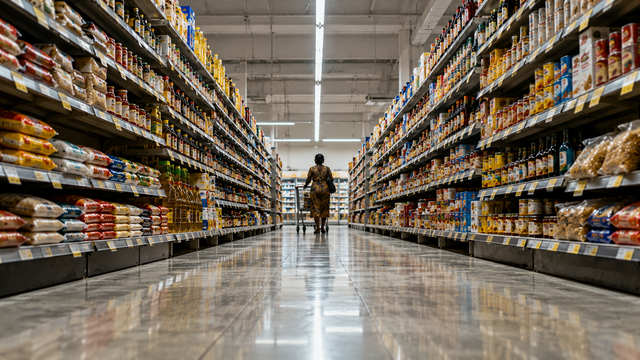
Macroeconomic events do not hit households simultaneously. They move through transmission channels -- credit markets, supply chains, retail pricing, government budgets -- each of which introduces delay. A central bank rate rise does not increase a household's monthly mortgage payment until that household's fixed-rate term expires. A commodity price spike at the farm gate does not reach the supermarket shelf until it clears processors, distributors, and retailers: a chain that typically introduces six to eighteen months of lag. A currency depreciation does not fully translate into import price inflation for twelve to twenty-four months, with approximately half the pass-through occurring in the first year and the remainder in the second. The 2026 protest wave was driven by conditions that were already visible in 2024 data. The conditions that will drive the next cycle are already visible in 2025 data. The mechanism is not mysterious. It is a calendar.
18-24 months -- standard IMF and BIS estimate for full transmission of monetary policy tightening to household consumption
6-18 months -- typical farm-gate to retail food price transmission lag, depending on supply chain length and country
50-70% -- share of currency depreciation that passes through to import prices within 12 months; remainder transmits in months 13-24
1.5 million -- UK fixed-rate mortgages due to expire in 2024 onto rates 2-3x higher than their prior terms (Bank of England, 2023)
12+ -- countries with active IMF programmes including energy or fuel subsidy removal conditionalities in 2025-2026, including Egypt, Pakistan, Nigeria and Kenya
The standard expectation of how economic shocks work is that they are visible immediately: a price rises, a rate increases, a currency falls, and households feel it at once. This expectation is wrong for the majority of channels through which macroeconomic conditions reach ordinary people. The transmission is structural, sequential, and time-delayed in ways that are well-documented in the academic and policy literature but poorly communicated in public economic debate.
The Bank for International Settlements and the IMF have each published extensive research on monetary policy transmission lags, consistently finding that the peak impact of a rate change on household consumption, credit demand, and output arrives eighteen to twenty-four months after the decision. This is not an anomaly. It is the expected result of how credit contracts are written: most households carry fixed-rate mortgage or loan debt that does not reprice until maturity, insulating them from rate changes in the short run and concentrating the impact at the point of expiry. When central banks raised rates aggressively through 2022 and 2023, the majority of those increases had not yet reached household budgets by 2024. They were in transit.
The mechanics of the interest rate channel are most visible in housing markets, because mortgage debt is the largest single liability most households carry. In the United Kingdom, the Bank of England estimated in its 2023 Financial Stability Report that approximately 1.5 million fixed-rate mortgage contracts were due to expire in 2024, with holders rolling onto rates two to three times higher than their prior terms. The aggregate annual increase in mortgage costs for those households was estimated in the hundreds of millions of pounds. In continental Europe, where variable-rate mortgages are more common, the impact transmitted more rapidly -- but the shock was absorbed differently, through compressed consumption rather than a concentrated repricing event.
Across emerging markets, the mechanism is complicated by currency dynamics. Households and small businesses carrying dollar-denominated debt -- which is the majority of external private borrowing in most Global South economies -- saw their debt service costs rise not only because of higher benchmark rates but because local currency depreciation increased the local-currency cost of each dollar owed. These two effects combined and compounded. A household whose income is in naira or Egyptian pounds, whose debt is priced in dollars, and whose cost of living has risen because of import price inflation, is experiencing three simultaneous compressions from a single underlying cycle of dollar strength and rate increases -- and only the first has fully arrived.
"A household experiencing three simultaneous compressions from a single cycle of dollar strength has so far felt only the first. The others are still in transit."
The second major delayed channel is the one most directly felt by low-income households: food and energy prices. In a significant number of countries, the transmission of global commodity price increases to domestic retail prices has been partially deferred by subsidies. This deferral is not permanent. It is a political decision to absorb the cost at the government budget level rather than pass it to households -- a decision that either requires continued fiscal capacity or eventually reverses.
IMF loan programmes active in 2025 include conditionalities requiring the phased removal of energy and fuel subsidies in Egypt, Pakistan, Nigeria, Kenya, and a further cluster of Sub-Saharan African and South Asian economies. The conditionality logic is that subsidies are fiscally inefficient, disproportionately benefit middle- and upper-income households who consume more energy, and crowd out more targeted social spending. The economics of this argument are not without merit. The timing of its application -- during a period of structural global price elevation, weak currencies, and declining real wages -- is the point at which the argument becomes a transmission mechanism for hardship.
Nigeria removed its petrol subsidy in 2023. The full downstream effects -- on transport costs, food distribution costs, and agricultural input prices -- have not yet cleared the supply chain. A commodity price increase at the farm gate travels through transport, milling, wholesaling, and retail, each stage of which introduces its own repricing lag. In a country where road transport is the primary distribution method for food and where transport costs are directly linked to fuel prices, the 2023 subsidy removal is still working through the retail food price system in 2026. Pakistan's energy price adjustments under its 2023 and 2024 IMF arrangements are scheduled to continue into 2026. Egypt faces further reduction as conditions of its ongoing programme.
A third channel operates through exchange rates. When a currency depreciates, it increases the domestic price of imported goods -- but not immediately and not in full within the first year. Research on exchange rate pass-through in emerging markets consistently estimates that approximately 50 to 70 percent of a depreciation translates into import price inflation within twelve months, with the remaining 30 to 50 percent flowing through in months thirteen to twenty-four.
The currency depreciations recorded across the Global South in 2024 and 2025 -- driven by a combination of dollar strength, capital outflows responding to US rate differentials, falling commodity export revenues, and political risk premia -- have partially translated into consumer prices. The second wave is still arriving. For economies that are heavily import-dependent for food and energy -- the structural profile identified as a key vulnerability earlier in this layer -- that second wave lands on household budgets that have already absorbed the first. There is no cushion. The fiscal space to reinstate subsidies has been contracted by IMF conditionality. The political trust that might sustain patience through the adjustment has been spent responding to 2026 unrest.
"The second wave of import price inflation is arriving on household budgets that have already absorbed the first. The fiscal space to cushion it has been spent."
The aggregate picture is a convergence of delayed transmissions arriving simultaneously. Interest rate pass-through peaks in 2026 and 2027 for the economies that raised rates most sharply and whose households carry the most fixed-rate exposure. Subsidy removal schedules continue through 2026 across at least twelve IMF programme countries. Currency depreciation second-wave pass-through arrives through 2026 for economies that depreciated sharply in 2024 and 2025. Food price lags from that period's supply disruptions clear retail markets on the same timeline.
None of this requires a new shock to materialise. The shocks are already in the system. They were administered through monetary policy decisions, IMF negotiation outcomes, and currency market movements. They are travelling through the transmission channels at the rates that those channels operate. The households who will experience their peak impact are currently managing at the margin -- in the same economies, under the same governments, with the same declining institutional trust that produced the 2026 protest wave.
The governments that responded to 2026 unrest with emergency powers will face the same populations again in harder circumstances with less credibility. The governments that responded with subsidy cuts required by their creditors have removed the buffer that partially insulated those populations from the last wave. The governments that responded with nothing in particular have neither the fiscal capacity nor the institutional authority to construct a meaningful response now.
The data that shows this is not forecast data. It is current data. Mortgage maturity schedules are public. IMF conditionality terms are published. Currency depreciation pass-through rates are established empirical relationships. Food price transmission lags are documented in FAO analysis. The conditions for the next wave of unrest are not in the future. They are in the present, moving through the system at known speeds, arriving on a calendar that anyone with access to the underlying data can read.
- BIS, "Monetary policy transmission and household debt," BIS Quarterly Review, 2023 -- bis.org
- IMF, World Economic Outlook, October 2025 -- transmission lags and emerging market exposure -- imf.org
- Bank of England, Financial Stability Report, 2023 -- UK fixed-rate mortgage maturity profile -- bankofengland.co.uk
- IMF country programme documentation: Egypt (2024), Pakistan (2023), Nigeria (2023), Kenya (2023) -- imf.org
- FAO, Food Price Index and price transmission analysis, 2024 -- fao.org
Analysis and editorial production: The Meridian Desk. All data verified against primary sources at time of publication. November 2026.