Serbia: What They Are Not Telling You
Belgrade has been holding EU accession talks for over a decade. It has also been signing Chinese infrastructure contracts, refusing to sanction Russia, and systematically dismantling the institutions that accession is supposed to require. Brussels knows this. It has chosen, thus far, to say very little about it.
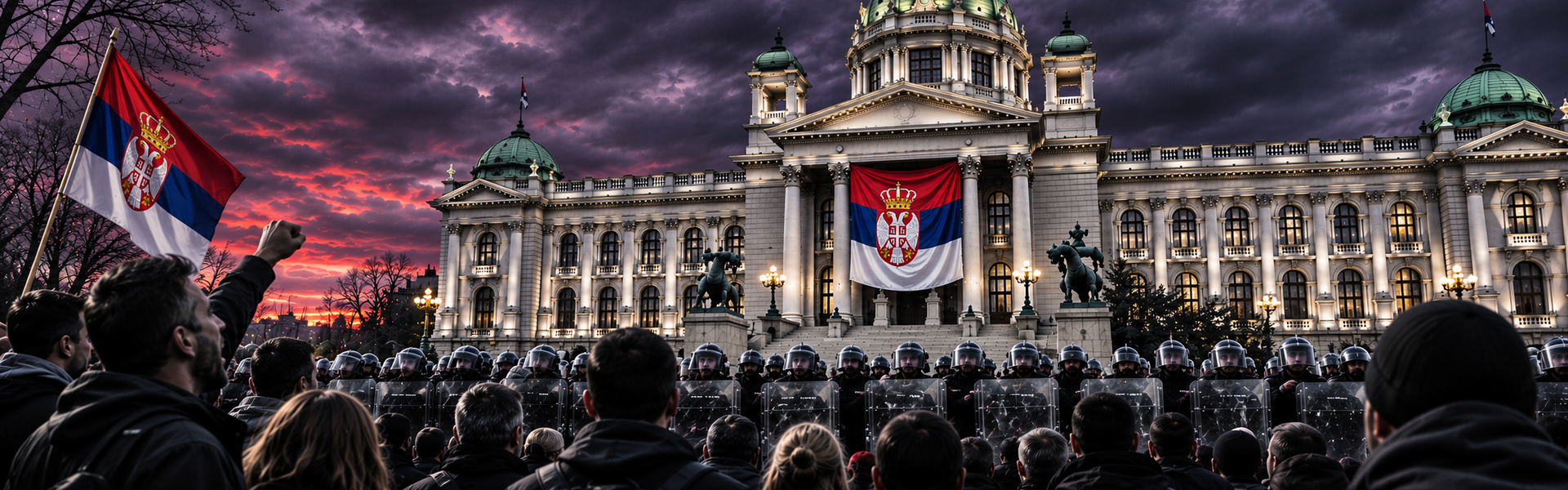
On 1 November 2024, a concrete canopy at Novi Sad railway station collapsed. Fifteen people were killed. The station had recently been renovated under a contract awarded to a Chinese state-owned construction consortium. The renovation had passed official inspections. Within hours of the collapse, President Aleksandar Vucic blamed protesters rather than contractors. Within days, students were occupying universities across Serbia. Within weeks, the protests had spread to twelve cities. Within months, they had been suppressed, investigated selectively, and largely disappeared from the Western press cycle. The contractors were not prosecuted. The procurement records were not released. Serbia's EU accession talks continued.
That sequence of events tells you almost everything you need to know about Serbia in 2026. Not the official story, which is about progress and reform and the European path. The real story, which is about a government that has learned to perform democracy for external audiences while operating something quite different at home, and a European Union that has strong structural reasons to pretend not to notice.
Serbia applied for EU membership in 2009 and received candidate status in 2012. It has been in accession negotiations ever since. The process operates on chapters: 35 areas of EU law that candidate countries must align their legislation with before membership can be considered. Serbia has opened 22 chapters and provisionally closed two. At the current pace, analysts estimate that full accession remains more than a decade away, if it occurs at all.
The EU's own annual progress reports on Serbia are instructive documents, though not in the way they are presented. Each year they record "limited progress" or "some progress" on the rule of law, judicial independence, freedom of expression, and anti-corruption measures. Each year they note concerns about media concentration, the selective prosecution of political opponents, and the erosion of parliamentary oversight. Each year they recommend continued engagement and further reform. The language is bureaucratic, calibrated, and effectively toothless. Serbia remains a candidate.
"Serbia has learned to perform democracy for external audiences while operating something quite different at home. Brussels has strong structural reasons to pretend not to notice."
The gap between the report language and the reality on the ground has widened considerably under Vucic, who has been the dominant figure in Serbian politics since his Serbian Progressive Party came to power in 2012. He served as Prime Minister until 2017, when he moved to the presidency. His party controls parliament, the main broadcasters, and the most-read tabloids. Opposition parties exist. They contest elections. They lose them, then dispute the results, then contest the next ones. The cycle continues.
Parallel to the EU accession process, Serbia has become one of China's most strategically positioned partners in Europe. The relationship is not new, but it has deepened significantly in the past five years, and its terms are rarely examined in Western coverage of the region.
E763 motorway (Milos Veliki): built by China Communications Construction Company under a Serbian state loan from China Exim Bank
Smederevo steel plant: acquired by HBIS Group (Chinese state-owned) in 2016 for $46 million; now employs 5,000 workers
Zijin Mining: Chinese state-linked company owns the Bor copper mine, one of Europe's largest; copper exports to China are Serbia's largest single export category
Huawei: deployed Safe City surveillance infrastructure in Belgrade; Serbia is one of two European countries with a Huawei 5G rollout
Jadar lithium project: Rio Tinto project revived in 2024 after government reversal; lithium corridor from Serbia to Germany under EU strategic minerals framework
Trade volume: China is Serbia's second-largest trading partner after Germany; bilateral trade exceeded $5 billion in 2025
The infrastructure loans are structured in ways that have drawn scrutiny elsewhere across the Belt and Road Initiative. The E763 motorway contract included non-disclosure clauses on the loan terms, a feature that has appeared in Chinese infrastructure agreements across Africa and Central Asia. The Serbian government has declined to publish the full terms. The road was built. It functions. The debt remains opaque.
The Bor copper mine acquisition by Zijin Mining illustrates a different dimension of the relationship. Copper is a strategic commodity: it is essential for electric vehicle production, grid infrastructure, and defence manufacturing. China acquiring one of Europe's largest copper deposits, through a Serbian government facilitated sale, in a country that is officially pursuing EU membership, is a geopolitical fact of some significance. It has received very little attention in Brussels.
Serbia has not sanctioned Russia following the invasion of Ukraine. It has not expelled Russian diplomats. It has not restricted Russian capital flows through its banking system. It voted in favour of the UN General Assembly resolution condemning the invasion, satisfying the minimum diplomatic requirement, then continued importing Russian gas at preferential rates and hosting Russian oligarchs who could no longer bank in Frankfurt or Paris.
Vucic's framing of this position is consistent: Serbia is a small country, historically linked to Russia through Slavic and Orthodox ties, and cannot afford to alienate a major power. This framing is accepted in Belgrade. It is also accepted, with varying degrees of discomfort, in Brussels, because the alternative, formally challenging Serbia's Russia position as a condition of continued accession talks, would remove the EU's primary lever of influence over Belgrade entirely.
"Serbia has refused to sanction Russia, deepened Chinese investment ties, and continued EU accession talks simultaneously. This is not confusion. It is strategy."
The result is a country that has successfully positioned itself at the intersection of three competing powers, extracting concessions from each. The EU offers accession as an incentive for alignment. China offers infrastructure finance without political conditionality. Russia offers energy security and historical solidarity. Serbia takes something from each and commits fully to none. This is not confusion. It is strategy, and it has been executed with considerable skill across more than a decade.
What the accession process, the Chinese partnerships, and the Russia question have in common is that they are all external stories. The internal story is about what has happened to Serbian institutions during the years when the external balancing act was under way.
Press freedom has deteriorated. Reporters Without Borders ranked Serbia 98th out of 180 countries in its 2025 World Press Freedom Index, down from 76th in 2019. The decline tracks the consolidation of major broadcast and print outlets under ownership groups with documented ties to the governing party. Public broadcaster RTS has been consistently criticised by the European Federation of Journalists for editorial interference. Independent outlets exist but operate under constant financial and legal pressure. Several have faced tax investigations that began shortly after publishing investigations into government contracts.
The judiciary has not been reformed in any meaningful sense despite repeated commitments in EU progress reports. High-profile corruption prosecutions have targeted opposition figures and business rivals of the governing party at a rate that independent legal analysts describe as statistically improbable. Prosecutors with politically sensitive cases have been transferred or removed. The Constitutional Court has been reformed legislatively in ways that reduced its independence. The Venice Commission, the Council of Europe's advisory body on constitutional law, issued a critical opinion. Serbia noted the opinion and continued.
The EU has not suspended Serbia's accession process. It has not formally conditioned continued talks on the release of the Novi Sad procurement records. It has not issued an ultimatum on the Russia sanctions position. It has not made the Zijin Mining acquisition or the Huawei 5G deployment a formal obstacle to any chapter of the accession framework.
The reasons for this are structural rather than negligent. The Western Balkans as a whole represent an area where EU disengagement historically produced worse outcomes. Bosnia-Herzegovina, Kosovo, North Macedonia, Albania, and Montenegro are all in various stages of the accession process or seeking to enter it. If the EU were to formally abandon or significantly downgrade the Serbia relationship, the signal to the entire region would be that the European path is not credible, which would accelerate the pivot toward alternative patrons, specifically China and, to a lesser degree, Russia and Turkey.
There is also the lithium calculation. Serbia's Jadar deposit is estimated to contain enough lithium to supply 17 per cent of Europe's projected electric vehicle battery demand. The EU's Critical Raw Materials Act, adopted in 2024, identified domestic and partnered supply of lithium as a strategic priority. The same year, Serbia reversed its previous suspension of the Rio Tinto Jadar project. The timing was not coincidental. Brussels needs Serbian lithium. That need changes the terms of every other conversation.
"Serbia's Jadar lithium deposit could supply 17 per cent of Europe's EV battery demand. Brussels needs Serbian lithium. That changes every other conversation."
None of this means that the EU is acting in bad faith or that engagement is wrong in principle. Regional stability has genuine value. The accession process, however imperfect, provides a framework for dialogue that would not otherwise exist. These are real considerations.
What it does mean is that the public narrative about Serbia, the story of steady if slow progress toward European standards, with concerns noted and reforms encouraged, is significantly incomplete. It omits the structural incentives that keep the EU from applying the pressure its own reports imply is warranted. It omits the deliberate architecture of Vucic's multi-vector foreign policy. It omits the domestic institution-building that is not happening while the accession chapters accumulate. And it omits the students who occupied universities after fifteen people died under a collapsed canopy that had passed inspection, and who were told that the problem was the protest, not the procurement.
That is what they are not telling you about Serbia. The story is not that the country is failing to reach European standards. The story is that the system has been designed to make failure look like progress, and the audience for that design is not in Belgrade. It is in Brussels.
- European Commission: Serbia 2025 Report, DG NEAR, Brussels, October 2025
- Reporters Without Borders: World Press Freedom Index 2025, Serbia country profile
- Balkan Investigative Reporting Network (BIRN): Novi Sad station collapse investigation, November 2024 to March 2025
- Venice Commission: Opinion on the amendments to the Law on the Constitutional Court of Serbia, Council of Europe, 2023
- Global Witness: Belt and Road non-disclosure clauses in Balkan infrastructure contracts, 2024
- European Federation of Journalists: Annual report on media freedom in Serbia, 2025
- European Commission: Critical Raw Materials Act -- Strategic Projects list, 2024
- Zijin Mining Group: Annual Report 2025, Bor copper operations section