The Mines Are Worth Billions. Who Gets Them?
Central Africa holds the cobalt, coltan, lithium and manganese the world needs for batteries, chips and defence systems. A landmark GI-TOC report published in November 2026 finds that armed groups, corrupt elites and criminal networks are already positioned to capture that wealth. The energy transition could make the region poorer.
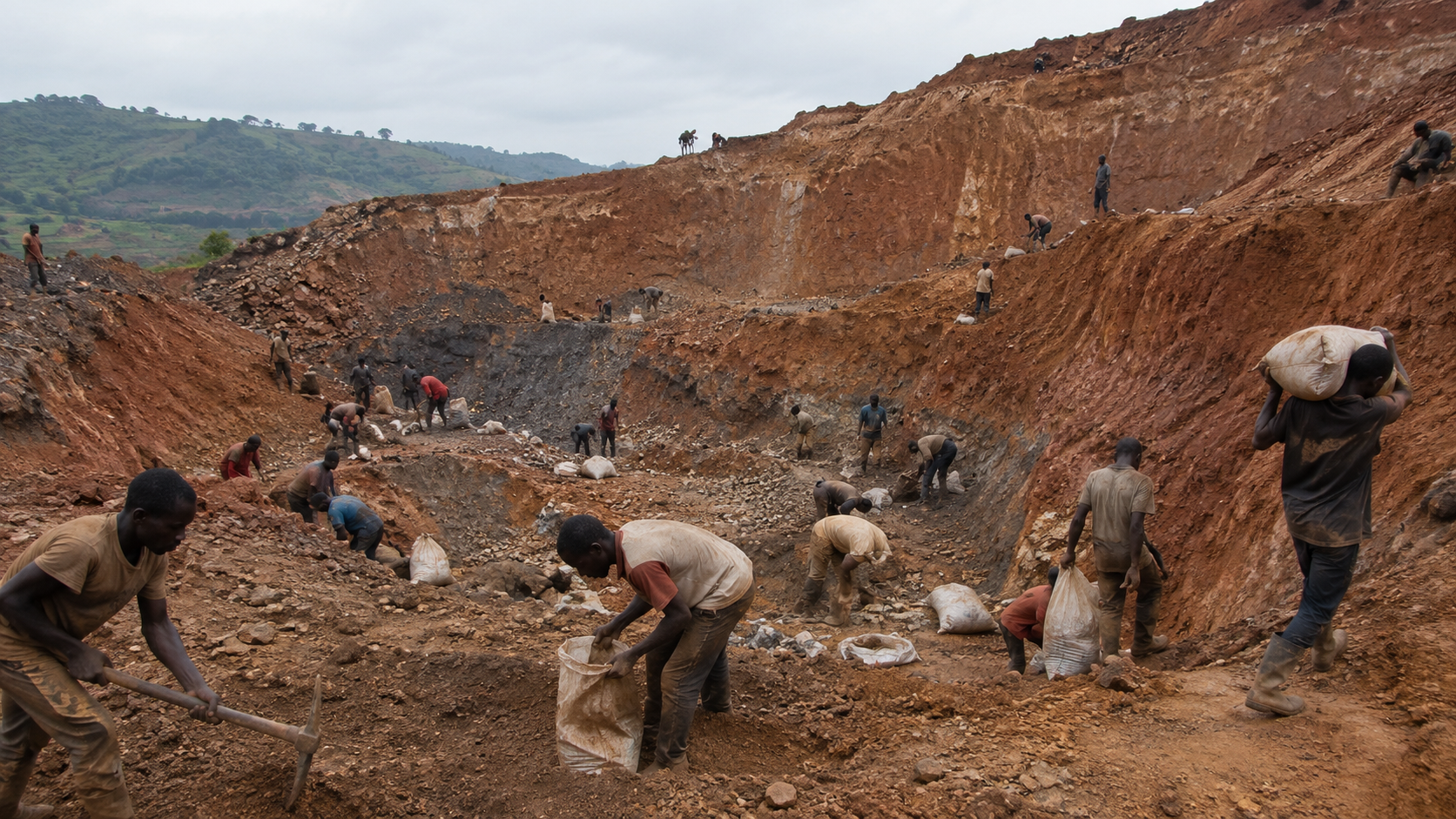
The world has decided it needs Central Africa's minerals. The electric vehicle battery in a car assembled in Germany requires cobalt from the Democratic Republic of Congo. The microchip in a defence guidance system requires tantalum refined from coltan mined in Kivu. The energy transition that wealthy nations are building their climate pledges on runs, in significant part, through one of the most institutionally fragile and conflict-afflicted regions on the planet. A report published in November 2026 by the Global Initiative Against Transnational Organised Crime asks the question that the press releases of mining deals do not: who, in practice, is going to take the money?
The Assets
Central Africa's critical raw material endowment is not marginal. The DRC produces over 70 per cent of the world's cobalt and approximately 50 per cent of global coltan, which is the ore from which tantalum is refined. It ranks second globally in copper production. Mining accounts for 95 per cent of its exports and roughly 40 per cent of its GDP. Its Tanganyika lithium deposit alone is estimated to be worth in excess of USD 15 billion, and the country's first certified lithium export was shipped in July 2026. Gabon is the world's second-largest manganese producer, with output of approximately 7 million tonnes in 2024, and holds a polymetallic deposit at Mabounié that reportedly contains the world's second-largest known niobium reserve. Chad produces antimony from the Tibesti region, with the government projecting output of roughly 19,000 tonnes per year. Cameroon holds deposits of tin, rutile, battery metals and bauxite. The Central African Republic has recorded at least 470 known mineral occurrences, the great majority unexplored.
The Competition
The strategic value of these deposits has not gone unnoticed by any major power. China holds approximately 60 per cent of global rare earth production, 80 to 90 per cent of rare earth separation and refining, and 80 to 90 per cent of rare earth magnet manufacturing. It has dominant positions across DRC cobalt and copper operations. The European Union signed a partnership agreement with the DRC in 2023; France's Eramet reached a new agreement with Gabon in July 2026. The United States concluded a strategic partnership with the DRC in December 2025, reportedly granting preferential access to 25 priority assets, with Rubaya, the major coltan site, explicitly mentioned. The UAE has taken a stake through IRH in a DRC tin producer, and concluded a USD 1.9 billion deal for four critical raw material mines. Russia, through networks linked to the former Wagner Group operating under the name Africa Politology, is running active influence operations against the Lobito Corridor, the rail and port infrastructure that the United States and the European Union have backed as an alternative to Chinese-controlled supply routes.
Who Is Already Taking the Money
The GI-TOC report does not project future risk. It documents present reality. In eastern DRC, the M23 armed group controls Rubaya, the country's largest coltan site. M23 reportedly moves up to 200 tonnes of coltan per month into Rwanda, where it is mixed with domestic material, laundering its origin. Rubaya alone accounts for over 15 per cent of global tantalum supply. At the same time, illegal copper and cobalt extraction at sites operated by ERG in Lualaba and Haut-Katanga is estimated to cost USD 2 billion per year, allegedly protected by security forces and political elites. The Manono lithium licence, covering what may become a critical asset for global battery supply chains, was itself awarded under documented conditions of corruption.
Chad's antimony sector in the Tibesti region presents a different but equally instructive case. The GI-TOC report documents antimony production that is effectively controlled by a small group of generals, with Chinese, Turkish and Libyan intermediaries managing the trade, exports routed through the port of Douala in Cameroon, and financial flows traced to offshore structures in the UAE and Hong Kong. A February 2026 presidential decree imposed a 2 per cent statistical levy and a 12.5 per cent mining tax, but the report's assessment of who captures the revenue beneath those formal levies is not reassuring.
Cameroon illustrates the information gap that enables criminal flows. Official gold exports for 2023 were declared at 22.3 kilograms. UAE trade records show that over 15 tonnes of gold were imported from Cameroon that same year. The difference is not a rounding error. It is the size of the undeclared economy operating alongside the formal one, in plain sight, across international trade data that any competent analyst can compare.
The Structural Problem
The GI-TOC report identifies the mechanism that makes this possible: adverse selection. The safeguards that govern critical raw materials are weaker than those applied to gold or the 3Ts (tin, tantalum and tungsten) under existing frameworks such as Dodd-Frank Section 1502. As the strategic premium on these minerals rises and supply-security pressure mounts, there is active lobbying by some importing country interests to relax even those weaker standards. HR 7085 in the United States Congress is cited as one such effort to roll back due diligence requirements. The practical consequence is that responsible operators who require transparency face higher compliance costs than those who do not. They leave. The actors who remain are, by selection, those comfortable with opacity and political brokerage.
Artisanal and small-scale mining is the entry point. Roughly 20,000 artisanal miners were reportedly removed from the Kamilombe mine in October 2026 to clear space for industrial operators. The displacement of ASM miners does not formalise supply chains. It concentrates control in the hands of larger actors while removing the livelihoods of the people who were there first, and it removes the distributed accountability, however imperfect, that comes with many small operators operating under community observation.
The Russian Dimension
Russia's role in the critical minerals competition takes a form that sits between geopolitics and organised crime, which is precisely the space the GI-TOC report defines as "geocriminality." Networks linked to the former Wagner Group, now operating as Africa Politology, are running documented influence operations against the Lobito Corridor, the railway and port infrastructure funded by the United States and the European Union that runs from the Congolese copper belt through Angola to the Atlantic port of Lobito. These operations include fabricated documents, paid commentators, and coordinated disinformation aimed at delegitimising the corridor and the Western partnerships associated with it. The strategic objective is to maintain Chinese and Russian access and to block the emergence of a genuinely competitive alternative supply route.
What This Means for the People Who Live There
The GI-TOC report's recommendations are addressed to governments, to FATF and GABAC, to importing countries, and to the institutions negotiating mineral partnerships. They are technically sound. Beneficial ownership disclosure, anti-money laundering enforcement on mineral traders, vetting of officials, conditioning of mineral agreements on traceability standards: these are the right instruments. The honest question is whether the political will to implement them exists among the countries that are both the largest customers for these minerals and, in several cases, the jurisdictions where the proceeds of their theft are banked and invested.
The energy transition is a genuine and necessary project. The critical minerals it requires are, in many cases, located in countries that have never retained the economic value of what their land contains. That pattern is not new. It is the history of the region. What is new is the scale and the speed. The world's demand for cobalt, coltan, lithium and manganese is going to accelerate sharply over the next decade. The question the GI-TOC report poses, and that every mineral deal press release leaves unanswered, is whether this acceleration will reproduce the extraction economy of the colonial era under new ownership structures, or whether it will, for once, build the institutional capacity, the fiscal returns, and the political accountability that allow the people on the ground to benefit from what is under their feet.
The report's title is Vulnerable Wealth. That framing is precise. The wealth is real. The vulnerability is structural, documented, and in several cases already actively exploited. The window in which the outcome can be changed is open, but it is not permanently open.
- Zobel Behalal and Romain Esmenjaud, Vulnerable Wealth: Who Will Profit from Central Africa's Critical Minerals?, Global Initiative Against Transnational Organised Crime, November 2026 — globalinitiative.net
- GI-TOC full report (English PDF): Download PDF
- DRC mining data: GI-TOC, citing COMTRADE and national statistics, 2024
- Gabon manganese production: Eramet/national statistics, 2024
- Cameroon gold declared exports vs UAE import data: GI-TOC report, cross-referenced against UN Comtrade, 2023