1971: The Day the World Started Borrowing Without Limits
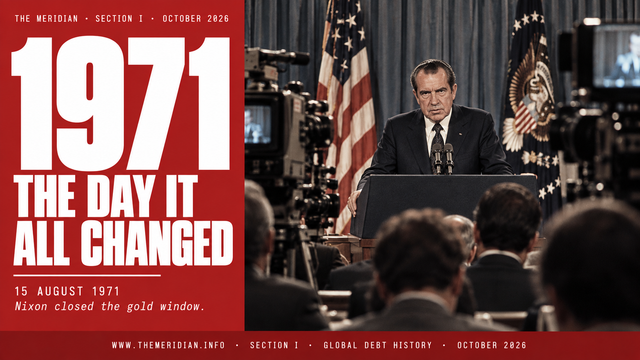
On 15 August 1971, Nixon closed the gold window and removed the only hard constraint on government borrowing. In the 55 years since, global debt has risen from $20 trillion to $348 trillion. Here is how it happened and what the world built with that permission.
On the evening of Sunday, 15 August 1971, Richard Nixon interrupted the American television schedule to announce what he called a temporary measure. Effective immediately, the United States would suspend the convertibility of the dollar into gold. The fixed price of 35 dollars per ounce that had anchored the international monetary system since 1944 was, without ceremony or international negotiation, gone. The word "temporary" was a courtesy. The decision was permanent. Its consequences are still accumulating.
The system Nixon dismantled had been built twenty-seven years earlier. In July 1944, 730 delegates from 44 Allied nations met at the Mount Washington Hotel in Bretton Woods, New Hampshire, to design the post-war international monetary order. The architects were two economists whose views disagreed on almost everything: John Maynard Keynes, representing Britain, and Harry Dexter White, representing the United States. What they produced was a compromise that neither entirely wanted and that the world accepted because it was better than the chaos of the interwar years, when competitive devaluations, trade wars, and financial instability had contributed directly to the political conditions that produced the Second World War.
The Bretton Woods system had one defining characteristic: discipline. Member countries pegged their currencies to the dollar. The dollar itself was pegged to gold at 35 dollars per ounce. Any country that accumulated dollars could present them to the United States and receive gold in return. This convertibility was the constraint. It meant that if the United States spent or lent more dollars than it held gold to back, trading partners could demand the difference in metal. The mechanism imposed a hard ceiling on American economic expansion that no domestic political process could override.
By 1971, that ceiling had become a problem. The costs of the Vietnam War, combined with Lyndon Johnson's Great Society domestic programmes, had produced consecutive budget deficits that were flooding the world with dollars. America's trading partners, led by France under Charles de Gaulle, had begun converting their surplus dollars into gold at precisely the rate the system entitled them to. Between 1958 and 1971, US gold reserves fell from approximately $22 billion to $10 billion. By August 1971, gold was leaving Fort Knox at a rate that made the 35-dollar peg arithmetically unsustainable. (Source: Federal Reserve historical record; IMF historical data)
The decision was made at Camp David over the weekend of 13 to 15 August. Nixon convened a group of advisors that included Treasury Secretary John Connally, Federal Reserve Chairman Arthur Burns, and Paul Volcker, then serving as Under-Secretary of the Treasury for Monetary Affairs. Connally was characteristically direct about the geopolitical dimension: the dollar was America's currency, and its problems were everyone else's. By Sunday evening the decision was made. Nixon went on television. The system was over.
What replaced Bretton Woods was not designed. It emerged. The Smithsonian Agreement of December 1971 attempted to establish new fixed rates at adjusted levels, but the arrangement lasted barely fourteen months before market pressure dismantled it. By 1973, the world had moved to floating exchange rates by default rather than design. The Jamaica Accords of 1976 formalised what had already happened, amending the IMF's Articles of Agreement to permit floating rates and rendering the official burial of the gold standard a retrospective administrative act. (Source: IMF founding and amended documents)
Following the 1973 oil shock, the United States negotiated a series of arrangements with Saudi Arabia that had no formal treaty status but enormous practical consequence. Saudi Arabia would price its oil exports in dollars and reinvest its surplus dollar revenues into US Treasury bonds. In exchange, the United States would guarantee Saudi security.
The arrangement ensured that global demand for dollars remained structurally high regardless of what the Federal Reserve did with interest rates. Every country that needed to buy oil needed dollars to buy it. Every country that needed dollars had to either earn them through trade or borrow them on terms set by American financial institutions. The constraint of the gold window had been replaced by the structural demand of the petrodollar. It was considerably more convenient for Washington, and considerably less constraining for Washington's borrowing. (Source: declassified US Treasury documents; historical record)
The practical consequence of removing the gold convertibility constraint was not immediately visible. In 1971, US federal debt stood at approximately $398 billion, equivalent to roughly 35% of GDP. The assumption, reasonable at the time, was that the discipline of the gold standard had been replaced by the discipline of domestic political accountability: governments that borrowed too much would face electoral punishment, and the threat of that punishment would contain the debt.
The assumption was wrong. What the gold window had actually provided was a hard external constraint that operated independently of domestic political incentives. Politicians who wanted to spend without taxing faced the gold window as a physical limit. Remove the limit and the political incentive structure does not change. Only the constraint does. The spending continued. The taxing did not increase to match it. The borrowing filled the gap.
This was not a sequence of emergencies. It was a structural condition operating exactly as the removal of the constraint had made possible. Other countries followed the same trajectory at different speeds and through different political mechanisms, but toward the same destination. Global debt, estimated at approximately $20 trillion in the early 1970s, reached $348 trillion by 2025. (Source: IIF Global Debt Monitor, 2025; BIS historical estimates)
It would not be honest to describe this half-century of borrowing as waste. The debt built things. It kept public health systems functioning through recessions that tax revenues could not cover. It financed university expansion, agricultural productivity improvements, and the digital infrastructure that underlies the modern economy. The internet itself emerged from ARPANET, a defence research programme funded through deficit spending. The modern world, in its infrastructure, its institutions, and its productive capacity, is in significant part the physical embodiment of unpaid bills.
The question is not what was built. The question is who is paying for it, and whether that is the same population that made the borrowing decision or benefited from what it financed.
The post-1971 system replaced the symmetric discipline of the gold standard with something considerably more asymmetric. The United States, as the issuer of the global reserve currency, retained a unique freedom: it could borrow in the currency it printed, meaning that in extremis it could always create the dollars needed to service its debt. No other country has this option. When developing countries borrowed in dollars after 1971, they borrowed in a currency they could not create. When interest rates rose in Washington, the cost of their debt rose with it, regardless of their own economic conditions or policy choices. When the dollar strengthened, the real burden of their repayments increased without any action of their own.
This asymmetry was not incidental to the post-Bretton Woods architecture. It was structural. It was the mechanism by which the dollar's reserve status translated into what Valéry Giscard d'Estaing, then French Finance Minister, called the "exorbitant privilege": the ability to borrow at lower cost, on better terms, with fewer conditions, than any other nation on earth, simply by virtue of issuing the currency that everyone else required.
"What Nixon suspended was not a policy. It was a constraint. Policies can be restored. Constraints, once removed, do not automatically return."
Nixon described the suspension of gold convertibility as a temporary measure. He was not lying about his intentions. He was wrong about the consequences. What he suspended was not a policy. It was a constraint. Policies can be restored. Constraints, once removed, do not automatically return.
The $348 trillion of global debt that now requires management, servicing, and eventual resolution is not the product of any single decision made in any subsequent year. It is the accumulated consequence of the decision made on that Sunday evening in August 1971, compounding for 55 years without a hard ceiling to stop it.
The constraint has not been restored. The debt continues to accumulate. The question this edition asks is not how to return to 1971. It is what happens to the $348 trillion that was built in the absence of a constraint, and who is asked to reduce it.
Add comment
Comments