What Does Putin Really Want?
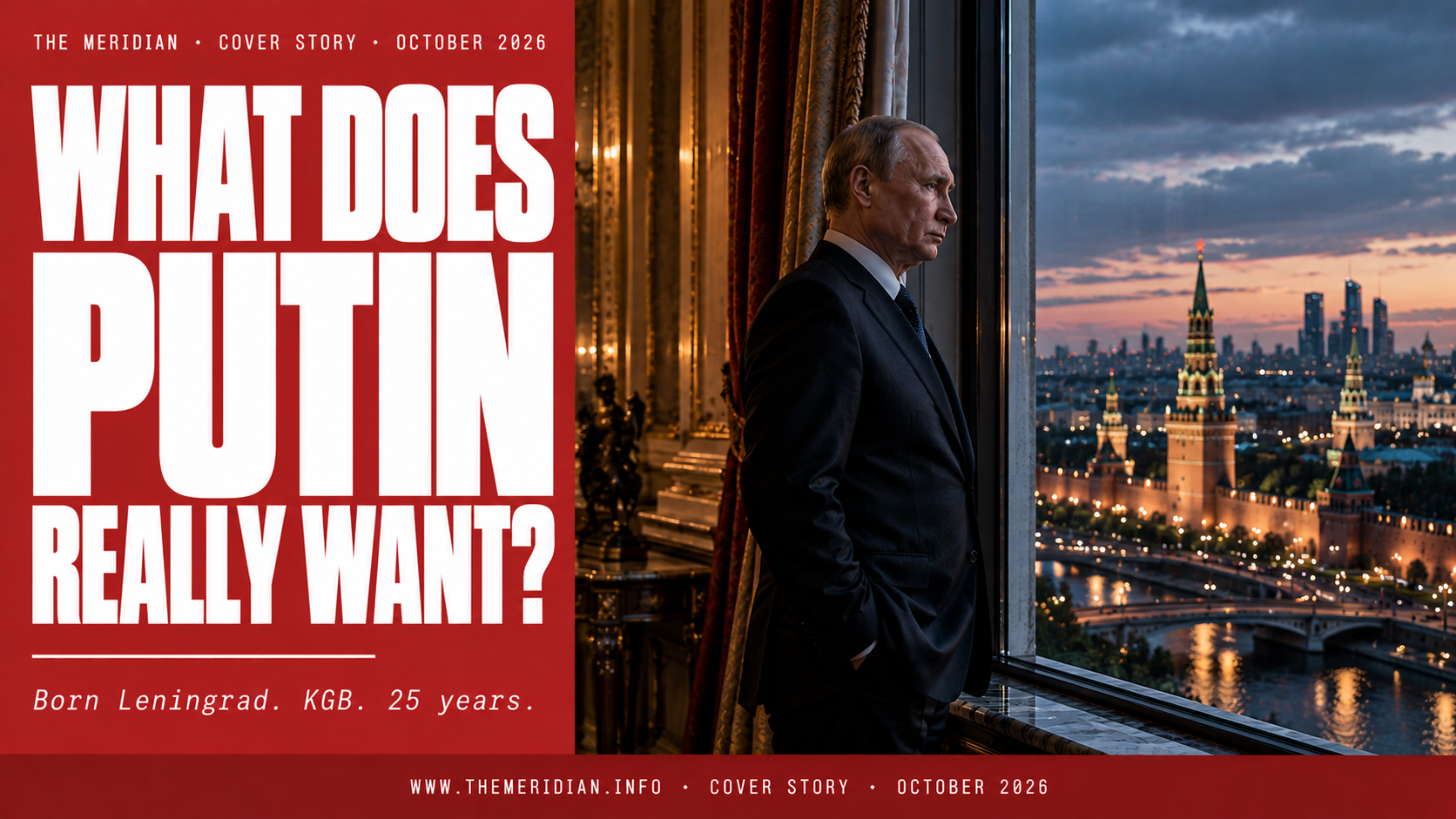
The most asked and least honestly answered question in contemporary geopolitics. The Meridian examines the man, the trap, the war, the debt it built, and the Russia his people actually live in. The answer is more uncomfortable than anyone in Washington, Brussels, or Kyiv will say out loud.
There is a photograph that circulates periodically showing Vladimir Putin at a state ceremony, utterly still while the people around him shift, fidget, and check their phones. His stillness is not performance. It is the product of a lifetime of professional discipline in an organisation where the ability to reveal nothing about what you are thinking is the primary professional qualification. The KGB did not train agents to be expressive.
The question the photograph always prompts, and which nobody has yet answered honestly at serious analytical length, is the one that has defined geopolitics since February 2022. What does Putin really want?
The Meridian's October 2026 edition is built around the global debt reckoning: the $348 trillion that the world owes to a small number of creditors and cannot organically repay. Putin belongs in that edition not as a sidebar but as a central analytical character. His decisions since February 2022 have accelerated the debt crisis of every European government, driven the global inflation that pushed borrowing costs to 18-year highs, and demonstrated something that debt analysis alone cannot show: that the global economic architecture is more fragile than its architects believed, and that a single man with a military and a gas pipeline can expose that fragility in a matter of weeks.
But the question of what he wants remains. The honest answer is more uncomfortable than anything Washington will say out loud.
Zelensky has made the presence of foreign soldiers fighting for Russia a recurring accusation. North Koreans. Africans. Central Asians. Men from countries whose names most Western readers cannot find on a map, fighting and dying in Ukrainian mud for a cause that is not theirs.
The accusation is framed as a moral failure of Putin's. He recruits from the desperate. He exploits poverty for military ends. He builds a mercenary army from the world's most vulnerable populations.
All of this is true. None of it addresses the more important question.
Why do they go?
They go because their governments failed them. Because the president of their country built a palace while their children went without schooling. Because the promise of $1,500 a month from the Russian Ministry of Defence is more money than they have held in their hands at one time. Because the alternative is returning to a village with no hospital, no road, no future.
Russia did not kidnap them. Russia offered a transaction. They accepted it. Not because they are victims of Putin specifically. Because they are victims of their own governments, their own elites, their own captured states that extracted everything available and left their populations with nothing to lose.
The Meridian has spent nine editions documenting the political economy of extraction across the Global South. The foreign soldier in a Russian uniform is one of its products. He is not there because Putin is uniquely malevolent. He is there because the Malian government, the Central African government, the North Korean government, produced populations so comprehensively stripped of economic possibility that a dangerous contract in a foreign war looked like the rational choice.
That observation does not absolve Putin. It condemns, with equal force, every government that produced the conditions from which he recruits.
Ukraine's foreign volunteers are different in character. They come from conviction. For the defence of a principle. For the belief that borders matter, that sovereignty matters, that a country has the right to exist without being absorbed by its neighbour. Both sides have volunteers. One side's are motivated primarily by money. The other side's primarily by ideology. Both are equally effective in the field.
What does that tell you about the world? It tells you that poverty is the most efficient military recruiter ever devised. And that every government that failed its people created a soldier for whoever was willing to pay.
Here is the paradox that almost nobody discusses seriously. Vladimir Putin has spent fifteen years building the institutional architecture to escape dollar dominance. The BRICS payment system. The petroyuan. Rouble settlement for energy contracts. The New Development Bank as an alternative to the IMF and World Bank. Every major Russian diplomatic initiative since 2009 has contained a mechanism designed to reduce dependence on the United States dollar.
And yet Russia desperately needs dollars. This is not a contradiction. It is a diagnosis.
Russia can produce oil, wheat, weapons, timber, fertiliser, and gold. It can feed itself, arm itself, and heat itself. By any resource measure it is one of the most self-sufficient large economies on earth.
And it still needs dollars. Because the global commodity market is priced in dollars. Because Russian private wealth, including the wealth of individuals close to Putin, is stored in dollar-denominated assets in jurisdictions the Kremlin cannot fully control. Because the defence industrial complex imports precision components priced in dollars. Because the shadow economy that keeps the sanctions regime leaking is denominated in dollars.
Putin wants to escape the dollar. He has not escaped it. He cannot escape it fast enough to fight a war, maintain an economy, and preserve the wealth of his inner circle simultaneously. He is fighting a war to escape a system he cannot yet escape from, using the resources of a system he is trying to replace.
This is his structural trap. Not one that anyone designed for him specifically. A trap built into eighty years of Bretton Woods dollar architecture that he cannot dismantle faster than it constrains him.
Vladimir Putin was born in Leningrad in 1952 in a communal apartment. His older brother Viktor died in the siege of Leningrad during the Second World War, before Putin was born. His parents survived the siege on almost nothing. His father was wounded in combat. His mother nearly starved. (Source: Putin, "First Person," 2000)
He grew up with the physical memory, transmitted through his parents' bodies and their silence about certain things, of what happens to Russia when it is weak. When its enemies reach its cities. When its people starve. When a country that considers itself a great power is reduced to defending a city block by block against an enemy that has come to erase it.
He joined the KGB not as a pragmatic careerist making the best of Soviet institutional options. He joined as a true believer. At sixteen he went to the KGB office in Leningrad and asked how to join. They told him to get a law degree first. He got the law degree. He came back. He joined.
He watched the Soviet Union dissolve in 1991 and described it in 2005 as the greatest geopolitical catastrophe of the twentieth century. Not because he mourned communism's ideology. He has never been a communist ideologue. But because he watched a great power become small. He watched countries that were part of Russia's sphere of influence align with NATO. He watched the United States treat Russia in the 1990s as a defeated nation to be managed rather than a partner to be engaged. He watched Boris Yeltsin, humiliated and diminished, sign agreements that moved NATO's eastern border steadily closer to Russia's western one.
"He does not want Russia to be respected. He does not want Russia to be liked. He wants Russia to be feared. Because fear, in the world that shaped him, is the only form of security that does not eventually collapse."
Everything Putin has done since coming to power in 2000 flows from one psychological fact. He does not want Russia to be respected. He does not want Russia to be liked. He wants Russia to be feared. Because fear, in the world that shaped him, is the only form of security that does not eventually collapse. Respect can be withdrawn. Agreements can be broken. Alliances shift. Fear is the one guarantee that a country's core interests will not be casually discarded by people in Washington or Brussels who have forgotten what Leningrad cost.
Whether this analysis is correct as a guide to Russian security is a separate question from whether Putin believes it. He believes it completely. And understanding that he believes it is the beginning of understanding every decision he has made.
The answer depends entirely on which metrics you choose.
The metrics the Russian government publishes are genuinely positive. GDP growth in 2026 reached approximately 3.6%, among the highest of any major economy, driven by defence spending and commodity export revenues. Unemployment is below 3%, the lowest in modern Russian history. The budget is balancing at current oil prices. Export revenues are at record levels. (Source: IMF World Economic Outlook, April 2026; Rosstat, 2026)
These figures are real. They are also the complete picture in the same way that a patient's weight is the complete picture of their health.
Life expectancy for Russian men stands at approximately 67 years, one of the lowest among developed economies. The leading causes: cardiovascular disease at rates dramatically above Western European equivalents, alcohol-related mortality, and a healthcare system that outside the major cities has been chronically underfunded for decades.
The World Happiness Report 2026 ranks Russia 72nd globally. Below Ukraine. A country that has been fighting a war on its own territory for more than four years, that has lost cities and infrastructure and hundreds of thousands of citizens, is measurably happier than Russia. (Source: UN World Happiness Report 2026)
The Economist Intelligence Unit's Democracy Index 2025 classifies Russia as an authoritarian regime, ranking it 144th out of 167 countries. Reporters Without Borders ranks Russia 164th out of 180 countries on press freedom.
The cost of living in Moscow has risen approximately 40% since February 2022. The rouble has lost approximately 50% of its value against the dollar since the invasion. Inflation has eroded the real incomes of ordinary Russian workers in ways that the headline GDP figure does not capture.
Approximately 700,000 Russians emigrated in 2022 alone. The majority were young, educated, economically productive, and professionally skilled. They left because they could. Those who could not leave remain.
On 20 September 2026, one week before this edition went to publication, Russia held its first parliamentary election since the full-scale invasion of Ukraine. The result was not in doubt before a single ballot was cast.
Putin's United Russia party won 355 of 450 seats in the State Duma, a record supermajority. It led with nearly 58% of the party-list vote with 95% of polling stations counted. The other parties that won seats, the Communist Party, the ultranationalist Liberal Democratic Party of Russia, New People, and A Just Russia, all largely vote alongside United Russia in parliament. (Source: Central Election Commission of the Russian Federation, September 2026)
The only registered anti-war party in Russia, Yabloko, had been removed from the ballot by Russia's Supreme Court one month before polling day. It managed to enter one regional parliament in western Russia with just over 6% of the local vote. At the national level it won nothing.
Forty-nine veterans of the Ukraine war were elected to the new parliament. The parliament that will govern Russia through any negotiated peace settlement is a parliament of war veterans and United Russia loyalists with no anti-war voice at the national level.
Ukraine fired waves of drones at Moscow on the final day of voting, killing two people and setting an oil refinery on fire. Russia described the attacks as an attempt to disrupt the democratic will of Russian citizens.
The EU's top diplomat Kaja Kallas dismissed the election: "The veneer of democracy is all that remains in Russia." Tatyana Stanovaya of the Carnegie Russia Eurasia Center noted that the demand for ending the war is growing among Russians, even among those who voted for United Russia. Putin, she wrote, will interpret the result as confirmation of public support for the war. "Even though it is not the case."
Vladimir Putin was re-elected President of the Russian Federation in March 2024 with 87.28% of the vote. He has now secured a parliamentary supermajority in September 2026. He is, by every formal democratic metric available, the most popular leader of any major country on earth.
The Meridian leaves that observation alone. It does not need a comment.
Professor Michael Clarke, one of Britain's most credible defence analysts, assessed in late September 2026 that Putin is pursuing a strategy to end the war in Ukraine before the end of this year. The military positioning, the ceasefire signals, and the back-channel communications all suggest that a negotiated settlement of some kind is being prepared. (Source: Sky News, Professor Michael Clarke, September 2026)
If the war ends, the debt it created does not.
Russia supplied approximately 40% of Europe's natural gas before February 2022. When that supply was disrupted, European wholesale gas prices rose by over 400% at their peak in August 2022. The IMF estimated that the war added between 2.5 and 3 percentage points to global inflation. Russia and Ukraine together supplied 30% of global wheat exports, 20% of global maize exports, and 75% of global sunflower oil. Fertiliser prices rose over 200%. The food price shock hit the Global South with catastrophic force, hitting populations that spend 40 to 60% of household income on food and have no strategic reserves to buffer the impact. (Source: IMF Global Food and Energy Price Shock assessments, 2022 to 2023)
The governments of Germany, France, Italy, the United Kingdom, and every other European economy that borrowed to subsidise energy bills, fund accelerated defence spending, and manage the inflation the war produced: that debt remains on their balance sheets regardless of what happens in Kyiv or Moscow.
The United Kingdom spent £109 billion on debt interest in 2025 to 2026, part of a debt trajectory that runs directly through the war's energy price shock. UK gilt yields are approaching 6%, an 18-year high. Germany borrowed tens of billions for emergency gas storage. France's deficit widened in response to energy subsidy demands. Italy's already fragile fiscal position worsened as commodity prices spiked.
Putin did not plan to add to the sovereign debt of Western Europe. He planned to defeat Ukraine. The debt was a collateral consequence, absorbed by Western governments through borrowing. When the war ends, that borrowing does not end. The interest payments continue. The fiscal constraints continue. This is perhaps the most important structural consequence of the Ukraine conflict that mainstream commentary has consistently failed to name clearly. And it is why Putin belongs in this debt edition not as a political story but as an economic one.
We have examined the soldiers fighting his war. The dollar trap he cannot escape. The psychology of a man shaped by siege and collapse. The Russia his people actually live in. The election nobody could lose. And the debt the war produced for countries that did not start it.
The honest answer is that he wants what the siege of Leningrad taught a small boy that power means. He wants Russia to be a country that other countries cannot afford to ignore, cannot afford to underestimate, and cannot afford to threaten without counting the cost very carefully. He does not want Russia to be loved. He does not want Russia to be a partner in the liberal international order. He wants Russia to be the country in the room that everyone is aware of, the way you are aware of something dangerous without looking directly at it.
He has achieved this. The question of what it has cost his own people to achieve it is answered by the happiness index, the life expectancy, the 700,000 who left in 2022, the anti-war party banned from the ballot one month before the election, and the mortgage payments in Moscow that have doubled since he ordered the tanks into Ukraine.
Professor Clarke says Putin wants to end the war in 2026. If he does, he will have demonstrated something that every government in the world should take seriously: that a determined actor with resources, patience, and a willingness to absorb costs can reshape the global economic architecture as a side effect of a regional military operation.
The $348 trillion in global debt this edition examines did not appear from nowhere. Putin accelerated it. He did not cause it. But he revealed, with the precision of someone who has been planning this for twenty years, exactly how fragile the architecture of the global economy is when someone decides to push against it. He would like you to know he is very comfortable.
Add comment
Comments