Odious Debt: The Debt the Global South Was Never Asked to Borrow
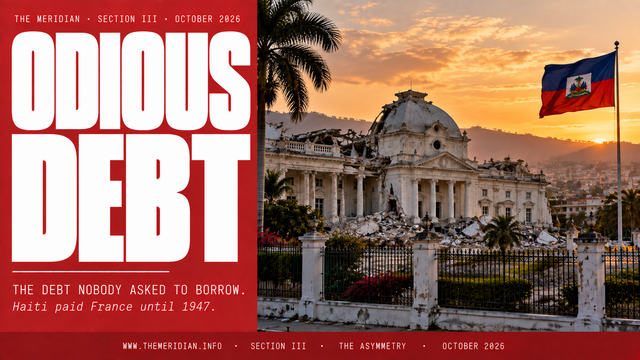
Haiti paid reparations to France until 1947 for the cost of its own freedom. The doctrine of odious debt has existed in international law since 1927. No court has ever applied it to a sovereign. Here is why that matters for $348 trillion in global debt.
In 1825, France sent a fleet of warships to the waters off Haiti. The message delivered to the Haitian government was not complex: France would recognise Haitian independence, which it had refused to do for 21 years since the Revolution ended in 1804, in exchange for 150 million gold francs as compensation to French slaveholders for the loss of their property. The property referred to was the enslaved people who had freed themselves.
Haiti, surrounded by French warships and economically isolated by two decades of non-recognition, agreed. It borrowed the money from French banks to make the first payment. The debt was later renegotiated and reduced to 90 million gold francs. Haiti paid it. The last instalment was paid in 1947: 143 years after independence, 122 years after the original obligation was formalised as a loan.
The doctrine of odious debt holds that a sovereign obligation incurred without the consent of the population and against its interests, where the creditor was aware of both conditions, is not legally binding on that population or on successor governments. The doctrine has existed in international law since 1927. No court has ever applied it to a sovereign debt. Haiti borrowed to pay its former enslaver for the cost of its own freedom, repaid that debt in full over 122 years, and no legal instrument existed or was applied to cancel it.
First: the debt must have been incurred by a despotic or unrepresentative regime, not by a government acting with the consent of its population.
Second: the debt must not have been used in the interest of the population: it must have served the personal enrichment of rulers, the maintenance of the regime against the population, or some purpose hostile to the population's welfare.
Third: the creditors must have been aware of both of the foregoing conditions at the time of lending.
All three conditions are demanding by design. The doctrine was not intended to provide a blanket exit from inconvenient obligations. It was intended to address a specific category of debt where the combination of illegitimacy, harmful purpose, and creditor knowledge made enforcement morally indefensible. (Source: Sack A.N., "Les Effets des Transformations des États," 1927)
The Haiti case meets all three Sack conditions with a clarity that no subsequent legal case has matched.
The government that agreed to the 1825 reparations did not represent the population's interests in the relevant sense: it was operating under the threat of military force, with no realistic alternative to acceptance. The debt was not incurred in the interest of the Haitian population: it was incurred to compensate the people who had enslaved them for the loss of that enslaved labour. The creditors, the French banks that provided the financing and the French government that received the proceeds, were fully aware of both conditions: the purpose of the debt was publicly stated and was the explicit condition of the diplomatic recognition that France was withholding. (Source: historical record; Haitian government archives)
Haiti's total reparations payment, converted to contemporary economic terms, represents an enormous transfer of wealth from one of the world's poorest countries to one of its richest, extending from 1825 to 1947. Various economists have estimated the economic cost to Haiti at between $21 billion and $115 billion in today's money, depending on the methodology used for historical GDP reconstruction and the compound interest calculation applied. The range is wide. The direction is unambiguous.
The consequences are visible in Haiti's contemporary condition. Its per capita income is approximately $1,700, a fraction of that of its Caribbean neighbours. Its institutional capacity, physical infrastructure, and public health system all reflect a century and more of extractive fiscal obligations that consumed the resources that would otherwise have built them. The reparations debt was not the only cause of Haitian underdevelopment. But it was a structural cause operating over more than a century, and it meets the legal definition of odious debt more precisely than any other case in the literature.
"Haiti borrowed to pay its former enslaver for the cost of its own freedom. It repaid that debt in full over 122 years. The doctrine that would have cancelled it existed. It was never applied."
When apartheid ended in South Africa in 1994, the new ANC-led government inherited approximately $25 billion in debt contracted by the apartheid regime. This debt had financed, among other things, the security apparatus of the apartheid state: the police force, the military, the surveillance infrastructure used to suppress the population that the new government now represented. The ANC's position before coming to power was that this debt was odious and should not be honoured. After coming to power, it honoured the debt. The combination of creditor pressure, the need for international financial market access, and the practical difficulties of distinguishing odious from non-odious components of the debt portfolio made repudiation impossible in practice, even where it might have been defensible in principle. (Source: ANC constitutional documents; Jubilee South Africa)
Iraq after the 2003 invasion presented a third case. Saddam Hussein's government had contracted approximately $130 billion in sovereign debt, much of it used to finance a military apparatus used against the Iraqi population and its neighbours. The US Treasury Undersecretary John Taylor proposed in 2003 that Iraq's Saddam-era debt be treated as odious and cancelled. The proposal was not implemented. The selective invocation of the doctrine by a government that had just invaded the debtor country undermined the legal argument and illustrated how the doctrine's application depends entirely on who benefits from it. (Source: US Treasury statements 2003-04; academic literature)
The odious debt doctrine has never been applied by an international court to cancel a sovereign debt obligation. The reasons are structural rather than legal.
The international financial system depends on the principle of sovereign debt continuity: the assumption that debts survive changes of government and that creditors can rely on repayment regardless of who borrowed or for what purpose. This continuity principle is the foundation on which the entire sovereign debt market rests. If creditors could not rely on it, the risk premium on lending to governments would rise dramatically, making sovereign borrowing more expensive for every country, including and especially the developing countries that would theoretically benefit most from the doctrine.
The creditors who hold sovereign debt are the same institutions that would bear the cost of odious debt cancellation: banks, asset managers, pension funds. The governments of the countries whose financial systems those institutions inhabit are the same governments that dominate the governance of the IMF, the World Bank, and the international legal institutions that would need to apply the doctrine. The incentive structure does not favour application.
The doctrine of odious debt is not a utopian proposal. It is a legal concept with a 100-year history, a rigorous theoretical foundation, and documented cases that meet its criteria. The reason it has never been applied is not that the cases do not exist. It is that the application would cost money, and the people who would bear that cost are the people who design the system within which the application would have to occur.
$348 trillion in global debt includes, somewhere in its composition, debt that was contracted without the consent of the populations that service it, for purposes hostile to those populations, with the awareness of the creditors who provided it. The doctrine that would address this is available. The architecture that would implement it does not yet exist.
Building that architecture would require the creditors to acknowledge that some of what they are owed was never legitimately theirs to collect. They have not yet acknowledged this. But the doctrine is there, waiting for the moment when the political conditions change enough for the argument to become actionable.
Add comment
Comments