The United States: The Exorbitant Privilege Is Running Out
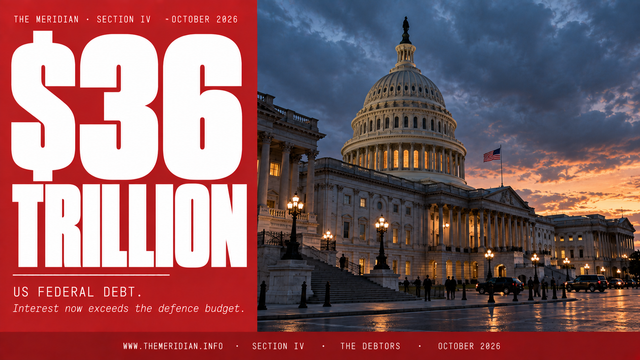
$36 trillion in federal debt. Interest payments now exceed the entire US defence budget. The dollar's exorbitant privilege is real. But it has limits. Here is what they look like and how the unwinding, when it comes, will fall on those who can least afford it.
The United States owes $36 trillion. In fiscal year 2026, for the first time in American history, the federal government will spend more on interest payments on its debt than on its entire defence budget. The country that designed the international financial order, that issues the reserve currency that prices global trade, that borrows at rates four times lower than Kenya and eight times lower than Pakistan, is paying more to service yesterday's debt than to maintain the military apparatus that has underwritten the dollar's global role for 80 years.
This is not a crisis. Not yet. The dollar remains the dominant reserve currency. US Treasury bonds remain the global benchmark risk-free asset. Foreign central banks still hold approximately $8 trillion in US government securities. The exorbitant privilege, the term coined by Valéry Giscard d'Estaing in the 1960s to describe America's ability to borrow cheaply in the currency it prints, is intact.
But privilege is not the same as permanence. And the trajectory of US fiscal policy is testing the structural foundations of that privilege in ways that have no peacetime precedent.
The phrase was coined by Giscard d'Estaing, then France's Finance Minister, in the 1960s to describe the structural advantage the United States derives from the dollar's role as the world's primary reserve currency. The privilege operates through multiple channels simultaneously.
First, the United States can borrow in its own currency from the entire world. Foreign central banks, sovereign wealth funds, and private institutions hold dollar assets because the dollar is the medium of international trade and finance. This global demand suppresses US borrowing costs below what any fundamental analysis of the US fiscal position would suggest.
Second, the United States earns seigniorage on the global economy. When foreign central banks hold dollar banknotes or dollar reserves, they are effectively extending an interest-free loan to the United States. The US issues dollars; the world holds them; the US earns the return on the assets those dollars financed.
Third, the dollar's role as the invoicing currency for global commodities, particularly oil, means that global trade generates a persistent demand for dollar liquidity independent of US economic performance. Countries need dollars to buy oil regardless of whether they approve of US fiscal policy. These advantages are real and large. They are not unconditional.
"Privilege is not the same as permanence. The United States is paying more to service yesterday's debt than to maintain the military apparatus that has underwritten the dollar's global role for 80 years."
The Congressional Budget Office's 2026 Long-Term Budget Outlook projects US federal debt rising from approximately 100% of GDP today toward 150% of GDP within two decades under current policy. The annual deficit is approximately $2 trillion and is not projected to decline under any current policy scenario. Interest payments now exceed $1 trillion per year and are growing faster than any other component of the federal budget. (Source: Congressional Budget Office 2026)
In May 2025, Moody's stripped the United States of its last remaining triple-A sovereign credit rating, downgrading it to Aa1. Moody's cited the fiscal trajectory, the rising interest burden, and the absence of a credible medium-term consolidation plan. The United States now holds no triple-A rating from any of the three major agencies. (Source: Moody's, May 2025)
The dollar's share of global foreign exchange reserves has declined from approximately 72% in 2000 to approximately 57% in 2026. The decline has been sustained across 25 years and has been partly offset by the absence of a credible alternative reserve asset. Gold's share has increased as central banks, particularly in the Global South, have diversified away from dollar exposure. (Source: IMF COFER data 2026)
1. The interest rate limit. The privilege depends on the dollar's safe-haven status suppressing US borrowing costs. If the fiscal trajectory produces sufficient concern about creditworthiness, the safety premium compresses and yields rise. Rising yields worsen the deficit, which raises further concern. The Moody's downgrade suggests this process has begun. The feedback loop, once activated, is self-reinforcing.
2. The inflation limit. The Federal Reserve's credibility depends on its independence. If US fiscal deficits reach a level where the government requires the Fed to monetise debt, that independence is compromised, the dollar's store-of-value function is impaired, and the rationale for holding dollar reserves weakens.
3. The geopolitical limit. The dollar's global role is partly a function of US geopolitical power. Sustained fiscal pressure constrains defence spending, which constrains geopolitical reach, which weakens the institutional foundations of dollar dominance. The interest-exceeds-defence threshold is a symbolic marker of this limit becoming visible.
The United Kingdom's loss of reserve currency status in the 20th century is the most relevant historical precedent, and it is not encouraging for those who believe any transition, if one occurs, will be orderly.
Sterling was the world's primary reserve currency from roughly the mid-19th century until the Second World War. Its displacement by the dollar was a decades-long process driven by the accumulated fiscal costs of two world wars, the erosion of UK productive capacity, and the institutional architecture of Bretton Woods, which was designed by the Americans to enshrine dollar dominance. The transition was managed, but it was not painless: the UK experienced sustained currency crises, IMF intervention, and a long period of relative decline before the adjustment was complete.
The United States is not the United Kingdom. Its economy is larger, its military capacity greater, its institutional depth deeper. But the structural dynamic is comparable: a reserve currency issuer running sustained deficits that erode the fiscal foundations of reserve currency status.
The $348 trillion in global debt that this edition maps is priced, overwhelmingly, in dollars. Its servicing costs are a function of dollar interest rates. Its crisis dynamics are shaped by dollar liquidity. If the anchor currency wobbles, the entire architecture wobbles with it. Not immediately. Not catastrophically in the short term. But structurally and progressively, in ways that compound across decades.
The United States is not about to lose the exorbitant privilege. But the fiscal trajectory the CBO projects does not lead to a place where the privilege is sustainable indefinitely.
And the countries that have built their debt architecture around the assumption of dollar permanence, because they had no alternative, will bear the cost of the adjustment in ways that the United States will not. That asymmetry, again, is the one that runs through every section of this edition.
Add comment
Comments