Default: The Option Nobody Wants to Name
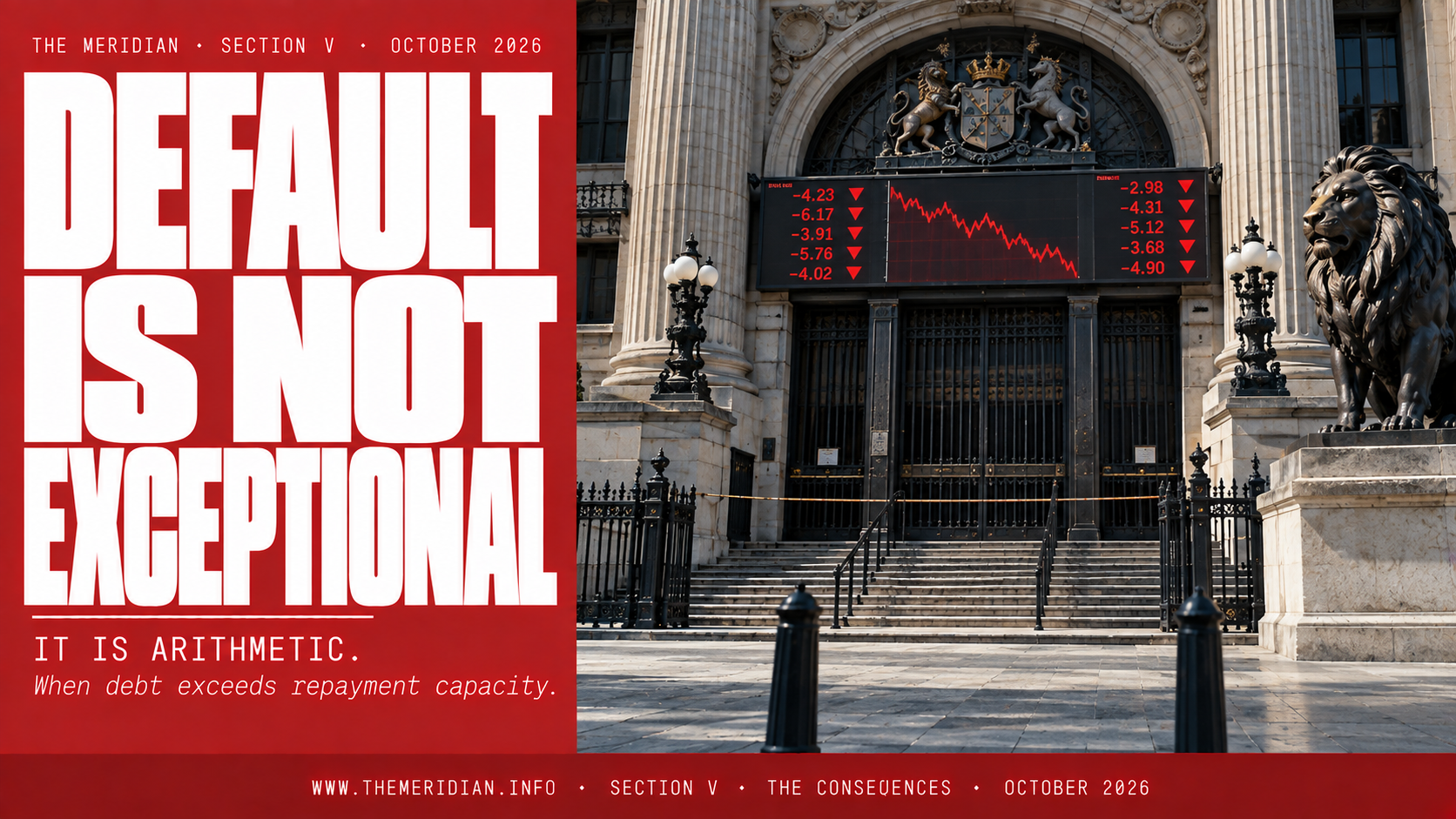
Argentina named it nine times. Iceland's banks named it in 2008. Zambia named it in 2020. Sri Lanka named it in 2022. Each time it was described as exceptional. It is not exceptional. It is the eventual arithmetic outcome when debt exceeds repayment capacity and the alternatives have been exhausted. Here is what it is, when it becomes unavoidable, and why it is systematically avoided even when the numbers say it should not be.
The word itself is the problem. Default carries a weight of moral failure that the underlying arithmetic does not justify. When a household cannot repay its debts, it is described as bankrupt and given access to a legal process that extinguishes the obligations it cannot meet and allows it to begin again. When a corporation cannot repay its debts, it enters administration or Chapter 11 and its obligations are restructured under a legal framework designed to produce an outcome better for all parties than disorderly collapse. When a sovereign government cannot repay its debts, it is described as having defaulted -- and the word lands with the force of a verdict rather than a description.
Default is not a moral failure. It is an arithmetic outcome. When the debt service obligations of a sovereign exceed what that sovereign can generate in revenue after maintaining the minimum functions of the state, default is not an option that has been chosen. It is a condition that has been reached. The question is not whether it will occur but in what form, under what conditions, after how much additional austerity has been applied to delay it, and at whose expense the delay was paid for.
Sovereign default, in technical terms, occurs when a government fails to make a scheduled payment of principal or interest on its debt, or when it restructures that debt in ways that impose losses on creditors beyond what the original terms provided. Both are forms of default, though the second -- restructuring -- is often presented as an alternative to default rather than a form of it, in order to avoid triggering cross-default clauses in other instruments or to preserve a relationship with creditors for future market access.
The distinction between default and restructuring matters less than the industry around managing it suggests. In both cases, creditors receive less than they were promised. In both cases, the sovereign regains fiscal space it did not previously have. The question of which label is applied is primarily a question of sequencing, legal architecture, and the willingness of creditors to participate voluntarily in a process that reduces their claims. When they do, it is called restructuring. When they do not, or when the government stops paying without a prior agreement, it is called default.
Argentina in 2001 defaulted on approximately $100 billion in sovereign bonds -- the largest sovereign default in history at the time. The default followed a decade of currency board convertibility that had eliminated hyperinflation but destroyed export competitiveness, a succession of IMF programmes that required fiscal adjustment in the face of a deepening recession, and a political crisis that produced five presidents in two weeks. The 2005 restructuring imposed losses of approximately 65 to 70 cents on the dollar on participating creditors. Approximately 75% of eligible bonds were tendered. The 25% that did not participate became the holdout creditor problem that produced a technical default in 2014 when US courts ruled that Argentina could not pay restructured creditors without paying holdouts in full. (Source: IMF; Bloomberg; NML Capital v Argentina court record)
Iceland in 2008 presents a different case that is often misread. Iceland's three major commercial banks -- Glitnir, Landsbanki, and Kaupthing -- collapsed in October 2008 under the weight of assets that had grown to approximately ten times Iceland's GDP. The banks defaulted. The sovereign government of Iceland did not formally default: it secured an IMF programme of approximately $2.1 billion in November 2008 and restructured the banking system without assuming the full burden of bank liabilities. Iceland's recovery was faster and more complete than that of many countries that chose to socialise their bank losses -- Ireland being the comparison most frequently drawn. The lesson the Iceland case offers is that the decision to let financial institutions fail rather than extend sovereign guarantees to their obligations can produce better long-term outcomes than the socialisation of private losses. (Source: IMF Iceland programme 2008)
Zambia in 2020 became the first sub-Saharan African country to default in the COVID era, missing a $42.5 million coupon payment in November 2020. The default triggered a restructuring process under the G20 Common Framework that took three years to complete, largely because of the difficulty of coordinating between China -- Zambia's largest bilateral creditor -- and the Paris Club of Western creditors. China's reluctance to accept losses comparable to those taken by Western creditors, and the absence of an agreed framework for Chinese participation in sovereign restructuring, produced delays that cost Zambia years of market access and sustained fiscal uncertainty. The Zambia case became the template illustration of why the G20 Common Framework, designed in 2020, was not fit for purpose in a world where China is a major sovereign creditor. (Source: G20 / IMF / World Bank; press record)
"Default is not chosen. It is reached. The question is not whether it will occur but how much austerity will be applied to delay it, at whose expense, and over how many years, before the arithmetic is finally named."
The holdout creditor problem is the single largest structural obstacle to orderly sovereign debt restructuring. When a sovereign restructures its debt, it requires a sufficient proportion of creditors to accept new terms that reduce the value of their claims. Creditors who refuse to participate -- holdouts -- retain their claims at full face value and can litigate for payment in jurisdictions that the sovereign cannot easily avoid.
Vulture funds, a term for investment vehicles that purchase distressed sovereign debt at steep discounts in the secondary market and then refuse to participate in restructuring, have demonstrated in multiple cases that aggressive holdout litigation can extract full face value from sovereigns that have already completed restructurings with the majority of their creditors. NML Capital's decade-long legal campaign against Argentina is the defining case: NML purchased Argentine bonds at approximately 20 cents on the dollar after the 2001 default and litigated until it extracted payment at face value, a return of approximately 400%. The legal precedent set by the US Southern District of New York ruling in NML's favour -- that Argentina could not pay restructured creditors without simultaneously paying holdouts -- made voluntary restructuring with holdout risk significantly harder for all future sovereign debtors. (Source: NML Capital v Argentina, US court record)
1. Loss of market access. A country that defaults loses access to international capital markets for a period that can extend years beyond the restructuring. In the interim, it cannot borrow externally to finance any deficit, however small, and must achieve primary surplus or domestic financing for all public spending. For countries with shallow domestic financial markets, this constraint is severe.
2. Banking system contagion. Domestic banks typically hold significant quantities of domestic government bonds. A sovereign default that reduces the value of those bonds impairs bank balance sheets, potentially triggering a banking crisis alongside the sovereign crisis. Governments avoid default partly to protect the banking system from this secondary collapse.
3. Political cost and IMF pressure. Defaulting governments face intense pressure from the IMF, from bilateral creditors, and from domestic financial institutions to avoid formal default and to seek programme support instead. The IMF's preferred creditor status -- its loans are repaid ahead of other creditors -- means that an IMF programme can provide the bridge financing that avoids default at the cost of programme conditionality. Governments frequently accept years of additional austerity under IMF conditions rather than name the default that the arithmetic has already produced.
4. The G20 Common Framework gap. Announced in November 2020, the G20 Common Framework was designed to coordinate debt relief for the poorest countries in a world where China is now a major creditor alongside traditional Paris Club members. The Zambia case demonstrated its limitations: three years to complete a restructuring for a country with relatively straightforward debt, because the framework has no enforcement mechanism for Chinese creditor participation and no agreed comparability of treatment standard that all parties accept. The architecture for orderly sovereign default in a multipolar creditor world does not yet exist at the scale required. (Source: G20 / IMF / World Bank 2020)
The $348 trillion in global debt will not all be repaid at face value. History does not support that outcome and current trajectories do not point toward it. Some of it will be reduced through inflation. Some through growth. Some through austerity applied over decades at the cost documented in the preceding article. And some through default and restructuring -- named or unnamed, orderly or disorderly, early or after every alternative has been exhausted.
The cost of the delay between when default becomes arithmetically correct and when it is finally named is borne by the population of the defaulting country in the form of austerity applied to avoid the naming. The additional interest paid during that delay accrues to the creditors whose claims are being serviced. The holdout litigation costs accrue to the funds that purchased the distressed claims at a discount. None of these costs fall on the institution that structured the debt, the government that accumulated it, or the rating agencies that rated it investment grade until the day before the default was announced.
Default is not the worst outcome in every case. For a country whose debt is arithmetically unsustainable, an early, orderly default with a credible restructuring framework produces better long-term outcomes than years of austerity that delays the inevitable and imposes the cost of the delay on those least able to bear it. The option nobody wants to name is sometimes the option that should have been named first.
Add comment
Comments