The Debt Jubilee: The Radical Idea Whose Time Is Coming
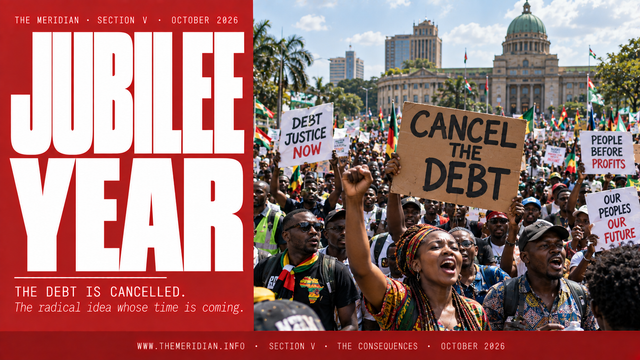
The concept originates in Leviticus: every 50 years, debts are cancelled and the land returns to its people. The HIPC initiative of 1996 wrote a secular version of it into international law for 40 countries. Its successor cancelled approximately $130 billion. Post-HIPC countries have re-accumulated debt to pre-relief levels. The $348 trillion global debt landscape makes the return of jubilee logic not radical but arithmetically necessary.
The Book of Leviticus, chapter 25, instructs the Israelites to count seven sabbath years -- seven times seven -- and in the fiftieth year to proclaim liberty throughout the land. In the jubilee year, debts are cancelled. Slaves are freed. Land that has been sold returns to its original owners. The accumulationsof fifty years are reset. The logic is not charitable. It is structural: the authors of Leviticus understood that debt, left to compound across generations, produces a concentration of economic power that eventually destroys the social order it operates within. The jubilee was not generosity. It was system maintenance.
Three thousand years later, the same logic has returned to the language of international finance -- not from scripture but from arithmetic. The $348 trillion in global debt that this edition maps includes a substantial portion that cannot be repaid under any plausible combination of growth, austerity, and inflation. It is not possible to squeeze Zambia, Ethiopia, Pakistan, and Ghana through enough structural adjustment programmes to generate the fiscal surpluses that would reduce their debt to sustainable levels within any timeframe that preserves functional states and minimal public services. The debt jubilee is not returning as an act of religious observance. It is returning because the numbers require it.
The economic historians who have examined ancient near-eastern debt practices note that the jubilee was a response to a specific and recurring problem: the debt cycle. Small farmers in subsistence agricultural economies were vulnerable to bad harvests. A drought, a flood, a blight produced a deficit that could only be financed by borrowing -- from larger landowners, from merchants, from moneylenders. The debt accumulated interest. If the next harvest was also poor, the debt compounded. Farmers who could not repay lost their land to creditors, became tenant farmers on what had been their own land, and eventually became debt bondsmen. The land concentrated in the hands of creditors. The society stratified irreversibly. The economic base that sustained the community was transferred to a small class of creditors whose interests diverged from the community's.
The jubilee interrupted this cycle at the point before it became irreversible. It did so not by preventing borrowing, not by moralising about debt, and not by requiring creditors to be charitable. It did so by making the accumulation permanent: by establishing a structural limit beyond which debt could not transfer assets in perpetuity. The logic was conservative in the original sense -- it conserved the conditions of social stability by preventing any single generation's misfortune from becoming the next generation's permanent dispossession.
The parallel to $348 trillion in global debt is not metaphorical. The structural condition the ancient jubilee addressed -- debt accumulation producing irreversible asset and power transfer from debtors to creditors -- is precisely what sovereign debt is doing to the relationship between creditor nations and debtor nations, between international financial institutions and the governments that depend on them, between bondholders and the populations whose fiscal capacity they have first claim on.
The modern jubilee movement reached its political peak in the Jubilee 2000 campaign, a coalition of development organisations, churches, trade unions, and civil society groups founded in the United Kingdom in 1996 and named explicitly after the biblical concept. The campaign collected 24 million signatures on a petition calling for cancellation of the unpayable debts of the world's poorest countries by the year 2000. The petition was presented at the G8 summit in Cologne in 1999. It did not achieve its demand. It achieved something else: it placed debt cancellation on the political agenda of the G8 in a way that produced the Heavily Indebted Poor Countries Initiative and, a decade later, the Multilateral Debt Relief Initiative. (Source: Jubilee 2000 / Jubilee Debt Campaign records)
The HIPC Initiative, launched by the IMF and World Bank in 1996 and enhanced in 1999, was the institutional response to the jubilee demand. Forty countries were deemed eligible for relief. The process required two stages: a decision point, at which the country committed to an economic reform programme, and a completion point, at which it had implemented those reforms sufficiently to receive full debt relief. The conditions attached to HIPC relief were, in most cases, structural adjustment conditions of the same type documented elsewhere in this edition: spending restraint, revenue increases, privatisation, trade liberalisation. Jubilee advocates noted, with some precision, that the mechanism designed to relieve the burden of structural adjustment required the implementation of structural adjustment as a precondition. (Source: IMF / World Bank HIPC documentation)
"The HIPC Initiative cancelled $130 billion in debt from 40 of the world's poorest countries. Within two decades, many of those countries had re-accumulated debt to levels comparable to those that preceded the relief. The structure that produced the debt was not cancelled. Only the debt was."
The combined debt relief delivered under HIPC and the Multilateral Debt Relief Initiative announced at the G8 Gleneagles summit in 2005 amounted to approximately $130 billion. This was, at the time of its delivery, a significant sum and a genuine achievement of the international debt relief movement. It was also partial, conditional, and structurally incomplete in ways that have become visible in the two decades since.
The coverage gap is the first limitation. HIPC and MDRI covered debt owed to multilateral institutions and bilateral creditors within the Paris Club framework. They did not cover commercial debt held by private bondholders. They did not cover debt owed to China, which was not a Paris Club member and whose bilateral lending to African countries was already growing in the early 2000s. As China's lending expanded dramatically through the Belt and Road Initiative and related instruments from 2013 onwards, and as commercial bond market access opened to an increasing number of African sovereigns through Eurobond issuance, the share of debt covered by the HIPC framework shrank relative to the total. The relief was comprehensive for the debt architecture of 1999. It was partial for the debt architecture of 2026.
The re-accumulation problem is the second limitation. Many countries that reached HIPC completion point and received full relief had, by the early 2020s, re-accumulated debt to levels comparable to or above those that had qualified them for the relief in the first place. The reason is structural: the HIPC initiative cancelled the debt but not the conditions that produced it. Countries that borrowed because commodity export revenues were volatile and insufficient to finance development continued to face volatile and insufficient commodity revenues. Countries that borrowed in foreign currency because no international investor would lend in domestic currency continued to face original sin constraints. The debt was cancelled. The debt architecture was not redesigned. (Source: IMF data 2023-26; Jubilee Debt Campaign analysis)
1. The arithmetic argument. A significant portion of current Global South sovereign debt cannot be repaid under any plausible combination of growth, austerity, and inflation. Countries spending 37% or more of government revenue on external debt service before funding any public service are not in a position that improvement of their fiscal management can resolve. The debt exceeds the repayment capacity of the economy. The choice is not between repayment and jubilee. It is between organised debt relief through a legitimate framework and disorderly serial defaults that cost more, take longer, and deliver less for both debtors and creditors.
2. The climate argument. The countries most indebted relative to their fiscal capacity are overwhelmingly the countries least responsible for the carbon emissions that have produced the climate crisis and most exposed to its consequences. Debt relief is inseparable from climate finance: a country spending 40% of its revenue on debt service cannot simultaneously invest in climate adaptation. The two crises have the same geography. A debt jubilee for climate-vulnerable countries is not a moral demand only. It is a precondition for the climate investment that the countries responsible for the crisis are committed, in treaty terms, to enabling. (Source: Jubilee Debt Campaign 2024-26; UN climate finance framework)
3. The system stability argument. Serial sovereign defaults, holdout litigation, and the breakdown of the G20 Common Framework are more expensive for the international financial system than organised debt relief would be. The costs of disorderly defaults -- lost market access, banking system contagion, geopolitical destabilisation -- fall on creditors and on the international system, not only on the debtors. A structured jubilee framework, applied to the debts that are arithmetically unpayable, would cost less in aggregate than the current system of delayed defaults extracted through years of austerity.
The debt jubilee will return. The arithmetic of $348 trillion in global debt, distributed as it is between countries that can service it and countries that cannot, requires some form of systematic relief for the portion that exceeds repayment capacity. The question is not whether a jubilee will occur but in what form, under what conditions, and whether it will be accompanied by the structural reforms that would prevent the immediate re-accumulation of the debts relieved.
The HIPC initiative cancelled the debt. It did not redesign the architecture. A twenty-first century jubilee that repeats this error will produce the same outcome: relief followed by re-accumulation, with the interval between them measured in years rather than decades if the structural conditions are not addressed alongside the balance sheet.
The radical idea is not that unpayable debts should be cancelled. That is accounting. The radical idea is that the architecture which produces unpayable debts -- the original sin of foreign currency borrowing, the interest rate asymmetry, the IMF governance structure, the rating methodology bias, the CFA franc reserve requirement -- should be redesigned at the same time. The jubilee that addresses the debt without addressing the architecture is not a jubilee. It is a delay.
Add comment
Comments