The Reckoning: A Closing Essay
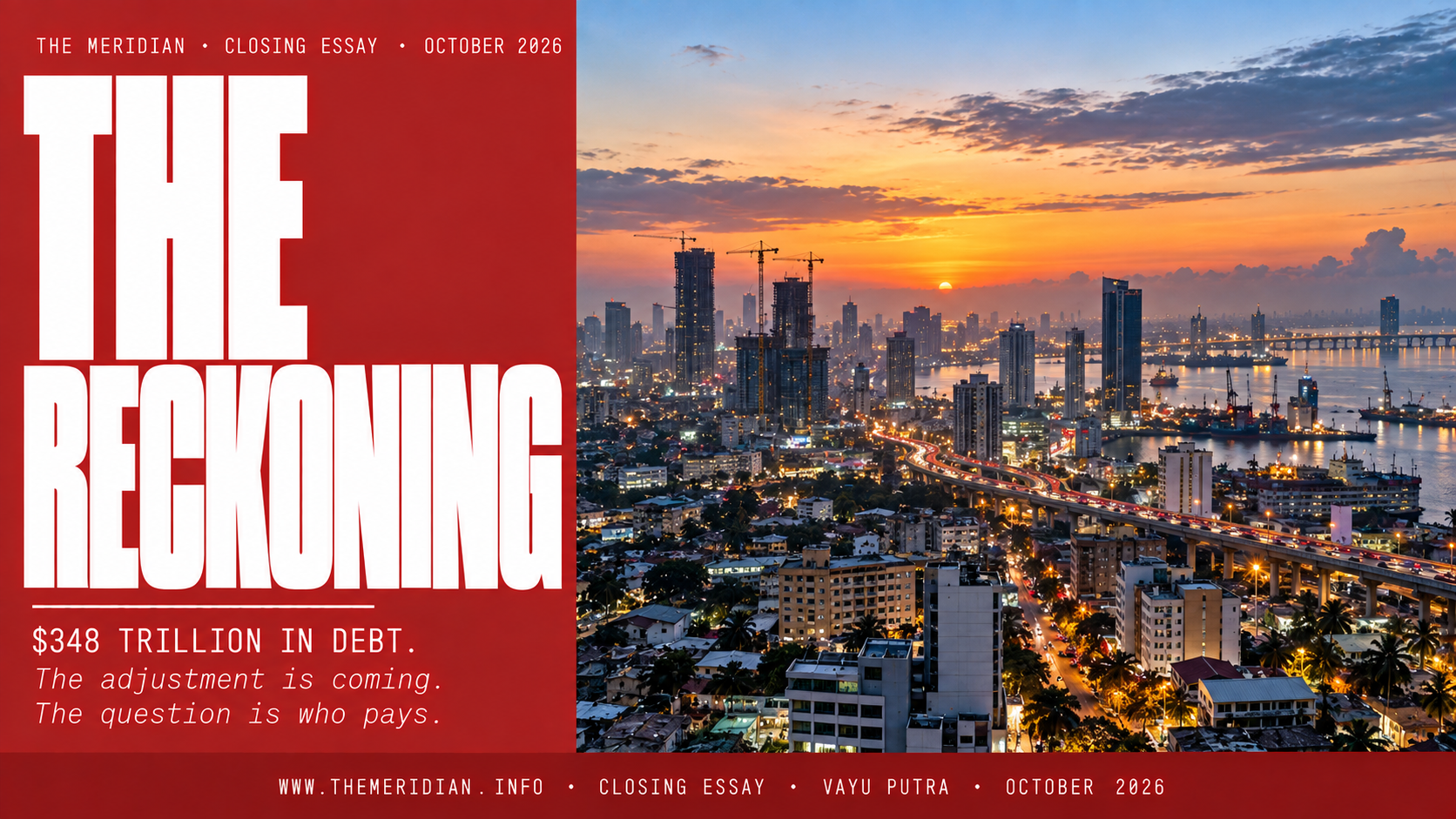
$348 trillion in debt. The architecture that produced it. The asymmetry that governs it. The adjustment that is coming. This is the closing essay of The Meridian's October 2026 edition -- a statement of what this edition has argued, what it has found, and what it believes must change.
$348 trillion. The number is too large to be real without context. It is more than three times the total value of everything the world's economies produce in a single year. If every human being on earth were to dedicate their entire economic output for three years to nothing else, they would clear this debt -- if the interest stopped accumulating, which it does not. The analogies are not helpful. The number is simply very large, and its size is the first thing this edition has tried to make real.
The second thing is simpler and more important. The debt does not sit still. It compounds. And the people who designed the architecture within which it compounds are not the same people who will bear the cost of the adjustment when the compounding eventually exceeds what can be managed.
This edition has traced the architecture. It was not designed in a single moment or by a single hand. It emerged from Bretton Woods in 1944, when the United States was the only economy with the productive capacity and reserve currency status to anchor the post-war financial order. It was shaped by the IMF's governance structure, which assigns voting weight by quota and has never reflected the economic reality of a world in which Asia, Africa, and Latin America together account for more than half of global GDP. It was built into the rating methodology of three American agencies that rate the creditworthiness of 190 sovereign borrowers according to criteria that systematically disadvantage the countries that were not in the room when the criteria were designed. It was preserved in the CFA franc's operations account, which has required 14 African countries to deposit 50% of their foreign exchange reserves with the French Treasury for 80 years. It was amplified by the original sin of developing country debt -- the structural inability of most Global South economies to borrow internationally in their own currencies -- which transfers the exchange rate risk of sovereign borrowing from creditors to populations.
The architecture is not neutral. It was designed, explicitly and implicitly, to serve the interests of the countries that designed it. Those countries are the same countries that issue the reserve currencies. They are the same countries that hold the dominant voting shares in the IMF and World Bank. They are the same countries whose rating agencies assign the spreads. They are the same countries that set the interest rates that the rest of the world cannot avoid.
"The asymmetry is not incidental. It is the product of an architecture in which the protection against imposed austerity is monetary sovereignty, and monetary sovereignty belongs overwhelmingly to the countries that designed the architecture."
The asymmetry runs through every article in this edition. The United States borrows at 4.5%. Kenya borrows at 16%. The United Kingdom decided its own austerity in 2010 and reversed it when it chose. Pakistan cannot decide to reverse the austerity that serves its IMF programme conditions because the conditions are externally set and compliance is quarterly monitored. Greece lost 25% of its GDP during adjustment and watched its pension system dismantled by an institution its citizens had no vote in. Ghana's pensioners lost their retirement savings as a precondition of IMF support in 2023. Japan's 263% debt-to-GDP causes no crisis because Japan borrows in yen, from Japanese institutions, while running a current account surplus. Sri Lanka's 120% debt-to-GDP produced collapse in 2022 because Sri Lanka borrowed in dollars it could not print, from creditors who could not roll over their claims when the reserves were exhausted.
The reckoning is not a future event. It is a present condition that is being managed, deferred, and partially absorbed through three mechanisms already operating simultaneously. The first is inflation: as documented in this edition, the 2021 to 2023 inflation episode was, among other things, a mechanism of debt burden reduction that fell in its costs on wage earners, savers, and the holders of cash while it benefited sovereign debtors and asset holders. For the Global South, whose debt is denominated in foreign currency, the mechanism operates in reverse: domestic inflation weakens the exchange rate, which makes the dollar debt more expensive, which compounds the burden rather than reducing it. The second is serial default: Argentina nine times, Sri Lanka for the first time in its history, Zambia as the first sub-Saharan COVID default, Ghana through domestic debt restructuring. Default is not exceptional. It is the arithmetic outcome when debt service exceeds fiscal capacity after the alternatives have been exhausted. The third is jubilee -- systematic debt relief applied to the portion of global debt that exceeds the repayment capacity of the economies carrying it. This mechanism is not yet operating at scale. The HIPC initiative was its partial implementation. The re-accumulation of debt by HIPC completion-point countries is evidence that relief without structural redesign produces relief followed by re-accumulation.
The question is not whether the reckoning comes. It is which form it takes, and who bears the cost of each form. Inflation imposes the cost on wage earners and savers. Serial default imposes it on the populations of the defaulting countries through the years of austerity applied to delay the default and the adjustment costs that follow it. Jubilee, if it arrives, will impose a cost on creditors in the form of reduced returns on claims that, in some cases, should never have been made at the rates and on the terms on which they were extended.
This edition is not a programme. The Meridian does not write manifestos. But twenty-seven articles across five sections have produced six propositions that this edition believes are not radical demands. They are the minimum conditions for a debt architecture that does not require the same populations to pay the same costs of the same structural failures indefinitely.
IMF governance must reflect the world. A voting structure in which the United States retains effective veto power, in which European economies are overrepresented relative to their economic weight, and in which Africa, South Asia, and Southeast Asia are collectively underrepresented cannot produce a creditor institution that the debtor countries it governs trust. Credit rating methodology must be reformed or supplemented: the feedback loop by which African sovereigns are rated below their fiscal fundamentals, pay higher spreads, accumulate higher deficits, and are then rated lower still costs the Global South billions of dollars annually and has no legitimate technical justification. Original sin must be addressed through IMF Special Drawing Rights expansion and genuine local currency lending at scale: the structural inability of developing country economies to borrow in their own currencies is the single most consequential asymmetry in the global debt architecture. The CFA franc operations account must end: France committed to ending it in 2019, the commitment has not been implemented, and 180 million people continue to pay the price of the delay. The debt restructuring architecture must be redesigned for the multipolar creditor world: the G20 Common Framework has been demonstrated by the Zambia case to be inadequate, and an international sovereign debt restructuring mechanism with binding participation and legal frameworks that address the holdout creditor problem has been technically available since the SDRM proposals of 2001 and politically blocked since the same year. Odious debt must have legal standing: the doctrine exists, the cases that meet its criteria exist, the architecture that would implement it does not, and building it would require creditors to acknowledge that some of what they are owed was never legitimately theirs to collect.
The Meridian does not believe that debt is bad. Debt built the modern world, as this edition's first historical article documented. The institutions, the infrastructure, and the investment that transformed the material conditions of human life in the twentieth century were financed on credit, and that credit was productive. The debt that built the modern world was worth borrowing.
The question this edition has asked is different: whether the architecture within which debt is now accumulated, priced, serviced, and adjusted is producing outcomes that can be defended as fair, efficient, or sustainable. The answer in every section of this edition is no.
$348 trillion in debt sits on an architecture designed by creditors, priced by institutions that creditors control, adjusted through mechanisms that impose the cost on the populations of the debtor countries who had the least voice in the borrowing decisions that produced the debt. The nurse in Pakistan who earns in rupees that buy less each year. The pensioner in Ghana whose retirement savings were restructured as a programme condition. The student in Kenya who watched her government propose taxes on sanitary products to meet an external revenue target. The patient in Greece who waited in a hospital that had run out of medicine while the pension that had financed her retirement was cut by 45%. None of these people designed the architecture. All of them are paying for it.
That is The Meridian's finding in October 2026. The reckoning does not arrive all at once. But it arrives. And when it does, the only question that will matter is whether the architecture that produced it was redesigned before the arrival -- or whether, once again, the adjustment fell on those who had nothing to do with the design.
Add comment
Comments