The War That Made Everyone Poorer
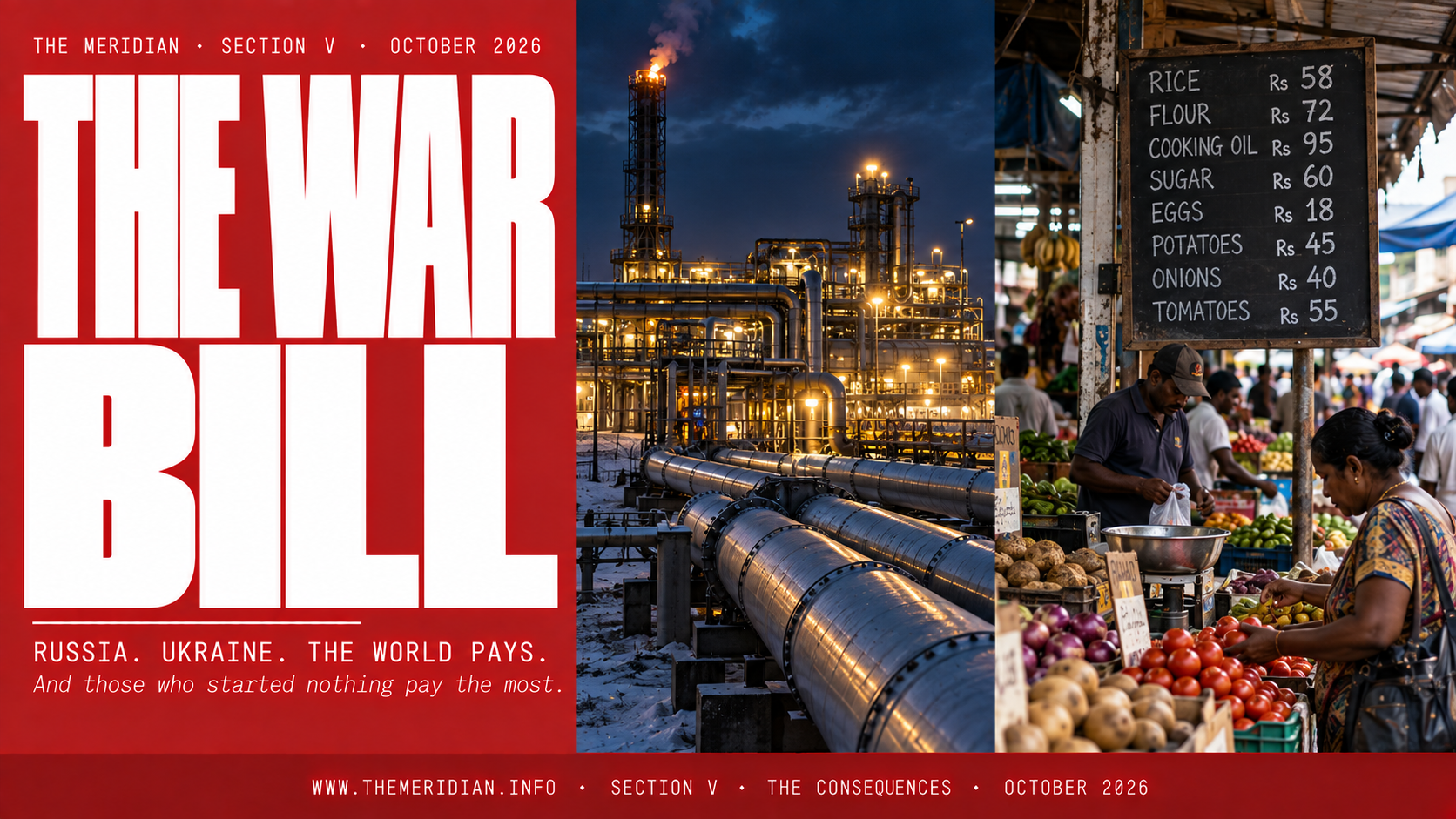
The Russia-Ukraine war sent European gas prices to 340 euros per megawatt-hour. The FAO Food Price Index hit its highest level on record in March 2022. Russia and Ukraine together account for approximately 30% of global wheat exports. The war did not create the $348 trillion debt problem. It made it worse for everyone -- and worst for those who had nothing to do with it.
On 24 February 2022, Russian forces crossed the border into Ukraine. Within days, European natural gas prices had begun their ascent toward levels that would have seemed impossible twelve months earlier. Within weeks, global wheat prices had spiked on the prospect of disrupted exports from two of the world's largest producing regions. Within months, the FAO Food Price Index had reached its highest recorded level in the thirty years it had been tracking global food prices. The IMF revised its global inflation forecast upward. Central banks across the world accelerated rate rises they had already begun. Sovereign balance sheets from Manila to Nairobi absorbed the commodity price shock as a simultaneous increase in import costs, a compression of fiscal space, and a tightening of the external financing conditions that determine what it costs to roll over foreign currency debt.
The war was fought in Ukraine. Its fiscal consequences were distributed across the entire global economy, with the distributional logic that runs through every section of this edition: the countries least responsible for the conflict, least equipped to absorb the shock, and with the least policy space to respond bore the most severe consequences relative to their capacity.
European gas prices, which had been trading at approximately 20 to 30 euros per megawatt-hour in the period before the invasion, reached approximately 340 euros per megawatt-hour in August 2022. The magnitude of that move -- more than ten times the pre-war price -- reflected the structural dependency of European economies on Russian gas that had been built over decades as an economic convenience and that became, in the space of weeks, a strategic vulnerability of the first order. (Source: IEA / European Energy Exchange 2022)
The European response -- emergency energy subsidies, accelerated renewables deployment, LNG import infrastructure, reduction in industrial gas consumption -- was fiscally enormous. European governments spent hundreds of billions of euros on energy support measures to shield households and businesses from the price surge. That spending was financed by borrowing. The war, which had nothing to do with most European households, was paid for partly by them in the form of higher energy bills and partly by their governments in the form of sovereign debt that will be serviced for years.
Russia and Ukraine together account for approximately 30% of global wheat exports and approximately 65% of global sunflower oil exports. When the invasion disrupted planting, harvesting, and export logistics in Ukraine, and when Western sanctions complicated Russian export routes, the global supply of two essential food commodities contracted simultaneously. The FAO Food Price Index reached its highest level since the index began tracking in 1990. (Source: FAO Food Price Index March 2022)
The food price shock transmitted into Global South economies through two channels simultaneously. The direct channel was the increased cost of food imports: countries that depend on wheat imports from the Black Sea region faced immediate price surges for a commodity with no short-term substitution available. Egypt, which imports approximately 60% of its wheat and had historically sourced a large share from Russia and Ukraine, faced an immediate and severe fiscal shock to its food subsidy bill. Bangladesh, Tunisia, Lebanon, and a range of sub-Saharan African countries experienced comparable pressures.
The indirect channel was through cooking oil and fertiliser prices: the disruption to sunflower oil exports sent palm oil and other edible oil prices sharply higher. Russian exports of fertiliser, a significant share of which are derived from natural gas, were disrupted by sanctions and export controls. Higher fertiliser prices raised agricultural production costs in exactly the countries whose food systems were already under price pressure from the import shock. The food crisis was, in its structure, a compound event: the war hit food supply and food production costs simultaneously, in countries that had the least capacity to absorb either shock. (Source: FAO / World Food Programme 2022)
"The Global South's additional food import bill in 2022 was approximately $100 to $120 billion above pre-war levels. Not one of those countries started the war. Every one of them paid for it -- in import costs, in food inflation, and in the sovereign debt accumulated to finance the response."
NATO members that had for years resisted meeting the alliance's 2% of GDP defence spending target found political space to do so, and in some cases to exceed it, in the aftermath of February 2022. Germany, which had kept its defence budget below 2% of GDP for decades, committed to a Sondervermögen -- a special fund outside the constitutional debt brake -- of 100 billion euros for defence investment. Poland rapidly increased its defence spending toward 4% of GDP, the highest proportion in the alliance. The Baltic states, Romania, and Slovakia all expanded their defence commitments materially. (Source: NATO Secretary General annual report 2023-24)
Individually, each of these increases was a national decision made in response to a genuine and rational security assessment. Collectively, they represented a substantial addition to sovereign debt across multiple European economies that were simultaneously managing post-COVID fiscal positions, energy subsidy costs, and the inflationary consequences of the commodity price shock. The war's fiscal bill, in Europe, was layered: energy costs, food costs, refugee support costs, and defence investment costs arrived simultaneously on balance sheets that were already stretched.
Ukraine: reconstruction needs estimated at approximately $411 billion over ten years as of 2023, with updated estimates substantially higher as the conflict continued. Ukraine will require international financing at a scale that dwarfs any previous single-country reconstruction effort in the post-war period. The financing will take the form of grants, concessional loans, and eventually commercial debt. The debt burden of reconstruction will sit on a country whose productive capacity has been substantially damaged by the conflict it is financing. (Source: World Bank Rapid Damage Assessment 2023)
Europe and NATO members: energy subsidy costs, defence investment surges, and refugee support costs have added substantially to sovereign debt across multiple high-income economies simultaneously. These economies have the institutional capacity and market access to manage the addition. It is nonetheless real, and it will be serviced for decades.
The Global South: countries that imported from Russia and Ukraine -- wheat, sunflower oil, fertiliser -- faced simultaneous food import cost increases, fuel cost increases, and the tightening of international credit conditions produced by the rate rises that the commodity-driven inflation surge triggered across developed economy central banks. Several countries that had managed their debt positions reasonably were driven to IMF programmes in 2022 and 2023 partly or substantially by the external shock the war produced. Kenya, Ghana, Pakistan, Bangladesh, Egypt, and Tunisia all entered or deepened IMF programme engagements in this period. None of them had any role in the decision that produced the shock.
The Russia-Ukraine war did not create the global debt problem documented in this edition. It found a world already carrying $348 trillion in debt, already struggling with the asymmetries described across Sections I through V, and added to the burden of every balance sheet simultaneously while distributing that addition according to the same logic that governs every other aspect of the global debt architecture: the cost falls heaviest on those with the least capacity to absorb it.
Russia imposed a sovereign default through the mechanism of Western sanctions blocking its payment routing -- the first Russian foreign currency default since 1918. Ukraine faces a reconstruction bill that will define its fiscal position for a generation. Europe paid for its energy dependency in subsidies and defence investment financed by sovereign debt. The Global South paid for a commodity price shock it did not cause, in import bills it could not avoid, financed by borrowing at rates it cannot control, from institutions whose governance it does not meaningfully influence.
The war that made everyone poorer made some people much poorer than others. The bill is being settled in the same currency that settles every debt crisis documented in this edition: the fiscal capacity of governments that had nothing to do with the decision that produced the cost.
Add comment
Comments