The IMF Wants Pakistan to Cut. Pakistan Has a War to Fight.
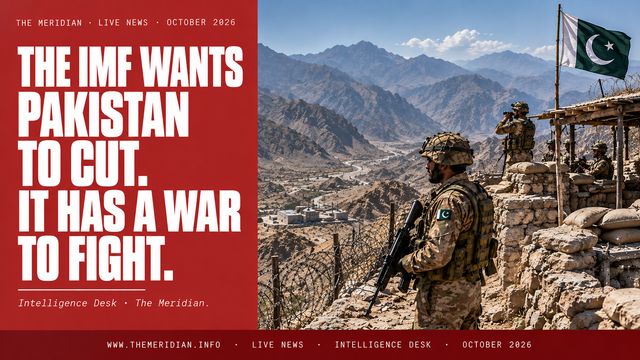
Pakistan is allocating over 50% of its federal budget to debt service, operating under an active IMF programme demanding fiscal consolidation, and fighting a land war on its western border with Afghanistan. The Fund's conditions and the war's costs are pulling in opposite directions. The people in the middle are not in Washington or Geneva.
Pakistan's current IMF Extended Fund Facility, approved in September 2024 and valued at approximately $7 billion over 37 months, carries a standard set of structural benchmarks: primary surplus targets, elimination of energy subsidies, rationalisation of the tax base, and currency flexibility. These are the conditions the Fund applies to a distressed economy seeking external financing of last resort. They assume a government capable of redirecting resources from consumption to debt service, stabilising the fiscal position, and allowing the exchange rate to clear. None of those assumptions accounts for a government simultaneously funding an active military campaign on its western border. Pakistan is doing both.
The war on the Afghan border is not a metaphor. Since the Taliban's return to power in Kabul in 2021, the Tehrik-i-Taliban Pakistan has substantially rebuilt its operational capacity inside Afghanistan and expanded attacks into Pakistani territory. The Pakistani military has conducted multiple cross-border artillery and air operations into Afghan territory since 2023, in addition to sustained ground operations in Khyber Pakhtunkhwa and Balochistan. Pakistan's defence budget for fiscal year 2025/26 stands at approximately 2.1 trillion Pakistani rupees, an increase of over 17% on the prior year. That figure does not capture the full cost of the campaign. Supplementary defence appropriations, intelligence operations, and the fiscal cost of internally displaced populations from conflict zones are absorbed into other budget lines. The IMF's programme targets a primary surplus of 1% of GDP. The declared and undeclared costs of the border war are moving in the opposite direction.
Pakistan's fiscal position, independent of the war, is among the most constrained of any IMF programme country in the current cycle. Debt service, covering both external and domestic obligations, consumed approximately 58% of federal revenues in fiscal year 2024/25, a ratio that leaves less than half of government revenue available for defence, development, and the entire civil apparatus of the state before any IMF-mandated cuts are applied. The Pakistani rupee has lost over 40% of its value against the US dollar since 2022, raising the local-currency cost of dollar-denominated external debt on each rollover. The IMF's programme assumes the rupee stabilises as confidence in the fiscal adjustment returns. That assumption is being tested by the simultaneous expenditure pressure of the military campaign, the rupee's sensitivity to global risk appetite, and the fuel price shock currently transmitting through Hormuz and Bab al-Mandab tanker disruptions into Pakistan's import bill.
“Pakistan is being asked to cut the state while defending it. No country in the history of IMF programming has done both at the same time and succeeded.”
The structural contradiction between fiscal consolidation and active war is not new in principle. Greece in 2010 was asked to cut while managing civil disorder. Argentina in 2001 cut until the government fell. Sri Lanka in 2022 exhausted its reserves before approaching the Fund. What distinguishes Pakistan's case is the simultaneity and the scale: an external military operation, an internal counter-insurgency, a $7 billion programme with 37 months of benchmarks, a currency under chronic pressure, and a population of 240 million whose welfare functions depend on the fiscal space the programme is designed to compress. The IMF does not design programmes to fail. It designs programmes that work if the assumptions hold. The assumptions are not holding.
The geopolitical architecture surrounding Pakistan's crisis has produced what the intelligence community terms a stability deficit: a country too large to restructure cleanly and too unstable to ignore. China holds a significant share of Pakistan's bilateral debt through China-Pakistan Economic Corridor financing and has rolled over obligations on terms the Paris Club would not recognise as transparent. Saudi Arabia and the UAE have provided periodic liquidity support linked to strategic relationship maintenance rather than conditionality. The United States, with its own interests in the stability of a nuclear-armed state on Afghanistan's border, has applied diplomatic rather than financial pressure. None of these actors has a structural interest in resolving the contradiction between fiscal consolidation and war. Each has an interest in Pakistan remaining functional enough to serve its own regional calculations. The IMF's programme exists in the gap between what those actors are willing to provide and what Pakistan actually requires.
The arithmetic resolves in one direction. A primary surplus target combined with a rising defence appropriation and a weakening currency means that something else is cut. In Pakistan's case, that something is the development budget, the health and education allocation, and the energy subsidy that currently prevents electricity prices from reaching a level that would make formal economic activity unviable for the lower four income deciles. The IMF's programme is technically coherent. The war is operationally necessary, by Islamabad's assessment. The population of 240 million people caught between those two imperatives is not a variable in either calculation. It is the residual.
Add comment
Comments