They Burned the Food. 23,000 People Were Waiting for It.
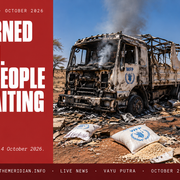
On 4 October 2026, three World Food Programme trucks carrying 18 metric tonnes of food aid were destroyed outside El Fasher, North Darfur. The food was for 23,000 people in Zamzam camp, where the UN has recorded famine since March. The WFP called the attack deliberate. No government has followed that word with action.
On 4 October 2026, a World Food Programme convoy travelling south of El Fasher in North Darfur was struck by armed men in unmarked vehicles. The attack destroyed three trucks carrying 18 metric tonnes of food assistance destined for internally displaced communities in Zamzam camp, where the UN has recorded famine conditions since March 2026. Two WFP contracted drivers were killed. A third was hospitalised. The WFP suspended all convoy operations in North Darfur the following day. In a statement issued on 5 October, WFP Executive Director Cindy McCain described the attack as deliberate and called for an immediate independent investigation. No investigation has been opened.
The 4 October strike is not an isolated incident. Since the outbreak of conflict between the Sudanese Armed Forces and the Rapid Support Forces in April 2023, OCHA has documented 87 attacks on humanitarian assets in Sudan, of which 61 have occurred in Darfur. Those attacks have destroyed or rendered inoperable 134 humanitarian vehicles, damaged or looted 12 warehouses, and killed 23 aid workers. The ACLED conflict database records RSF-affiliated forces as the perpetrating actor in 71% of incidents where attribution was possible. The RSF has denied involvement in each case. The geographic pattern of the attacks, concentrated on supply routes into besieged population centres held by the Sudanese Armed Forces, is inconsistent with incidental contact and consistent with a deliberate strategy of supply interdiction.
The strategic logic of targeting humanitarian convoys in a siege environment is not difficult to reconstruct. El Fasher is the last major city in Darfur not under RSF control. It has been encircled since May 2024. Its civilian population, estimated at between 800,000 and one million people including displaced persons from across the region, is dependent on humanitarian supply lines for food, medicine, and fuel. Every convoy destroyed reduces the operational capacity of the organisations maintaining those lines. Every organisation that suspends operations in response to a security incident reduces the flow of aid into the city. Starvation as a siege instrument does not require the attacker to fire a single shot at a civilian. It requires only that the supply chain be made sufficiently dangerous to operate.
“Starvation as a siege instrument does not require firing a single shot at a civilian. It requires only that the supply chain be made sufficiently dangerous to operate.”
The international response has been shaped less by the evidence than by the geopolitical interests of the states with the most leverage over the RSF. The United Arab Emirates has been identified by the UN Panel of Experts on Sudan as a primary conduit for arms transfers to RSF-affiliated forces, a finding the UAE has rejected. Egypt has maintained engagement with both parties while pursuing its own interest in preventing an Ethiopia-aligned government in Khartoum. The United States has imposed sanctions on RSF commander Mohamed Hamdan Dagalo and several associates but has not moved for Security Council action, in part because any resolution attributing responsibility to the RSF risks a Chinese or Russian veto, and in part because the diplomatic architecture for a Sudan settlement currently involves UAE mediation that Washington has declined to disrupt. The result is that a documented pattern of deliberate humanitarian targeting has produced no accountability mechanism and no change in the trajectory of the conflict.
The humanitarian arithmetic of the 4 October attack should be stated plainly. The WFP is operating in Sudan at approximately 38% of its required funding level. It reaches 4.4 million people per month against a need of 25.6 million people in acute food insecurity, the largest food crisis in the world by absolute number of people affected. The suspension of North Darfur convoy operations removes food assistance from an estimated 340,000 people in Zamzam and Abu Shouk camps, where IPC Phase 5 famine classifications apply. At Phase 5, mortality from starvation and starvation-related disease is occurring. The convoy is not a logistical detail. It is the difference between a population being fed and a population being starved.
The WFP called what happened outside El Fasher on 4 October deliberate. The word matters. Deliberate targeting of humanitarian infrastructure and personnel is a war crime under the Fourth Geneva Convention and its Additional Protocols. It triggers specific obligations for states party to the Rome Statute and potentially activates ICC jurisdiction. It is precisely because the word carries these consequences that it is used carefully by humanitarian organisations and avoided entirely by the governments with the power to act on it. The WFP used it. No government followed. That gap between what the evidence shows and what the international community is willing to name is not a failure of information. It is a political choice. The cost is being paid in Zamzam camp.
Add comment
Comments