The Global South Is the World's Fastest-Growing Region. It Is Also the Most Exposed When Everything Goes Wrong.
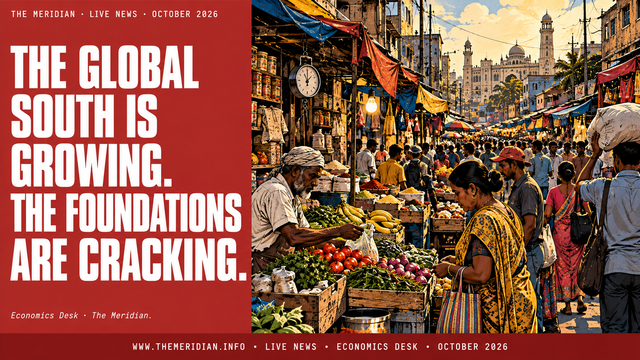
The IMF released its October 2026 World Economic Outlook in Bangkok today. Emerging and developing economies are projected to grow at 3.7 percent in 2026, nearly twice the rate of advanced economies. The IMF calls this resilience. Its own data calls it something more complicated.
The numbers, taken in isolation, make a compelling case for optimism. Emerging market and developing economies are projected to grow at 3.7 percent in 2026, rising to 4.4 percent in 2027. Advanced economies manage 2.1 percent and 1.8 percent respectively. Emerging and developing Asia leads all regions at 5.1 percent. Sub-Saharan Africa posts 4.5 percent. India is projected at 7 percent growth for the coming fiscal year. On the surface, the Global South is the world's growth story. The data says so.
The IMF's own analysis, however, tells a second story alongside the first. That second story is about what the growth is running on, and what happens when the conditions sustaining it change. Global headline growth slows from 3.5 percent in 2025 to 3.1 percent in 2026. EMDE inflation is projected at 5.7 percent, up from 5.2 percent in 2025. Oil is averaging 96 dollars a barrel in 2026, 16 percent above the IMF's own April forecast and 41 percent above 2025 levels. Public debt across emerging and developing economies is on a trajectory from 74 percent of GDP in 2025 to 84 percent by 2031.
These are not peripheral figures. They are the structural conditions underneath the growth headline. And they point in a direction the headline does not.
“Growing fast inside a system designed by and for others is not the same as winning.”
The energy shock is not of the Global South's making. The 2026 Iran war, which began in February after US-Israeli airstrikes killed several Iranian officials including Supreme Leader Ali Khamenei during nuclear negotiations, triggered the largest supply disruption in the recorded history of the global oil market. Iran blocked the Strait of Hormuz. Prices rose sharply. The IMF's baseline assumption, published today, is that shipping through the strait resumes gradually from March 2027 with conditions normalising by October 2027. That is at minimum six more months of elevated energy prices baked into the global forecast. For energy-importing developing nations, which constitute the majority of the Global South, the consequence is wider current-account deficits, weaker currencies, and imported inflation that no domestic policy choice can fully offset.
Natural gas is trading approximately 36 percent above the IMF's April reference price. The households absorbing the downstream cost of these prices did not vote on the decisions that caused them.
On public debt, the trajectory deserves close attention from policymakers across the Global South. The rise from 74 percent of GDP in 2025 to a projected 84 percent by 2031 is ten percentage points of GDP added to the debt burden of the world's developing economies over six years, during a period of elevated interest rates and tightening global financial conditions. The IMF also flags that bank holdings of government securities in low-income countries have risen by approximately 45 percent since the early 2000s. When sovereign debt stress materialises, it moves directly into the banking system, which contracts lending, which contracts growth. That chain has played out in multiple countries in recent years. The forecast trajectory makes it more likely, not less.
“Taiwan and South Korea account for 62 percent of net trade in AI-related computing hardware. The United States and China account for over 75 percent of net imports. The IMF is direct: artificial intelligence is not automatically democratic.”
The IMF's discussion of artificial intelligence in this edition of the World Economic Outlook is, for Global South policymakers, the most consequential section to read carefully. Taiwan and South Korea together account for 62 percent of net trade in AI-related computing hardware. The United States and China together accounted for more than 75 percent of net imports of that hardware in 2025. The IMF is explicit in its language: artificial intelligence is not automatically democratic. Countries outside the existing AI value chain face a specific combination of risks: limited near-term productivity gains from the technology, capital-market volatility linked to AI investment cycles concentrated elsewhere, and higher energy costs driven by data centre demand in countries they do not control. Southeast Asian manufacturing hubs connected to established supply chains may capture some benefit. The majority of sub-Saharan Africa, Central Asia, and the smaller economies of Latin America and the Caribbean are not in that position.
The IMF recommends investment in skills, digital networks, and resilient supply chains. These are correct recommendations. They also require fiscal space that the debt trajectory above is narrowing, year by year.
What the October 2026 World Economic Outlook confirms, taken in its entirety, is that the Global South is simultaneously the engine of global growth and the region most structurally exposed to decisions made in capitals that neither consult it nor bear the full cost of its consequences. A region can lead the world in growth rates while remaining vulnerable to an energy shock triggered by a war it did not start, a debt trajectory shaped by interest rate decisions made in Washington and Frankfurt, and a technology revolution concentrated in two countries and their immediate partners.
The Global South is the world's fastest-growing region. It is also the most exposed when everything goes wrong. Both of those things are true at the same time. The October 2026 World Economic Outlook is evidence for both.
Add comment
Comments