Washington Has Charged Maduro. Again. Venezuela's Oil Is Still Flowing. Again.
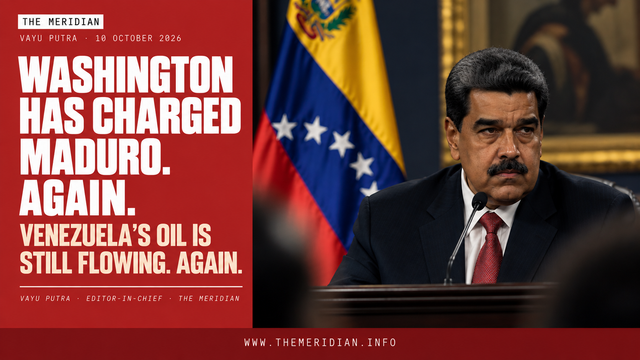
Nicolás Maduro and Cilia Flores are in a detention centre in Brooklyn. The United States Department of Justice has now added conspiracy to commit torture to their charges. The methods listed in the indictment are specific: electric shock, asphyxiation, rape, prolonged isolation, starvation, psychological abuse. Their trial is set for June 2027. The UN says the torture has not stopped. Venezuela's oil is still flowing.
The original indictment against Nicolás Maduro was unsealed in the Southern District of New York in March 2020. The charges were narco-terrorism conspiracy and cocaine importation conspiracy. The allegation was that Maduro and associates had conspired with the FARC to move cocaine through Venezuela toward the United States, using military-protected flights and maritime routes under state protection. The reward for information leading to his arrest was set at $15 million, later raised in stages to $50 million. For four years, the indictment functioned as an instrument of pressure rather than prosecution. Maduro remained in Caracas. The oil kept moving. The reward was never claimed.
In January 2026, US forces carried out a pre-dawn raid on Maduro's compound in Caracas. He was taken into custody and arraigned in Manhattan on 5 January, where he pleaded not guilty. A superseding indictment unsealed the same week added his wife, Cilia Flores — former attorney general and a central figure in the governing apparatus — along with his son Nicolás Maduro Guerra, Diosdado Cabello, and other senior figures in what the DOJ has characterised as a state-backed narco-terrorism structure. Both Maduro and Flores are being held in a detention centre in Brooklyn. The trial is scheduled for June 2027. In the months since, the co-defendant architecture has begun to collapse: Hugo Carvajal, Venezuela's former intelligence chief, pleaded guilty in June 2025; Niño Guerrero, another named defendant, was killed in a targeted strike in June 2026.
On Thursday, the DOJ unsealed a further superseding indictment. The new charge is conspiracy to commit torture. The indictment accuses Maduro and Flores of presiding over “a system of repression that relied on violence against political opposition, arbitrary detention, and the torture of detainees, including United States citizens.” The methods listed are explicit: electric shock, asphyxiation, rape, forced nudity, prolonged isolation, starvation, punishment cells, and psychological torture including threats to kill victims' families. Flores is separately accused of having ordered specific acts of torture and received updates on the condition of individual prisoners — to protect, prosecutors allege, family members implicated in illegal activity. Her request to be transferred to house arrest was denied by the court on Thursday.
“The United States has charged Maduro with narco-terrorism, drug trafficking, and the torture of Americans. He is in a detention centre in Brooklyn. The torture, the United Nations says, has not stopped. Removing the man did not remove the system.”
Maduro's removal from power has not resolved the underlying condition. His former Vice-President, Delcy Rodríguez, was sworn in as interim leader with the backing of the Trump administration, and an amnesty law has since been passed. The Venezuelan parliament reports more than 7,700 people freed under it. The independent prisoners' rights group Foro Penal has been able to confirm fewer than 700 releases; it records more than 500 still held for political reasons. In March 2026, UN High Commissioner for Human Rights Volker Türk told the UN Human Rights Council that his office had received reports of continued torture and mistreatment at the Rodeo 1 and Fuerte Guaicaipuro detention centres — after Maduro's seizure, not before. The Independent International Fact-Finding Mission on Venezuela reported it had continued to receive testimony of human rights violations committed after 3 January. The Venezuelan government called Türk's statement biased and the allegations unfounded.
What the October 2026 charges establish, in addition to their specific legal content, is the distance between what the United States can charge and what it can change. Maduro is in Brooklyn. The repressive architecture he built is in Caracas, still operational under a different name. The oil revenues that funded both the narco-state and the torture apparatus continue to flow. That is not a verdict on the charges, which are serious, specific, and grounded in the accounts of real people subjected to documented abuse. It is simply the situation: a June 2027 trial, a system that preceded Maduro and outlasted his arrest, and the compound question of whether accountability in a Manhattan courtroom constitutes accountability for the country that endured it.
Add comment
Comments