The $3.5 Billion Question: Who Really Built Mauritius?
Since 2011, India, France, China and multilateral banks have channelled more than $3.5 billion into Mauritius in grants, loans and lines of credit. The government calls it strategic partnership. The data reveals something more complicated: 78% is repayable debt, most of it tied to foreign contractors, and the grace periods expire in three years.
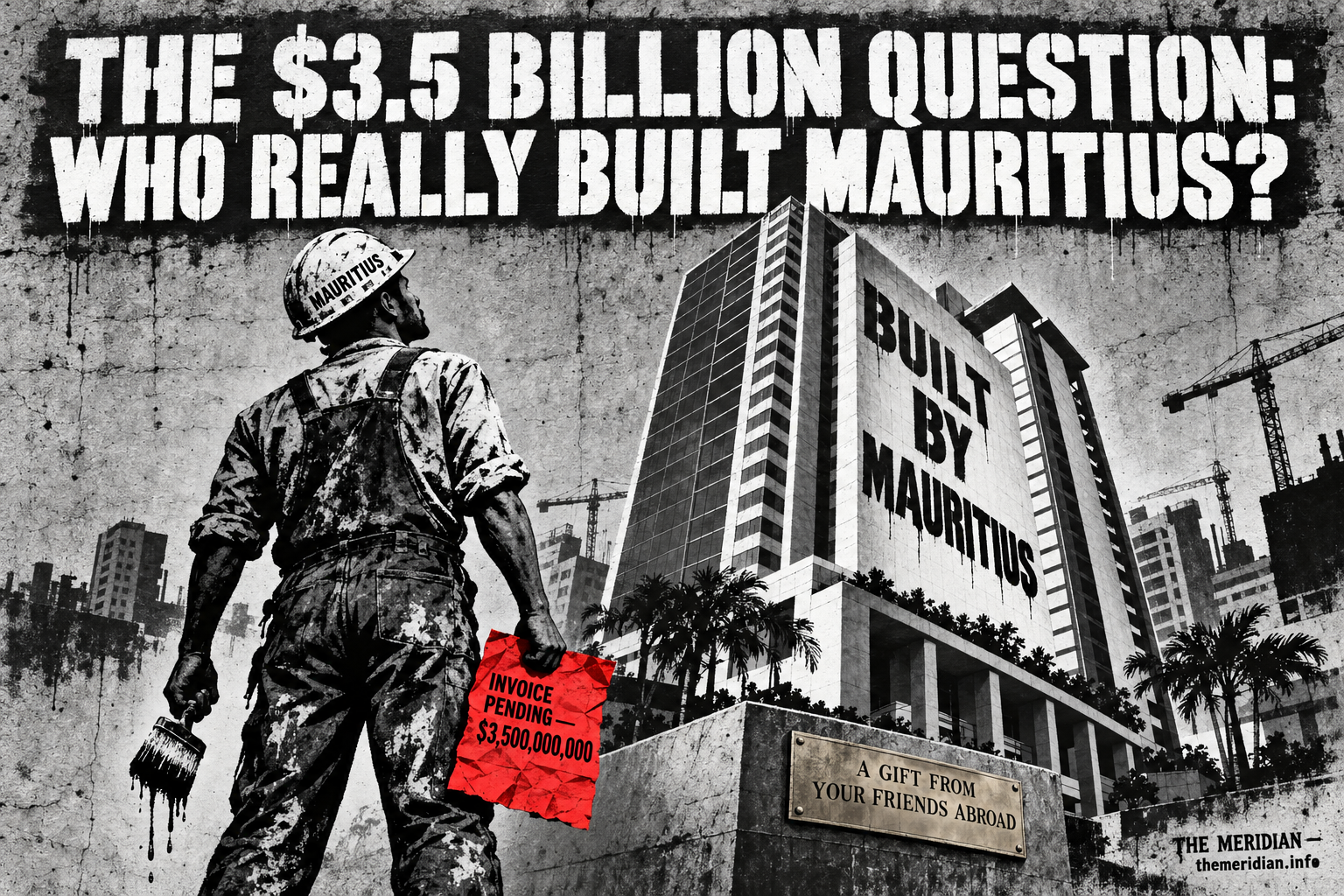
In the official narrative of Mauritian development, the story is one of ambition rewarded. A metro system that runs through Port Louis. A new Supreme Court building on the waterfront. A state-of-the-art ENT hospital in Vacoas. Airport terminals that process international passengers. Motorways under construction. A national hospital, the largest in the country’s history, on the drawing board. The government presents these as the fruits of strategic partnerships forged with friendly nations. That is partially true. What it omits is the other part of the story: who is paying for all of this, on what terms, and what happens when the invoices arrive.
At $3.5 billion over fifteen years, the aggregate figure is large by any measure. For a nation of 1.3 million people, it represents roughly $230 per person per year in external financing. But the figure that matters most is not the total. It is the composition. Of that $3.5 billion, only approximately $780 to $850 million (around 22 per cent) consists of non-repayable grants. The remaining 78 per cent is debt: concessional loans, sovereign lines of credit, and policy financing instruments that carry interest rates, grace periods, repayment tenors and, in most cases, procurement conditions that dictate where the money must be spent.
The Loan Dressed as a Gift
When India announced its $680 million Special Economic Package during the 2025 state visit, the headline dominated coverage for days. The figure was real. But the composition of that package rewards closer reading. Of the $680 million, $215 million constitutes genuine grant funding: the new Sir Seewoosagur Ramgoolam National Hospital, an AYUSH Centre of Excellence, veterinary facilities and maritime helicopters. A further $25 million was disbursed as direct budgetary support, fully deposited into the treasury within the fiscal year. The remaining $440 million, the largest single component of the package, is a Line of Credit through the EXIM Bank of India. It is a loan. It bears interest. It will be repaid.
This pattern is consistent across the entire fifteen-year financing history. India’s 2017 $500 million facility for the Metro Express expansion was a Line of Credit, not a grant. The 2021 $100 million maritime and defence facility was a Line of Credit. The 2024 INR 487 crore (~$58 million) water pipeline replacement was a Line of Credit. The 2016 Special Economic Package, the $353 million facility that built the Metro Express Phase 1, the Supreme Court building, the ENT Hospital and distributed school tablets, was the most significant grant in the bilateral relationship. It was, however, the exception, not the rule. Every major infrastructure line that followed it was, structurally, debt.
“The $680 million headline that dominated coverage concealed a critical detail: $440 million of it is a loan. It will be repaid. With interest. By Mauritian taxpayers.”
France’s contribution tells a similar story. The Agence Française de Développement provided a €300 million sovereign loan in 2020 to support emergency COVID-19 fiscal management. A €200 million public policy loan followed in 2023 for the Central Water Authority pipeline overhaul. Both carry EURIBOR-linked interest margins, commitment fees, and repayment tenors spanning fifteen to twenty years. The African Development Bank’s €188 million 2020 COVID-19 rapid facility was similarly structured. China’s $264 million airport expansion financing, channelled through the Export-Import Bank of China, was a preferential buyer’s credit, a commercial instrument with a subsidised rate. Of the major bilateral and multilateral flows into Mauritius since 2011, the genuinely free money is the minority share. The rest is the national debt, denominated in euros and dollars, accumulating silently behind the ribbon-cutting ceremonies.
The Tied-Aid Trap: 75 Cents on the Dollar Goes Home
The debt dimension of this story is significant. The procurement dimension is, in some respects, more revealing. When India extends a Line of Credit to Mauritius through the EXIM Bank under the Indian Development and Economic Assistance Scheme (the IDEAS framework that governs most bilateral infrastructure financing), the terms include a mandatory domestic content requirement. A minimum of 75 per cent of the total contract value must be procured from Indian suppliers, contractors and service providers. A statutory relaxation is available for civil construction-intensive projects, lowering the threshold to 65 per cent. Engineering, Procurement and Construction contracts are restricted to Indian EPC conglomerates. Larsen & Toubro managed the Metro Express. RITES Ltd operates in the rail and transportation space. Mauritian firms are eligible for subcontracts within the remaining non-Indian quota.
The arithmetic is direct. When India lends Mauritius $500 million, approximately $375 million of that sum is contractually required to flow back to Indian firms as payment for goods, engineering and construction services. The loan stays in Mauritius as infrastructure. The money moves to India as revenue. This is not a development partnership in the conventional sense. It is a subsidised export credit facility, with public infrastructure as the commercial invoice.
China’s financing structure operates on similar logic. Preferential export buyer’s credits from the Export-Import Bank of China require that primary EPC contracts be awarded to Chinese state-owned enterprises. China State Construction Engineering Corporation and Beijing Construction Engineering Group have participated in Mauritian projects, with 50 to 70 per cent of plant machinery, equipment and structural components sourced from mainland China. The Bagatelle Dam, financed under Chinese credit, was built by China International Water and Electric Corporation. The SSR International Airport terminal expansion, funded by a $264 million EXIM Bank of China facility, was similarly structured. When cost overruns at Bagatelle Dam nearly doubled the contract value, from an initial Rs 3.3 billion to over Rs 6.5 billion due to geotechnical complications and deep foundation redesigns, it was Chinese variation orders, not Mauritian procurement oversight, that drove the escalation.
France stands as the notable exception. AFD sovereign loans follow OECD Development Assistance Committee untied aid standards. Procurement is open to international and local competitive bidding, supervised by the Mauritian Central Procurement Board with AFD non-objection clearances. There are no nationality conditions on contractors. The money lent by France can, in principle, be spent on any qualified firm that wins a transparent tender. This is structurally different from the Indian and Chinese facilities, and it deserves to be noted as such.
“Of the three largest bilateral creditors, only France imposes no nationality condition on how its loans are spent. India requires 75% back to Indian firms. China requires 50–70% back to Chinese firms. The infrastructure stays in Mauritius. The revenue leaves.”
The Legal Architecture of Dependency: The G2G Exemption
Mauritius has a functioning public procurement law. The Public Procurement Act 2006 mandates open advertised bidding through the Central Procurement Board for all major public works contracts exceeding statutory thresholds. Competitive tendering, transparency, non-discrimination: these are the statutory defaults. They are also, under bilateral credit arrangements, frequently bypassed.
Section 3(b) of the PPA contains a Government-to-Government exemption clause. Procurements undertaken pursuant to an agreement between Mauritius and a foreign state that allows Mauritius to benefit from the expertise of that foreign state in a particular field are explicitly excluded from standard CPB competitive tendering. Under this clause, procurement carried out directly through a foreign state agency, such as RITES or L&T designated under Government of India agreements, proceeds without the competitive tender process that the PPA was designed to mandate. Section 4 reinforces this architecture: when an international financing treaty contains procurement provisions that conflict with local law, the bilateral agreement prevails.
The practical consequence is that the largest infrastructure contracts in Mauritian history, namely the Metro Express, the airport expansion, the water pipeline replacement and the new national hospital, have been awarded, or are being awarded, under frameworks that bypass the Mauritian procurement system entirely. The Central Procurement Board, the institution through which Mauritian civil society and business community exercise oversight over public spending, is structurally excluded from these transactions. This is not illegal. It is precisely how the system was designed to work. But it means that Mauritius has written its own procurement law around bilateral dependency, exempting the largest public expenditures from the competitive scrutiny that the law was designed to provide.
The 2027–2030 Reckoning
The full weight of fifteen years of concessional debt has not yet been felt. Most of the major facilities extended between 2017 and 2021 carried grace periods of five to seven years, during which only interest, not principal, was due. Those grace periods are expiring. Between 2027 and 2030, Mauritius enters a phase of accelerated debt service on its external obligations that will be unlike anything it has faced in the post-independence era.
| Year | Estimated Total Service (USD Equiv.) |
|---|---|
| 2027 | ~$150 Million |
| 2028 | ~$185 Million |
| 2029 | ~$205 Million |
| 2030 | ~$190 Million |
Debt service on sovereign external obligations is projected to reach approximately $205 million per year at its 2029 peak, before declining modestly into 2030 as some facilities mature. This is not an unmanageable figure for a country with Mauritius’s reserve position. But it is a structural constraint that will arrive precisely when the flagship projects of the 2025 Special Economic Package are still under construction. The new SSR National Hospital, the single largest grant asset in the package, has a projected completion date of 2029 to 2030. The M4 Motorway and Ring Road Phase II are expected in 2028 to 2029. The airport ATC tower targets 2027. Mauritius will be paying peak debt service, in euros and dollars, on borrowed money, while the infrastructure that money is meant to deliver is still being built.
The Chagos Calculation
The Mauritius government has identified a structural mechanism to manage this debt-service trajectory. Under the fiscal strategy embedded in the Medium-Term Budget Framework, all revenues received from the Chagos Archipelago, being the lease fees and financial receipts arising from the historic treaty settlement concerning the islands, are statutorily earmarked for the accelerated repayment of public external debt. These receipts serve as a direct foreign currency offset against the euro- and dollar-denominated liabilities accrued through the development financing programmes described in this article.
This deserves to be stated plainly. Mauritius spent decades asserting sovereignty over the Chagos Archipelago. The assertion was legally correct, morally grounded, and ultimately successful. The financial flows arising from that sovereignty have now been designated as a debt-repayment instrument for the infrastructure loans extended by India, France and the multilateral banks. The strategic asset that Mauritius won through persistent diplomatic and legal struggle is, in the first instance, a mechanism for servicing the debt incurred while that struggle was ongoing. Whether this represents sound fiscal management or a troubling recursion, with sovereignty funding the debt incurred in building what sovereignty was supposed to be able to fund itself, is a question for Mauritians to answer.
The Paradox of the Full Reserve Tank
There is one further dimension of this story that resists easy resolution, and it concerns the Bank of Mauritius. As of June 2026, Mauritius holds Gross Official International Reserves of $10.3 billion, a record high. This represents 14.3 months of import cover, almost five times the international safety threshold of three months. The central bank’s benchmark Key Rate stands at 4.75 per cent, its highest since 2013. The BOM has sold $289 million in foreign exchange interventions to stabilise the rupee against structural import pressures. By every conventional measure of external solvency, Mauritius is in an exceptionally strong position.
And yet, in 2024, the government borrowed INR 487 crore (approximately $58 million) from the State Bank of India under a concessional credit line to replace 100 kilometres of deteriorating water distribution pipes. In 2025, it borrowed $440 million from the EXIM Bank of India to build a motorway, upgrade the airport’s air traffic control tower and procure cargo cranes for Port Louis harbour. A country sitting on $10.3 billion in reserves is borrowing, at concessional rates, to fix its own water network.
The explanation lies in the structure of those reserves. Mauritius is home to one of the world’s most active offshore financial centres. Its gross external liabilities routinely exceed 1,000 per cent of GDP because of non-resident assets, Global Business Companies and Special Purpose Entities domiciled within the Mauritius International Financial Centre. The $10.3 billion in reserves is not entirely available sovereign wealth. A significant portion reflects obligations to non-resident entities operating within the offshore structure. The sovereign public external debt, being the debt the government actually owes, represents only 22 to 25 per cent of total public liabilities. The state is sovereign-solvent but domestically constrained: it cannot easily mobilise the offshore liquidity that makes its reserve figures impressive, and it faces domestic capital markets that are not deep enough to absorb multi-hundred-million-dollar infrastructure programmes without crowding out other borrowers.
This structural reality does not excuse the terms of the financing that fills that gap. It explains why the gap exists. The tied-aid procurement conditions, the G2G exemption from competitive tendering, the 78-cent debt ratio: none of these are consequences of the reserve paradox. They are political choices, made over fifteen years of bilateral negotiation, that have produced a specific architecture of dependency alongside the infrastructure it funded.
The Verdict
The question posed by this data is not whether Mauritius has been built. It has been. The metro runs. The courts sit. The hospital treated patients in Vacoas. The airport handled 3.5 million passengers last year. The infrastructure exists, and it has genuine public value. The question is who sent the invoice, on what terms, and what has been traded in the process of accepting it.
The answer, constructed from fifteen years of financing records, is this: Mauritius has built its public infrastructure primarily on foreign debt, with procurement conditions that directed the majority of that debt back to the contractors of the lending countries, through legal exemptions that bypassed its own procurement law, with a strategic sovereign asset now earmarked to service the accumulated obligations, and with the most significant repayment cliff still ahead. India is owed the most. France lent on the fairest terms. China built the most problematic projects. And the Mauritian taxpayer, across all of these arrangements, holds the liability that none of the ribbon-cutting ceremonies mention.
None of this makes Mauritius exceptional among small island developing states. It makes Mauritius typical. What would make it exceptional is a national conversation, grounded in the actual numbers, about what kind of infrastructure financing it wants for the next fifteen years, and whether the terms of the last fifteen are the terms it would choose again.
The question is not whether Mauritius has been built. It has. The question is whether a nation that cannot build its own hospital without a foreign loan, and whose procurement law was rewritten to exempt those loans from competitive tendering, can call itself the architect of its own development.
The Meridian · Investigative · October 2026This analysis draws on primary source documents including the Mauritius Public Procurement Act 2006 (as amended 2026), the IDEAS Scheme Guidelines (Government of India / DEA), the Bank of Mauritius Financial Stability Report (June 2026), the Ministry of Finance Medium-Term Budget Framework 2026–27, EXIM Bank of India LoC brochures and tender documentation, AFD project disclosures, AfDB project appraisal documents, the Indian High Commission in Mauritius bilateral brief, the Prime Minister’s Office Cabinet Decision releases, the AidData China Research Portal, Reuters, and KPMG Mauritius Budget Highlights. All figures stated are best available approximations based on publicly disclosed data; exchange rate conversions are indicative. The Meridian welcomes responses, corrections and additional documentation from government bodies, bilateral partners and civil society organisations.
© 2026 The Meridian · themeridian.info · All rights reserved.
Reproduction, redistribution or republication of this article, in whole or in part, without the express written permission of The Meridian is strictly prohibited.
Add comment
Comments