The Rentier Trap: How Mauritius Borrowed Its Way to Prosperity and Is Now Paying the Price
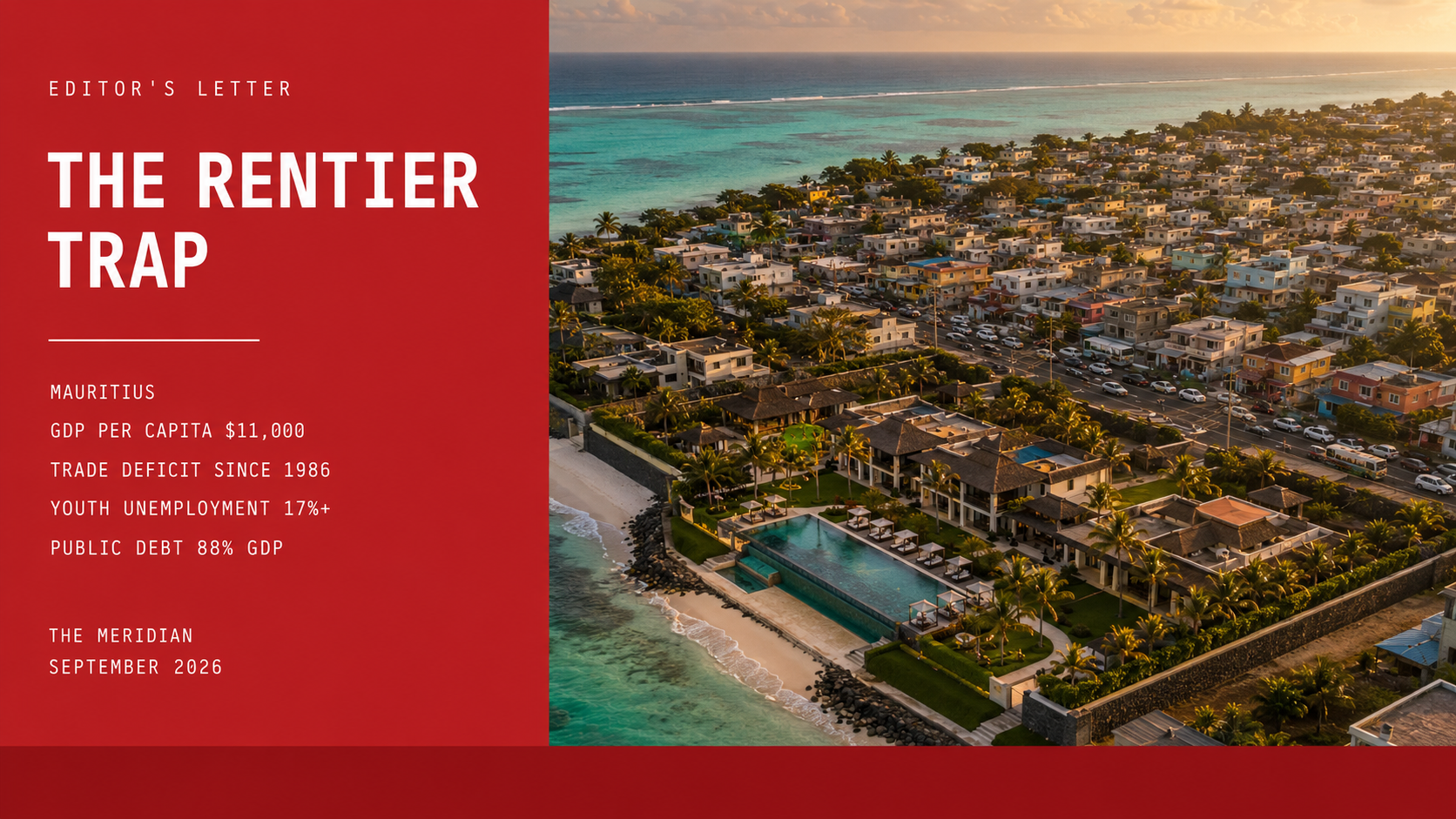
Start with the standard account. Mauritius built its prosperity from nothing: no natural resources, no strategic geography, no significant domestic market. Three sequential rent transitions delivered real wealth. The World Bank cited it as a model. The Mo Ibrahim Foundation ranked it first in Africa on governance. The standard account is not wrong. But it stops at the achievement and does not examine the structure underneath it. When you examine that structure, a different picture emerges: not of failure, but of a model whose logic contains the conditions of its own fragility. This edition examines that structure. We call it the Rentier Trap.
The first rent was textiles and sugar. Preferential access agreements with Europe, the ACP-EU Sugar Protocol, and Multi-Fibre Arrangement quotas gave Mauritian exports a price guarantee that the global market would never have produced on its own. The revenues built the state, educated a generation, and laid the institutional foundations for what came next. But they depended entirely on external price guarantees that other countries were negotiating, not Mauritius. When those guarantees ended, which they did, the textile sector contracted and the sugar industry restructured from twenty-five mills to six. The island moved on. That capacity to move on is the part that gets celebrated. What gets less attention is what moving on required: a new rent, sourced externally, governed by conditions the island could not set.
The second rent was tourism. Mauritius positioned itself at the luxury end of the global leisure market. The strategy worked: high-spending visitors, rising receipts, strong brand recognition. Tourism grew to roughly twenty per cent of GDP. But tourism is a discretionary rent. People choose to come when geopolitical conditions are stable, aviation fuel is affordable, and the global economy is generating discretionary income. The rupee is now at a record low of over Rs 47 per dollar. Aviation fuel surged 74 per cent in two months in mid-2026. Tourist arrivals from core European markets declined. None of those conditions are governed from Port Louis.
The third rent was offshore financial services. Mauritius built a treaty network that made it the routing jurisdiction of choice for investment into India and sub-Saharan Africa. The offshore sector contributes approximately 5.8 per cent of GDP, according to the Financial Services Commission of Mauritius (2023/24). But offshore finance is war-fragile and politically exposed. The G20 tax transparency agenda, the FATF review cycle, and bilateral treaty renegotiations all represent external conditions over which Mauritius has no structural leverage. The island is a price-taker in the market for financial architecture, as it was in the market for textile quotas and sugar premiums four decades earlier.
Three sequential rent transitions. Each delivered real wealth. Each left the island more structurally dependent on external conditions it could not control. Each prevented the accumulation of the one thing that would have altered the structural position: an export manufacturing base whose price is set by the cost of production, not by the discretion of buyers, the policies of foreign governments, or the tolerance of international institutions for small-island tax architecture.
The cost structure of the ordinary Mauritian household is not discretionary. Mauritius imports more than eighty per cent of its food and nearly all of its energy. The price level is set in Rotterdam, Dubai, and Johannesburg. When the rupee depreciates, the cost of living rises directly. There is no offsetting export stimulus, because there is no export manufacturing base to stimulate. The central bank holds instruments designed for demand-pull inflation. The inflation Mauritius is experiencing is cost-push, imported, and structurally embedded. The instrument does not fit the problem. This is what The Meridian has called the Import Dependency Trap: a state that imports its price level cannot conduct sovereign monetary policy, regardless of its formal institutional independence.
The fiscal position compounds the structural picture. Public debt stands at approximately eighty-eight per cent of GDP. The current account deficit runs at 5.9 per cent of GDP and is widening. Youth unemployment sits above seventeen per cent in an economy that has built no manufacturing sector to absorb graduates, and a service sector designed for foreign capital and foreign tourists at the apex and low-skill hospitality labour at the base. The universities produce graduates. The economy does not produce the roles those graduates were trained to occupy. Three thousand five hundred Mauritians emigrate annually. Sixty-three thousand foreign workers are employed in Mauritius simultaneously. The island is exporting its human capital and importing its labour force. The mechanism that produces this outcome is not a policy failure. It is a structural feature of a rent-dependent economy operating at the threshold of its model.
The Rentier Trap is not a prediction of collapse. It is a diagnosis of a condition. The condition is treatable. Whether it will be treated is a political question, not an economic one.
This edition uses three comparative cases to examine what rent-dependent economies do at the structural threshold. Dubai engineered its own exit from oil dependency before the oil ran out. It used resource rents to build logistics infrastructure, a financial centre, and a tourism destination that would generate revenue without the resource. The process was costly, authoritarian, and required a set of geopolitical and financial conditions that very few smaller economies can replicate. But the exit was real: Dubai today generates most of its revenue from non-oil sources. The trap was avoided.
Iran is the case where the trap closed. Hydrocarbon rents concentrated in state institutions without being converted into productive diversification. Sanctions accelerated a structural failure that predated them. The currency collapsed. Inflation became structural. The economy now operates on parallel market mechanisms that substitute for rather than replace the formal economy. The lesson from Iran is not that sanctions cause rentier failure. It is that rentier failure creates the conditions under which any external shock becomes catastrophic.
Mauritius is neither Dubai nor Iran. It is at the threshold. The offshore sector faces mounting pressure from G20 transparency initiatives. Tourism is exposed to aviation costs, geopolitical disruption, and climate risk simultaneously. The fiscal space accumulated over years of growth is narrowing at precisely the moment it is needed most. The window for structural transition is open. It is also clearly narrowing. What distinguishes Mauritius from Iran is the political system. What distinguishes it from Dubai is the absence of the resource revenue that financed the transition. The question is whether the political economy can produce the structural reforms that the transition requires before the window closes.
The Essential-Discretionary Rent Hierarchy. Rents from essential goods are war-durable. Rents from discretionary services are geopolitically fragile. Mauritius's rent stack is weighted entirely toward the fragile end.
The Import Dependency Trap. A state that imports its price level cannot conduct sovereign monetary policy. Rupee depreciation raises costs without delivering the export stimulus it is supposed to produce.
The Double Extraction Mechanism. Foreign capital extracts value at entry via concession, at operation via profit repatriation, and at exit via currency conversion under depreciation. The host economy bears the externalities of all three stages.
The IRS Villa FX Arbitrage Mechanism. The Integrated Resort Scheme converts rupee-denominated land into dollar-denominated capital, compressing foreign exchange availability for productive imports while inflating real estate for domestic buyers.
The Human Capital Displacement Model. A rent economy requires low-skill labour at the base and foreign high-skill workers at the apex. Domestic graduates are systematically displaced toward emigration or underemployment.
The Price Sovereignty Theorem. A state that cannot set prices in its own currency for essential goods does not possess meaningful economic sovereignty, regardless of its formal political independence.
This edition of The Meridian publishes fifteen articles across four layers. The first layer examines the Rentier Trap directly: the structural history of the Mauritian model, the Import Dependency Trap, the Double Extraction Mechanism, and the human cost of an economy that systematically displaces its own graduates. The second layer examines the three comparative cases in full. The third layer publishes intelligence briefs on developments that matter to the Global South this month: Russia's demographic fracture and its supply chain consequences, Zambia's re-election under Hichilema, the Mecca Joint Defence Agreement, the widening AI capability gap and the launch of WAICO, Canada's publicly owned pipeline decision, and the European summer heat emergency. The fourth layer publishes two analytical essays: one on the end of cheap labour arbitrage as a global structural force, and one engaging with Brookings Institution Hutchins Center Working Paper 112 on the unexplained rise in the neutral interest rate, which The Meridian argues is not unexplained at all.
The Brookings paper, authored by Christensen and Rudebusch in August 2026, finds that none of the three leading explanations for the approximately one percentage point rise in the neutral rate since 2020, namely fiscal debt expansion, AI-driven productivity, and monetary policy recalibration, adequately accounts for the observed increase. The cause is described as analytically open. The Meridian's argument is that the cause the paper did not look for is the structural repricing of global production costs as the cheap labour arbitrage era ends. That argument is developed in full in the analytical essay published alongside this edition.
Mauritius borrowed its prosperity in the sense that it built an economic model on rents it did not control, in currencies it did not print, at prices it did not set, through institutions whose rules it did not write. The borrowing was not irresponsible. It was rational given the options available to a small island with no natural resources and no strategic geography at the moment of independence. The rent transitions were real. The prosperity was real. The institutions that were built with the proceeds of each transition were real and in many cases genuinely good.
What was not built was a productive base that generates value independently of external rent conditions. What was not accumulated was monetary sovereignty over the price level of essential goods. What was not retained was the human capital the state educated, which the economy could not absorb at the level at which it was trained. These are not moral failures. They are structural outcomes of a model that optimised for the available rent and did not build the exit from rent-dependency that would have required forgoing the rent in the short term in order to change the structural position in the long term.
The window is open. It is also clearly narrowing. September 2026 is the edition that shows you exactly where the threshold is, what crossing it requires, and what the comparative record says about the probability of getting it done in time.
Add comment
Comments