The Island That Borrowed Paradise: How Mauritius Chose Its Economic Model and Who Won
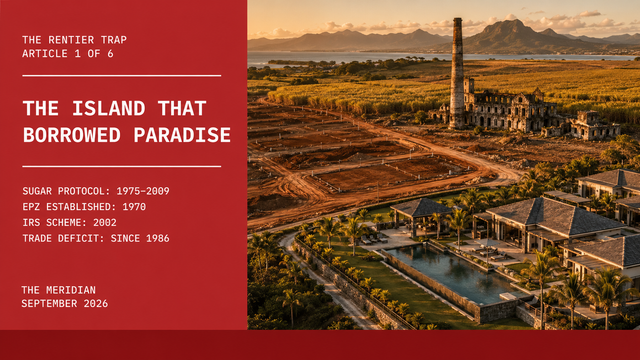
The standard account of Mauritius's economic miracle asks how the model worked. The more important question is who chose it, on whose behalf it was designed, and which interests it was built to protect. The evidence across three sequential rent transitions points to a consistent answer. Each transition required the least possible transformation of the ownership structure already in place. The miracle, examined from below, looks rather different than it does from above.
In 1961, the British Nobel laureate economist James Edward Meade delivered his report to the Governor of Mauritius. Published as Sessional Paper No. 7 of 1961, it concluded that the island faced a Malthusian trap: a population that had grown from 419,000 in 1944 to 640,000 by 1961, concentrated on a single crop, with no identified alternatives and no prospect that any plausible rate of economic expansion could generate sufficient employment to improve living standards. The report examined the labour market, the prospects for agricultural and industrial development, the financial system, and the education system. It did not examine the ocean. The Exclusive Economic Zone surrounding Mauritius, which covers 2.3 million square kilometres of some of the most biologically and mineralogically significant waters in the Indian Ocean, does not appear in the analytical framework of the 1961 report. This absence was not careless. It was categorical. The colonial economic framework classified Mauritius as a sugar island. Everything that followed accepted that classification.
The ACP-EU Sugar Protocol, which came into force in 1975 under the first Lome Convention, guaranteed Mauritius preferential access to the European market at approximately twice the world price. The arrangement delivered, according to The Meridian's August 2026 analysis, approximately four billion euros to Mauritius over the thirty years of the protocol's operation. By the height of the sugar economy, 85 per cent of the island's arable land was planted with cane and twenty-five mills were in operation. The question the development economics literature rarely poses about this period is not whether it created prosperity. It did. The question is who held the asset that the prosperity was extracted from.
The answer is the Franco-Mauritian estate-owning class: descendants of the French colonial settlers and sugar planters who had held the land since the eighteenth century and retained it through British colonialism and into independence. The ACP-EU Sugar Protocol did not alter the ownership structure of the Mauritian sugar economy. It monetised it, at twice the world price, for thirty-four years, through a legal arrangement negotiated between the European Community and the post-colonial government of Mauritius. The estate owners did not need to transform their asset. They needed only to maintain it and collect the rent.
When the protocol ended in 2009, following the European Commission's reform of its sugar regime, the world price of sugar, which the protocol had insulated the Mauritian industry from, became the operative price. It fell 36 per cent relative to the guaranteed level. Twenty-five mills became six. The small planters who had grown cane on leased land from the estates found their margins destroyed. The consolidation that followed transferred productive capacity upward, to the larger operators who could absorb the price collapse. The land itself remained. What changed was what it was used for.
The Mauritius Export Processing Zone was established in 1970. Its intellectual origin is documented in the academic literature: Sir Edouard Lim Fat, a Sino-Mauritian businessman born in 1921, is credited across multiple sources, including the academic literature published by ResearchGate and Academia.edu on the history of the MEPZ, as the pioneer of the scheme. The model was drawn directly from the Kao-Hsiung Export Processing Zone in Taiwan, established in 1965, which Sir Edouard Lim Fat had studied. The MEPZ was not a recommendation of the Meade report. It was a proposal from a member of the Sino-Mauritian mercantile community who understood the Taiwanese model and saw its application to the Mauritian employment problem.
The fiscal architecture of the EPZ is recorded in the BIZWEEK analysis of Mauritius's development strategy, citing the Meade report Section 2:22 as implemented by subsequent policy: complete exemption from corporate tax for the first ten years, 50 per cent exemption for years eleven to fifteen, and 25 per cent exemption for years sixteen to twenty. The first companies to establish in the zone were predominantly textile and garment manufacturers from Hong Kong, Taiwan, and Singapore. The Franco-Mauritian estate class provided land. The Sino-Mauritian mercantile class provided the entrepreneurial architecture and local commercial networks. Asian capital, attracted by the tax holiday and preferential European market access under successive Lome Conventions, provided the investment. Within the first months of operation, five factories and more than 500 workers were in the zone.
The EPZ worker received employment. That is not a trivial benefit: the EPZ years of the 1970s and 1980s drove a significant reduction in unemployment and, crucially, drew women into the formal labour force in large numbers. The demographic consequences were real: Mauritian fertility rates fell sharply as women entered paid work, breaking the Malthusian trajectory Meade had identified. The EPZ was, as one subsequent analysis described it, "not merely an employment programme. It was a demographic intervention of the first order." These gains were genuine and their importance should not be minimised. But the distribution of the gains was not equal. The tax holiday structure transferred fiscal cost to the public budget. The wage structure was set by the EPZ framework, not by collective bargaining. The profit was repatriated by the foreign investor. The land was rented from, or originally owned by, the estate class. The model served everyone involved. It served some considerably more than others.
The Integrated Resort Scheme, established in the early 2000s, was the third act of the same underlying logic. Sugar land that had lost its ACP-EU price guarantee needed a new use. Coastal land that had supported the EPZ's supporting infrastructure needed a new revenue stream. The IRS provided it: foreign nationals were permitted to purchase Mauritian property, obtain residence rights, and bring their capital. The legal architecture required minimum investment thresholds that placed IRS property beyond the reach of the domestic market while remaining attractive to European, South African, and Asian buyers of premium island real estate.
The Economic Development Board of Mauritius records Rs 152 billion in foreign real estate investment channelled through the IRS and subsequent schemes since 2006. Mauritian nationals account for 9 per cent of acquisitions. The remaining 91 per cent of acquisitions represent foreign capital purchasing Mauritian land, obtaining Mauritian residency, and converting rupee-denominated assets into dollar or euro-denominated ones. Property prices rose 80 per cent over the two decades of the scheme's operation. Wages rose 20 per cent over the same period. The IMF, in its 2025 Article IV consultation with Mauritius, flagged the gap between property price inflation and wage growth as a source of structural inequality. The mechanism that produced the gap is the IRS. The beneficiaries of the mechanism are the landholders who were in a position to sell into it.
Each transition was the rational response to the available rent at the moment of choice. Each also required the least possible transformation of the asset base already held by those who made the choice. This is not a coincidence. It is the political economy of the model.
What connects these three transitions is not merely the pattern of who benefited. It is the analytical frame that made each choice appear to be the only available choice. The Meade report of 1961 categorised Mauritius as an island with a population problem, a sugar monoculture, and no identified alternatives. The EEZ was not in the frame. The ocean was not in the frame. The islands of the Mauritian archipelago were not in the frame. The wind, the currents, and the maritime geography of a state that controls 2.3 million square kilometres of ocean were not in the frame. The EPZ was proposed as the response to a problem that the frame defined. The tourism model was proposed within the same frame. The IRS was proposed within the same frame. Each was the most efficient solution to the problem as the frame specified it.
The colonial economic framework of 1961 did not merely describe Mauritius. It prescribed what Mauritius was permitted to see as its own resource base. That prescription was not revisited by the development economists, the international financial institutions, or the domestic policy class that administered the subsequent transitions. The Meade report was published as Sessional Paper No. 7 of 1961 by the authority of the Mauritius Legislative Council. It guided, as the BIZWEEK analysis of Mauritius's development trajectory records, two generations of Mauritian policymakers. What it guided them away from is the analytical question this series is asking.
Transition 1 / Sugar Protocol (1975-2009). The asset was land, held by the Franco-Mauritian estate class since the colonial period. The rent was the European price premium, set by negotiators in Brussels, not in Port Louis. The protocol ended in 2009 when the European Commission reformed its sugar regime. Twenty-five mills became six. The land remained with the estate class.
Transition 2 / Export Processing Zone (1970 onwards). The model was Taiwanese, proposed by a Sino-Mauritian businessman. The investment was Asian. The fiscal cost was borne by the Mauritian public budget through ten-year full tax exemptions. The profit was repatriated. The worker received employment at EPZ wage rates. The estate class received land rent. The Sino-Mauritian mercantile class received commercial commission and logistics revenue.
Transition 3 / Integrated Resort Scheme (early 2000s onwards). The asset was again land, now coastal. The buyer was foreign. Rs 152 billion in foreign real estate investment entered since 2006. Mauritian buyers accounted for 9 per cent of acquisitions. Property prices rose 80 per cent. Wages rose 20 per cent. The mechanism converted rupee-denominated land into dollar-denominated capital and transferred the fiscal benefit of residency rights to foreign purchasers.
Mauritius has not recorded a trade surplus since 1986. Statistics Mauritius and Bank of Mauritius data confirm this without ambiguity. The Ministry of Finance projects the merchandise trade deficit at 10.7 per cent of GDP for the fiscal year 2025/26. This is the arithmetic consequence of building an economy on rents from external buyers rather than on productive export of manufactured or processed goods. The EPZ produced textile exports through the 1970s and 1980s, but the textiles were manufactured by foreign capital, assembled by Mauritian labour, and repatriated as profit to Hong Kong, Taiwan, and Singapore. The export revenue passed through Mauritius. The productive capacity did not accumulate here.
The pattern of the trade balance is the structural verdict on the three transitions. An economy that exported sugar at guaranteed European prices, then assembled foreign textiles under EPZ concessions, then sold coastal land to foreign buyers under IRS terms, is an economy that has consistently specialised in providing access to its assets rather than building the productive capacity to price those assets on its own terms. The trade deficit since 1986 is not a policy failure. It is the predictable arithmetic of a model whose logic was never oriented toward building a manufacturing export base, because the interests that chose the model had no need of one.
The development economics literature on Mauritius asks why the miracle worked. The Meridian's question is different: for whom did it work, by what mechanism, and whose interests defined the available choices at each transition point? The evidence assembled in this article does not support the conclusion that the model was designed as a deliberate instrument of class reproduction. It supports something more mundane and more durable: that the model chosen at each transition was the one that required the least transformation of the asset base held by those who had the political and economic leverage to shape the choice.
The Franco-Mauritian estate class did not need to change what they owned to extract the sugar rent. They needed only the protocol. The Sino-Mauritian mercantile class did not need to build new industrial capacity to benefit from the EPZ. They needed only the tax holiday and the foreign investor. The same land that produced sugar at European prices was eventually sold at European prices to European buyers through the IRS. The colonial frame that made the ocean invisible in 1961 was never officially revised. It did not need to be. The people who could have revised it were doing well enough within it.
The trade deficit since 1986 is not evidence that the model failed. It is evidence of what the model was for.
Add comment
Comments