Youth Without a Future: How Mauritius Exports Its Graduates and Imports Its Workers
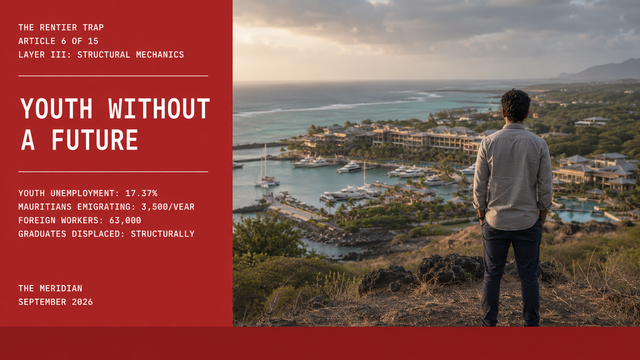
In the first quarter of 2026, Statistics Mauritius recorded 12,100 unemployed youth between the ages of 16 and 24, representing 36 per cent of all unemployed persons in the economy. In the same economy, 63,000 foreign workers are employed. The two facts coexist not because the economy lacks jobs but because the jobs the economy generates do not match the people it has trained. The Meridian examines why the mismatch is structural, not cyclical, and what the model that produced it was designed to do.
The standard account of youth unemployment treats it as a transitional problem: graduates enter the labour market, spend some months finding positions appropriate to their training, and the rate normalises. The World Bank's Youth Development Indicators record Mauritius's youth unemployment rate at 17.37 per cent in 2025, based on ILO methodology, with the rate having averaged above 16 per cent for three consecutive years. At its peak in 2021 it reached 25.37 per cent. The rate has not normalised. It has oscillated within a band that reveals a structural floor, not a transitional friction. When youth unemployment runs at three times the overall rate for more than a decade, with 63,000 foreign workers simultaneously employed in the economy, the explanation is not that graduates are between jobs. The explanation is that the economy was not built to employ them.
The three rent sectors that define the Mauritian economy each require a specific labour configuration. Tourism, which contributes approximately 20 per cent of GDP, requires low-skill hospitality workers at the operational base: room attendants, kitchen staff, restaurant servers, groundskeepers, drivers. These roles are filled substantially by foreign workers, particularly from Asia, who accept rupee wages that domestic workers at equivalent education levels decline. At the management apex, five-star international hotel chains typically place expatriate general managers, revenue managers, and food and beverage directors from their global talent pools, on packages denominated in euros or dollars. The Mauritian worker occupies the positions in between, primarily front-of-house and supervisory roles, at rupee wages that the tourism revenue model can sustain without significantly expanding the Mauritian middle class.
The offshore financial services sector, which contributes 5.8 per cent of GDP according to the Financial Services Commission's 2023/24 data, is structured similarly at the apex. The fund administrators, compliance officers, and senior relationship managers servicing the offshore vehicles that route investment into India and sub-Saharan Africa are typically imported: Mauritians with international financial qualifications and global networks from London, Singapore, or Hong Kong. Below the apex, the sector employs local administrative staff, paralegal support, and accounting personnel at domestic salary levels. The mid-tier professional roles that absorb graduates in mature financial centres, those of the associate analyst, the junior portfolio manager, the research economist, are structurally undersupplied in a sector whose client base is external and whose value chain is routed through the island rather than generated within it.
A Mauritian graduate with a degree in business, law, economics, or technology is positioned structurally between the two levels that the economy has built. They are overqualified for the hospitality base, which the labour market fills with foreign workers at lower cost. They lack the specific global professional network and international credential that the offshore apex imports. The construction sector, which is significant in the Mauritius economy given the IRS development pipeline, employs foreign workers at the operational level. The manufacturing sector, which produced graduate-absorbing mid-tier employment in the EPZ era, has contracted to a residual share of the economy.
The World Bank's 2020 poverty and equity note on Mauritius found that 21 per cent of 351,000 Mauritian youth aged 16 to 35 were NEET: not in education, employment, or training. Of NEET youth, approximately 70 per cent were women, reflecting the gender dimension of the structural displacement. The same analysis found that 74 per cent of Mauritian NEET youth with low education levels were living in households in the bottom 40 per cent of the income distribution and approximately 30 per cent were in poor households. Youth unemployment in Mauritius is not evenly distributed across the economic spectrum. It is concentrated precisely where the rent economy's employment architecture leaves the largest gap.
The survey evidence on emigration intention is the sharpest available indicator of the structural displacement. An Afrobarometer survey published in December 2024 found that 74 per cent of Mauritians aged 18 to 24 had given at least some thought to emigrating, primarily to find better job opportunities. The equivalent figure for those aged 25 to 34 was 73 per cent. The share of youth who had considered emigrating "somewhat" or "a lot" had more than doubled compared to the same survey's findings in 2016. The emigration intention is not primarily driven by the desire for adventure or cultural exposure. It is driven by a specific and articulate assessment that the Mauritian economy does not contain the professional opportunities that the educational system has prepared young Mauritians to occupy.
The 3,500 Mauritians who emigrate annually are not disproportionately concentrated in the low-skill segment. The migration literature on small island developing states consistently identifies that emigration from islands with significant tertiary education investment is skill-selective: the graduates leave, not the school leavers. The school leavers compete for the hospitality roles that the economy's base requires. The graduates leave for Australia, Canada, the United Kingdom, and France, where the professional mid-tier that Mauritius has not built exists and can absorb them. Mauritius funds the education. The destination economies collect the return on that investment. The host economy bears the cost of a decade of schooling and receives, in exchange, the remittances that the diaspora sends home at an average transfer fee that the World Bank has documented as among the most expensive in the region.
The economy imports 63,000 workers for the roles it cannot fill domestically and exports 3,500 graduates annually for the roles it has not built. The educational system and the labour market are not aligned. They were never designed to be, because the economy was designed for something else.
Mauritius has invested substantially in its educational system. The 2022 census records 106,300 persons enrolled in post-secondary education. Literacy stands at 91.9 per cent. The country ranked 57th in the Global Innovation Index in 2023 and first in Africa. These are real achievements of the public investment in education that successive governments have maintained. The problem is that the educational system has been expanded without a parallel expansion of the professional economy that would absorb its output. The investment in education has produced graduates. The investment in the productive economy that would employ them at the level they have been trained to operate has not been made, because the rent model that the economy is built on does not require it.
The consequence is a transfer of human capital from the Mauritian public budget to the economies of the countries that receive the graduates. Each emigrating Mauritian professional represents approximately twelve to eighteen years of public educational investment: primary, secondary, and tertiary education, largely state-funded, that produces a qualified professional who then contributes their productive years to a different economy's tax base. The receiving economy did not pay for the formation of this worker. Mauritius did. The return on that investment is denominated in remittances, in the erosion of the human capital base that domestic economic development requires, and in the growing survey evidence that the generation coming of age in Mauritius does not expect to build its professional life there.
1. The labour market is built at the extremes. Tourism and construction require low-skill workers at the base. Offshore finance and IRS management require imported high-skill professionals at the apex. The mid-tier professional economy that absorbs graduates in manufacturing or technology-based service economies does not exist in sufficient scale. The graduate is structurally displaced from both ends.
2. Foreign workers fill the base that domestic workers decline. 63,000 foreign workers, predominantly from Asia, fill operational roles in hospitality, construction, and light manufacturing at rupee wages that Mauritians with secondary or tertiary education are not positioned to accept. The foreign worker is structurally necessary to the labour cost model of the tourism sector. The domestic graduate is structurally excluded from it by education level and wage expectation simultaneously.
3. The state funds the training of the departing generation. 3,500 Mauritians emigrate annually, primarily from the graduate segment of the labour force. 74 per cent of youth aged 18-24 have considered emigration, a figure that has more than doubled since 2016. The public investment in education produces workers for the economies that receive the graduates. The return on that investment, in the form of productive years, tax revenue, and institutional knowledge, accrues to Australia, Canada, the United Kingdom, and France, not to the island that paid for it.
The human capital displacement model is not a failure of the educational system. Mauritius has built a genuinely impressive educational infrastructure for an island of 1.27 million people. It is not a failure of the graduates, who are by survey evidence both capable and motivated. It is not a failure of individual firms, which are hiring the workers their business models require at the prices those models can sustain.
It is a structural consequence of building an economy on rents from external buyers, where the labour configuration required by the rent model does not match the labour supply that the educational system produces. Tourism needs cleaners and concierges at the base and expatriate hotel directors at the apex. Offshore finance needs compliance administrators at one level and globally networked fund managers at another. Neither configuration creates the mid-tier professional employment that absorbs a graduate in a manufacturing or technology economy. The economy was built for something else. The graduates are the collateral of that choice.
A generation whose best economic option is emigration is not a generation that has failed its economy. It is a generation whose economy has failed to build a role for it. The 74 per cent who have considered leaving are not being irrational. They are reading the structural signal clearly.
Add comment
Comments
Well resumed! With pertinent statistics and economic metrics. Only one constructive criticism from the perspective of the LPL: When talking about 'emigration' and circular economy in the new human displacement model, take into account the New World Order as well and the global agenda to replace population known as 'Grand Remplacement'. And also, when Mauritians emigrate abroad, they may face 'Rise of Far Right Movements'. But in fact, it is more complex than that and the LPL can share its opinions on this aspect with The Meridian if need be. Thanks, keep the good job!