Tourism: The Beautiful Trap
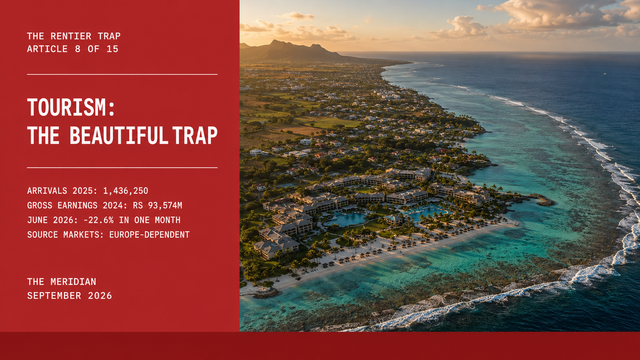
In January 2026, the Minister of Tourism announced that Mauritius had recorded 1,436,250 tourist arrivals in 2025 and tourism earnings expected to exceed Rs 100 billion, confirmed at Rs 103.4 billion by AXYS Hospitality Industry Report 2026. Both figures are records. France was down 0.6 per cent. The United Kingdom was down 2.0 per cent. Germany was down 1.3 per cent. The three core European source markets that built the Mauritius tourism model declined simultaneously while the headline numbers moved upward. The record is real. The structure underneath it is not what it appears.
The AXYS Hospitality Industry Report 2026, published by a Mauritius-based financial research firm in February 2026 and drawing on Statistics Mauritius data, identifies the structural condition that the arrival and revenue headlines do not. When tourism earnings are adjusted for inflation and expressed in constant real euros, the currency of the primary source market, daily tourist spending in Mauritius has remained stagnant for thirty years. The long-term historical average is approximately EUR 139 per day per tourist. Current spending stands at EUR 121 per day: 13 per cent below the historical norm. Volume is growing. Real value per tourist is declining. The model is filling more beds at lower real returns per bed. This is the first structural signal that the beautiful numbers carry.
The 2025 arrival data published by the Minister of Tourism in January 2026 contains a set of numbers that the headline figure obscures. Total arrivals grew 3.9 per cent, from 1,382,177 to 1,436,250. The growth was driven by India, up 33.5 per cent; Italy, up 18.2 per cent; Spain, up 19.0 per cent; the Czech Republic, up 13.2 per cent; Austria, up 7.4 per cent; and Réunion, up 3.1 per cent. France was down 0.6 per cent. The United Kingdom was down 2.0 per cent. Germany was down 1.3 per cent.
This matters for a precise structural reason. The Mauritius tourism model was built on French, British, and German visitors as its primary revenue base. These are the markets for which the luxury resort positioning was designed: high average daily rates, long stays, business class travel, premium accommodation. Indian, Italian, and Spanish visitors are growing in volume and are welcome contributors to the aggregate arrival figure. But the average expenditure profile, the length of stay, the accommodation category, and the revenue per visitor differ across source markets. Growing the aggregate by substituting lower-revenue-per-visitor markets for declining higher-revenue-per-visitor markets is a structural shift that arrival totals do not capture.
The structural conditions in France, the United Kingdom, and Germany in 2025 and 2026 are not transient. An Ifop survey conducted in March 2026 for Alliance France Tourisme found that 68 per cent of French people planned to take a holiday of at least one week in summer 2026, down nine points from 2025. Only 37 per cent were certain they would go, down from 50 per cent the previous year, reflecting what the survey described as "a rise in uncertainty." The planned summer holiday budget of the average French household in 2026 was EUR 1,530, approximately EUR 150 less than in 2025. More than 50 per cent of French respondents planned to cut spending on accommodation, catering, and on-site activities. The French are, according to the same survey, "favouring places close by, easily accessible." Mauritius, eleven hours by air from Paris and EUR 900 minimum in economy class return, is structurally the opposite of close by and easily accessible.
The survey data reflects a specific macroeconomic context. The European Commission's economic forecast for France, published in May 2026, projects French GDP growth at 0.8 per cent in 2026, unchanged from 2025, weighed down by the energy shock. The unemployment rate is set to rise to 8.3 per cent in 2026 and 8.7 per cent in 2027. Headline inflation is expected to peak at 2.9 per cent in the third quarter of 2026, with rising energy costs as the primary driver. The French government's general deficit stood at 5.1 per cent of GDP in 2025, down from 5.8 per cent in 2024 but still substantially above the Maastricht Treaty's 3 per cent ceiling.
The fiscal consolidation measures adopted for 2026 directly affect household disposable income. Welfare and pension payments are proposed to be frozen at 2025 levels rather than uprated for inflation, described by commentators as an "année blanche" for the welfare state. Housing benefit, disability benefits, and pension payments would not be adjusted for price increases. The 2023 pension reform raising the retirement age to 64 has been suspended until January 2028 but remains an active source of social discontent. Interest payments on French government debt rose further, to 2.6 per cent of GDP, as inflation-indexed bond returns increased. The household that has absorbed three years of elevated living costs, a pension reform, a planned welfare freeze, and a rising unemployment risk is not the household that books a twelve-night luxury resort stay in the Indian Ocean.
In June 2026, tourist arrivals to Mauritius fell 8.4 per cent compared to June 2025, according to Tourism Analytics citing Statistics Mauritius data. One month. One external variable: aviation fuel costs. The aviation fuel price spike documented in The Meridian's August 2026 edition translated directly into higher ticket prices for European-originating long-haul flights, and directly into reduced demand for an island eleven hours from its primary source market. The January 2026 announcement by the Minister of Tourism had projected improved air connectivity as a core strategy for 2026 growth, specifically noting additional capacity from Emirates Airlines as a driver of January's 8 per cent year-on-year increase. The June reversal demonstrates the asymmetry of airlift dependency: connectivity can be added at the margin, but aviation fuel costs are set at the barrel, and every barrel price increase is a headwind for a destination that requires eleven hours of flying to reach from Europe.
The geographic arithmetic is unalterable. Mauritius sits in the Indian Ocean, 9,700 kilometres from Paris, 9,900 kilometres from London, and 10,000 kilometres from Frankfurt. Air Mauritius, the national carrier, accumulated EUR 317 million in losses during the pandemic period and has operated through a recovery process since 2021. The airline is the single most important factor in airlift availability to the island, and its financial fragility means that route and capacity decisions are made under balance sheet constraints that a financially stronger carrier would not face. The tourism model depends on aircraft that it cannot price, fuel it does not produce, and airlines it does not fully control.
The AXYS Hospitality Industry Report 2026 makes the structural observation that the Mauritius hotel industry has "shifted towards premiumization," with four-star and above hotels now accounting for more than 85 per cent of hotel room capacity. The shift towards premium supply is real. The problem the same report identifies is that real revenue per tourist has not moved in thirty years. The premiumization of supply without a corresponding increase in real revenue per visitor indicates a market in which the premium pricing power of the sector is constrained by factors it cannot control: the purchasing power of the European source market, the competitiveness of alternative destinations at similar price points, and the willingness of the premium traveller to pay a Mauritius price premium in an era of intensifying luxury tourism competition from destinations that are closer, cheaper to reach, and investing aggressively in their own product quality.
The hotel sector benefited from Rs 13.1 billion in Mauritius Investment Corporation convertible debt at a fixed rate of approximately 3 to 4 per cent during the pandemic period, according to the AXYS report. These artificially low rates buffered the sector during the COVID-19 crisis and supported a recovery that might otherwise have been more structurally disruptive. As those concessionary financing conditions normalise, hotels face operating costs that include rising import costs for food, equipment, branded amenities, and energy inputs, all denominated substantially in US dollars, priced in a currency that has been depreciating to a record low of Rs 47.36 per dollar. The dollar cost of running a Mauritius hotel is rising in rupee terms. The euro revenue per guest is declining in real terms. The margin is being compressed from both directions simultaneously.
The model brings more people. It extracts less real value from each of them. The core source markets are contracting under structural economic pressure. One external variable cuts arrivals 8.4 per cent in a single month. Daily spending has not grown in thirty years. The trap is beautiful because the numbers look right from a distance.
The Meridian's Rentier Trap framework classifies tourism revenue as a discretionary rent: a rent generated from buyers who choose to pay it, whose choice is sensitive to their own economic conditions, and which disappears entirely when geopolitical disruption, economic stress, or a fuel price spike changes the decision calculus. The Oil Business edition of The Meridian examined how resource rents can be war-durable. Tourism rents are the opposite: they are peace-dependent, prosperity-dependent, and airlift-dependent. Every one of those dependencies is currently under pressure in the primary source markets.
The French household cutting its holiday budget by EUR 150, choosing destinations close by over long-haul, and uncertain whether it will travel at all is the precise demand signal that a discretionary rent model cannot absorb without structural consequence. The British household operating under a cost-of-living crisis in which disposable incomes are projected to decline for the rest of the decade, according to the Joseph Rowntree Foundation's 2025 assessment, is the buyer that the Mauritius luxury model was designed for and is now losing. The German household facing rising unemployment and an energy shock is not booking the next long-haul holiday at the same rate it was in 2022. These are not temporary softnesses in individual markets. They are structural conditions in the three economies that built the Mauritius tourism sector.
1. Source market concentration in structurally stressed economies. France, UK, and Germany account for the largest share of traditional Mauritius tourism revenue and all three declined in 2025 simultaneously. France's planned holiday spending is down EUR 150 per household in 2026. Unemployment is rising. The welfare state is being frozen. The French household is not the luxury long-haul tourist it was in 2015.
2. Real revenue per tourist declining despite volume growth. Tourist arrivals hit a record in 2025. Real daily spending stands at EUR 121 versus a thirty-year historical average of EUR 139. Volume substitution: more tourists, fewer euros per tourist. The growth disguises the structural yield compression.
3. Airlift dependency on volatile fuel costs. June 2026: arrivals down 8.4 per cent in one month as aviation fuel spiked. The destination has no influence over the price of the fuel that carries every guest. Air Mauritius operates with balance sheet constraints that limit its ability to absorb fuel shocks through capacity management.
4. Hotel sector margin compression: dollar costs, euro revenues. Hotel operating costs are partially denominated in US dollars (imported food, equipment, energy, branded amenities). Revenue is primarily in euros from European guests. The rupee at Rs 47.36 per dollar raises dollar-denominated costs in rupee terms. Real euro revenue per guest is declining. Both inputs to the margin equation are moving in the wrong direction simultaneously.
5. Premiumization without pricing power. 4+ star hotels now represent over 85% of hotel room capacity. The premium product exists. The premium buyer is under structural economic pressure in their home market, choosing closer destinations, spending less per stay, and in some cases not travelling at all. Premiumization without a growing premium buyer base is supply-side investment with demand-side constraint.
The tourism sector of Mauritius is not failing. The 2025 arrival record and Rs 103.4 billion in earnings are genuine achievements of a destination that has maintained its premium positioning through a period of significant global disruption. The recovery from COVID-19 was real and the government's investment in marketing and airlift connectivity contributed to it.
What the sector has not achieved, in thirty years of operation, is a genuine increase in real revenue per tourist. It has grown volume. It has not grown value. The shift to India, Italy, and Spain as growth markets sustains the arrivals headline but does not resolve the revenue-per-visitor challenge, and comes at the precise moment when the French, British, and German households who defined the sector's revenue quality are under the most sustained economic pressure in a generation. France's holiday budget is down. UK disposable incomes are declining for the rest of the decade according to the Joseph Rowntree Foundation. Germany faces rising unemployment. One aviation fuel spike cuts June arrivals 8.4 per cent in a single month. The dollar cost of running the hotel is up. The euro revenue per guest is down.
The beautiful trap is this: it works well enough for long enough that the structural signals are absorbed into the annual record rather than acted upon. The record is real. The vulnerabilities are structural. The question September 2026 asks is whether the record is the ceiling or a plateau on the way to a structural correction that thirty years of flat real yields have been quietly forecasting.
Add comment
Comments