The Rupee and the Real Economy
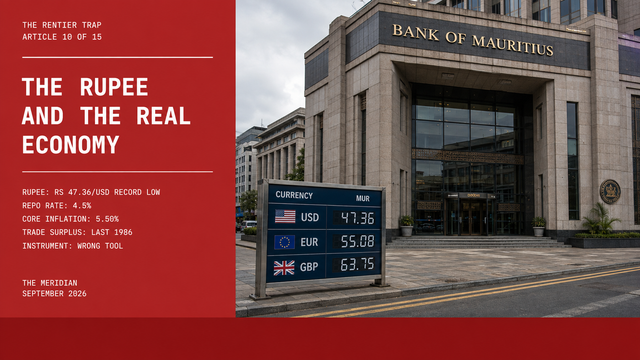
On 20 May 2026, the Bank of Mauritius raised its Key Rate by 25 basis points to 4.75 per cent per annum, its highest level since 2013. The Monetary Policy Committee cited the Strait of Hormuz closure, a sharp tightening of global energy supply conditions, and the re-emergence of external price pressures. The Bank's own press release stated that "imported inflation has increased, driven by higher energy prices and elevated freight and logistics costs." The instrument used to address this is a domestic interest rate. Raising the cost of borrowing in Mauritius does not reopen the Strait of Hormuz. It does not reduce the global oil price. It suppresses domestic demand in an economy where the inflation is external. This is the monetary policy bind that the rupee's trajectory makes visible.
The Bank of Mauritius has raised its Key Rate twice in eighteen months. On 4 February 2025, the Monetary Policy Committee raised the rate by 50 basis points from 4.00 per cent to 4.50 per cent per annum. The official press release gave two rationales: anchoring medium-term inflation expectations, and reversing the negative interest rate differential which, the Bank stated, "had contributed to a sustained depreciation of the rupee over the past few years." On 20 May 2026, the MPC raised by a further 25 basis points to 4.75 per cent, citing the Strait of Hormuz closure and its effects on global energy prices and freight costs. Two hikes. Two different stated rationales. Both responding, in part or wholly, to conditions that originate outside the Mauritian economy. Both using the same instrument: the domestic lending rate. The rate hike is the monetary policy toolkit's primary tool. The question this article examines is what that tool can and cannot do when the problems it is addressing are structural and imported rather than domestic and cyclical.
The February 2025 hike to 4.50 per cent addressed three conditions simultaneously: headline inflation that had reached 3.6 per cent in December 2024 but was carrying upside risks including, the Bank stated explicitly, "high imported inflation"; domestic inflation in services remaining elevated; and a negative real interest rate differential that the Bank assessed had been driving sustained rupee depreciation. The Bank's own characterisation of the exchange rate problem is precise and important. A negative interest rate differential means that holding rupees delivers a lower return than holding comparable foreign-currency assets. Capital moves toward the higher return. The rupee weakens. Raising the domestic rate addresses this by narrowing or reversing the differential, making rupee assets relatively more attractive and supporting the exchange rate through capital flow mechanics.
This is a legitimate monetary policy mechanism. It works when rupee depreciation is driven by capital outflows seeking higher yields elsewhere. It works less cleanly when rupee depreciation is driven by a structural current account deficit, meaning the economy must continuously send more foreign exchange abroad to pay for imports than it receives from exports. In that case, the interest rate can slow the outflow at the margin by attracting yield-seeking capital. But it cannot address the underlying deficit in the productive economy that generates the persistent excess demand for foreign exchange. Mauritius has not recorded a trade surplus since 1986. The structural current account deficit is the primary driver of the long-term rupee depreciation trajectory. The interest rate differential is a secondary and partial countervailing force.
The May 2026 hike to 4.75 per cent was driven by a different external shock: the Strait of Hormuz closure, which tightened global energy supply and cascaded into higher commodity prices, shipping costs, and investor uncertainty. The Bank's MPC statement recorded that year-on-year headline inflation had risen from 2.7 per cent in March 2026 to 3.6 per cent in April 2026, and that "imported inflation has increased, driven by higher energy prices and elevated freight and logistics costs." The Bank's response was to raise the domestic rate by 25 basis points. This raises the cost of borrowing for every Mauritian household and business. It does not affect the Strait of Hormuz. It does not affect the Rotterdam oil price. It does not affect the shipping cost from Asian suppliers to Port Louis. It addresses the domestic demand component of inflation, which is not the component driving the current inflation episode.
The Bank of Mauritius MPC minutes for the 77th meeting, published on 25 February 2026, record that between the November 2025 MPC meeting and 30 January 2026, the rupee gained 0.8 per cent against the US dollar but depreciated 2.0 per cent against the euro and 3.8 per cent against the Pound sterling. Foreign exchange market turnover reached US$3.46 billion in the same period, an increase of US$633 million relative to the equivalent period a year earlier, which the Bank described as indicating "higher liquidity and an improvement in market sentiment." The Bank noted that inflows were generated primarily by the financial services and accommodation sectors, while wholesale and retail trade generated the bulk of outflows.
This data contains the structural picture in compact form. The two principal sources of foreign exchange inflows are the offshore financial sector and tourism: both rent sectors, both structurally constrained as documented elsewhere in this edition. The principal source of outflows is wholesale and retail trade: the purchasing of imported goods in foreign currency. The exchange rate at any given moment reflects the balance between these flows. When tourism and offshore generate strong inflows, the rupee is supported. When global energy disruptions, aviation fuel spikes, and European cost-of-living pressures reduce tourism receipts, and when OECD reforms erode offshore revenues, the inflow side weakens. The outflow side does not weaken symmetrically, because import dependency is structural and cannot be reduced in the short run by any monetary policy instrument. The rupee at Rs 47.36 per US dollar in August 2026 is the price mechanism communicating this structural imbalance.
The Bank of Mauritius May 2026 MPC statement projected real GDP growth at 2.8 per cent for 2026, down from a previous forecast of 3.3 to 3.5 per cent. The revision reflects the impact of the Strait of Hormuz closure on the global economic environment and its direct consequences for Mauritius: higher fuel costs, reduced tourism from the aviation fuel pass-through, and tighter investor sentiment. The rate hike to 4.75 per cent, applied on top of a growth slowdown driven by external shocks, makes borrowing more expensive at the precise moment that the economy is absorbing the consequences of those shocks through slower growth. The business that faces higher energy costs and higher borrowing costs simultaneously is the structural compression the monetary policy bind produces.
The Bank's Governor, Dr Priscilla Muthoora Thakoor, stated at the February 2026 press conference that the MPC's stance was guided by the goal of ensuring "inflation expectations are firmly anchored while supporting sustainable economic growth." This is the dual mandate that all credible central banks operate under. The problem specific to Mauritius is that anchoring inflation expectations through rate hikes is straightforwardly effective when inflation is demand-driven, because higher rates suppress the demand that is generating the inflation. When inflation is primarily driven by the import cost of energy and food / over which domestic demand management has no direct leverage / rate hikes anchor expectations but do not reduce the underlying price pressure. The expectation is anchored. The energy cost is not.
The Bank of Mauritius is a credible institution operating precisely within its mandate. The problem is that the mandate's primary instrument addresses demand-pull inflation, and the inflation Mauritius faces is structurally cost-push and imported. The instrument works. The problem is wrong.
The standard textbook mechanism of exchange rate adjustment holds that when a currency depreciates, the price of exports falls in foreign currency terms, stimulating export demand and gradually correcting the trade deficit that produced the depreciation. This mechanism requires an export sector whose output is priced in the depreciating currency and whose competitive position improves when the rate moves. Mauritius's principal export sectors are tourism services, priced substantially in euros and dollars, and offshore financial services, where the competitive position is determined by the regulatory and treaty framework rather than the cost of labour. Neither sector's competitive position is primarily determined by the rupee exchange rate. The rupee depreciates. The hotel's dollar-denominated import costs rise. The euro revenue per tourist does not automatically increase. The offshore sector's attractiveness to a European fund manager is determined by the treaty network and the substance framework, not by whether the rupee is at 45 or 47 to the dollar.
What the rupee can tell the economy is that the exchange between what it produces and what it consumes is structurally imbalanced. The forty-year persistence of that imbalance, since the last trade surplus in 1986, is the record of an economy that has been consuming more foreign exchange than it generates from the productive activities of its people. Monetary policy can manage the rate of exchange at the margin. It can attract yield-seeking capital to support the currency in the short term. It cannot generate the trade surplus that would make the rupee's long-term trajectory stable. That requires productive capacity the economy does not currently possess. The rupee at Rs 47.36 per dollar is not a monetary policy failure. It is a structural economic signal that the instrument of monetary policy was not designed to transmute into a different economy.
1. Inflation is imported, the instrument is domestic. The May 2026 rate hike to 4.75% responded to inflation driven by the Strait of Hormuz energy shock, elevated freight costs, and global oil price rises. The Bank's own statement identifies "imported inflation" as the driver. Raising the domestic rate suppresses Mauritian household and business demand. It does not suppress the global energy price. The inflation source is external. The instrument is internal. The mismatch is structural, not a policy error.
2. Rupee depreciation has a structural cause the rate cannot address. The February 2025 hike explicitly aimed to reverse the negative interest rate differential driving rupee weakness. The differential can be managed. The underlying structural current account deficit, which has been running since 1986, cannot be closed by interest rate policy. The rupee will depreciate over the medium term as long as the economy imports more foreign exchange value than it generates. The rate buys time. It does not buy the productive capacity that would end the depreciation trajectory.
3. Rate hikes slow growth during external shocks. GDP growth slowed to 2.7% in Q4 2025 and is projected at 2.8% for 2026 after the May 2026 MPC revision. Rate hikes, applied to an economy already slowing under external energy shock pressure, increase borrowing costs for businesses and households absorbing higher fuel and food prices simultaneously. The instrument that anchors inflation expectations compresses growth during the episodes when growth compression is most costly.
The Bank of Mauritius is not failing at its job. The February 2025 and May 2026 rate hikes were technically defensible decisions within the framework of inflation targeting and exchange rate management. Governor Thakoor's management of the MPC process has been consistent, transparent, and communicative. The institution publishes its minutes, explains its rationale, and operates with the independence that monetary policy credibility requires. None of this is in question.
What this article documents is a structural position in which the monetary policy toolkit is deployed against conditions that the toolkit was designed for a different economy to address. Mauritius imports 90.9 per cent of its primary energy. It has not recorded a trade surplus since 1986. Its two primary foreign exchange earning sectors, tourism and offshore finance, are both under structural pressure from external conditions. Its inflation is driven substantially by the cost of those imports, which are priced in currencies the Bank of Mauritius does not print and at prices set in markets the Bank of Mauritius does not influence.
The rupee reflects what the real economy produces relative to what it consumes. Forty years of trade deficits have produced forty years of rupee depreciation. Two rate hikes in eighteen months have bought some time and anchored some expectations. They have not changed what the economy produces. Until that changes, the exchange rate will continue to communicate the same structural message, and the Bank will continue to use the instruments it has to manage the consequences of the message rather than address its cause.
Add comment
Comments