The Land Question
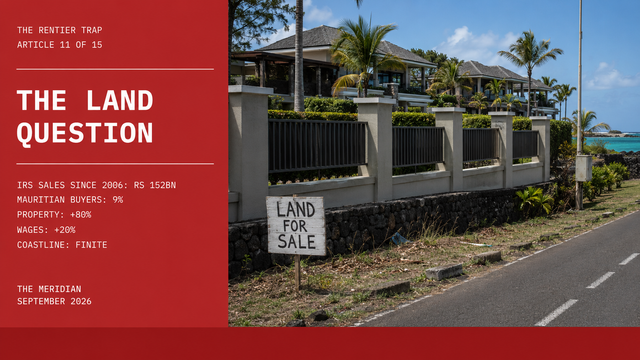
The Integrated Resort Scheme was introduced in 2002 to attract foreign investment through the sale of residential property on Mauritian freehold land. Over 5,000 units have been sold to non-citizens under EDB schemes since then. The Economic Development Board records Rs 152 billion in foreign real estate investment since 2006. Mauritian nationals account for 9 per cent of acquisitions. In the same period, property prices rose 80 per cent. Wages rose 20 per cent. On 13 December 2024, the new government mandated that 85 per cent of the purchase price be paid in Mauritian rupees. On 1 July 2026, registration duty for non-citizen buyers doubled from 5 to 10 per cent. The reforms acknowledge the problem. They cannot undo the distributional consequence of two decades of accumulation.
Mauritius is 1,865 square kilometres. Its coastline is finite. The land adjacent to its lagoons, the northern and western coastlines in particular, was the primary asset that the Integrated Resort Scheme, introduced in 2002, converted into a vehicle for foreign investment attraction. The mechanism was straightforward: non-citizens who purchased qualifying residential property at a minimum threshold received a Mauritian residence permit. The property gave access to the island. The island gave access to the property's appreciation. For two decades, the scheme delivered foreign exchange inflows, construction activity, and headline FDI figures. It also delivered a coastal property market in which the buyer with euros or dollars at USD 375,000 minimum had a structural advantage over the buyer whose savings are denominated in rupees. This is the land question: not whether the scheme worked as designed, but what it did to the distributional structure of the economy while it was working.
The Economic Development Board publishes property market insights that document the accumulation. The EDB June 2024 property report records the milestone progression: the 1,000th sale, the 2,000th, the 3,000th, the 4,000th, and the 5,000th sale across all EDB residential schemes since the IRS was introduced. More than 5,000 residential units on Mauritian freehold land have passed into the ownership of non-citizens through government-approved schemes since 2002. The Economic Development Board confirms total foreign real estate investment since 2006 at Rs 152 billion. Mauritian nationals account for 9 per cent of total acquisitions under the schemes, according to EDB data. The remaining 91 per cent are foreign buyers, predominantly from France, South Africa, the United Kingdom, and other European countries.
The geographic concentration is not random. IRS and PDS developments are permitted on freehold land of minimum 10 hectares with resort-standard infrastructure. This requirement concentrates development on coastal land that meets the minimum scale: the northern coast from Grand Baie to Cap Malheureux, the western coast from Tamarin to La Gaulette, and the eastern coast around Belle Mare and Trou d'Eau Douce. These are precisely the coastal locations where Mauritian households historically had access to public beaches, small fishing communities, and affordable coastal proximity. The EDB schemes have not replaced random rural land with resort infrastructure. They have replaced coastal land at precisely the locations most valuable to the population that was already there.
Property prices in Mauritius rose approximately 80 per cent between 2006 and 2026. Average monthly wages rose approximately 20 per cent in the same period, as recorded by Statistics Mauritius. The divergence of 60 percentage points between the asset that was being transferred to foreign buyers and the income of the population that was not buying it is the distributional signature of the scheme. It is not a complicated mechanism. When a segment of the property market is opened to buyers with purchasing power denominated in stronger currencies at minimum thresholds that exceed annual household incomes for the majority of the population, the price of that segment rises. When the price of that segment rises, it exerts upward pressure on adjacent segments. When adjacent segments rise, the Mauritian buyer whose savings are in rupees and whose income has grown at one-quarter the rate of property appreciation faces a market that has been systematically moving away from them.
The average monthly wage recorded by Statistics Mauritius in December 2024 is Rs 43,488. The minimum investment threshold for a residence permit under the PDS, IRS, RES, Smart City, or IHS schemes as of 2026 is USD 375,000, equivalent at the August 2026 interbank sell rate of Rs 47.36 per dollar to approximately Rs 17.76 million. A Mauritian household earning the average monthly wage would need to save its entire monthly income for approximately 34 years to accumulate the minimum threshold for scheme entry, without spending anything else. The scheme was not designed for them. It was designed to attract foreign capital. It achieved that. The question the distributional data poses is what was paid in exchange.
The structural depreciation of the rupee, documented in Article 10 of this edition, interacts with the land market through a specific arbitrage mechanism. As the rupee weakens against the euro and dollar, Mauritian land denominated in rupees becomes progressively cheaper in foreign currency terms for non-citizen buyers. A property priced at Rs 18 million in 2015, when the euro traded at approximately Rs 38, cost approximately EUR 473,000. The same property priced at Rs 18 million in 2026, when the euro trades at approximately Rs 50, costs approximately EUR 360,000. The rupee depreciation has effectively reduced the euro cost of Mauritian coastal land by approximately 24 per cent over a decade. The foreign buyer benefits from a currency discount compounded by rupee depreciation. The Mauritian buyer, whose savings are in rupees, does not receive this discount. They face the same rupee price. The depreciation is a transfer from the rupee-denominated economy to the foreign-currency buyer at the precise moment the exchange takes place.
The November 2024 election produced a new government with a 60-0 parliamentary majority. Within six weeks, on 13 December 2024, Cabinet approved amendments to the regulations governing all EDB residential schemes, introducing the requirement that non-citizen buyers pay 85 per cent of the purchase price in Mauritian rupees, with the remaining 15 per cent in either foreign currency or rupees. The stated rationale, confirmed in the EDB official communique, was to "strengthen the local economy while ensuring compliance with international financial standards." The rupee requirement ensures that foreign currency is converted into rupees upon transfer to Mauritius, delivering the foreign exchange benefit to the Mauritian banking system more directly than the previous structure, where the currency conversion timing and terms were more flexible.
The Budget 2025-2026, presented on 5 June 2025, doubled the registration duty and land transfer tax for non-citizen buyers under all EDB schemes from 5 to 10 per cent, effective 1 July 2026. At a USD 375,000 minimum purchase, this represents an additional USD 37,500 in transaction costs for the foreign buyer. The increase raises the fiscal capture from each transaction, reducing the net subsidy implicit in the scheme's previous concessionary tax structure. Both reforms address the fiscal and foreign exchange dimensions of the distributional problem the scheme created. They do not address the distributional consequence that has already accumulated over two decades: the property price appreciation that Mauritian buyers could not participate in, the coastal land that has transferred to non-citizen ownership, and the 60 percentage point divergence between asset prices and wages that now forms the structural baseline of the Mauritian housing market.
The reforms acknowledge what the data shows. They are prospective. The 91 per cent of EDB scheme acquisitions that went to non-citizens, the Rs 152 billion that left the productive economy as residential asset transfer, and the coastal land that has been zoned, built, and sold are historical facts. Policy reforms applied in 2024 and 2026 do not reassign them.
The land question in Mauritius is not primarily a question about what policy to adopt now. The December 2024 and July 2026 reforms are reasonable structural corrections that improve the fiscal and foreign exchange terms of the scheme going forward. The land question is a question about what twenty-two years of treating finite coastal land as the primary vehicle for foreign investment attraction have done to the distributional architecture of the economy, and whether the reforms adopted in 2024 and 2026 are sufficient to prevent the same mechanism from operating in the decades ahead.
The 80 per cent property price appreciation relative to 20 per cent wage growth is not correctable by a doubling of registration duty. The Mauritian household that could not buy coastal property in 2006 because the IRS minimum was USD 500,000 could not buy it in 2016 when the threshold fell to USD 375,000 and the property had already appreciated. It cannot buy it in 2026 at Rs 17.76 million minimum when the average monthly wage is Rs 43,488 and the wage growth over the scheme's lifetime has been one-quarter the property appreciation rate. The structural displacement of Mauritian buyers from the premium property market has been accomplished. The question that remains is whether the reformed scheme preserves it, moderates it, or begins to reverse it. On current evidence, the reforms improve the terms of the transfer. They do not change the direction of it.
1. Land is the one asset in a small island economy that cannot be produced in response to demand. The IRS and PDS schemes created demand for coastal freehold land by attaching residence rights to its purchase. The supply of coastal freehold land in Mauritius is fixed by geography. Attaching monetary demand from foreign buyers with stronger currencies to a fixed supply produces persistent price appreciation. This is arithmetic, not policy failure. The question is whether the appreciation accrues to the population that lives on the island or to the buyers who were attracted to it.
2. The currency mechanism amplifies the transfer over time. As the rupee depreciates against the euro and dollar, the foreign-currency cost of rupee-denominated Mauritian land falls. The foreign buyer's purchasing power in rupee terms increases. The Mauritian buyer's purchasing power in rupee terms does not increase at the same rate, because their income is denominated in the depreciating currency. The exchange rate mechanism that Article 10 of this edition documents as a macroeconomic condition is a distributional condition in the land market: rupee depreciation is a transfer mechanism that systematically advantages the foreign buyer and disadvantages the local one in a market where they are competing for the same finite asset.
3. The reforms are prospective. The accumulation is historical. The December 2024 85% rupee requirement improves the foreign exchange capture from future transactions. The July 2026 doubled registration duty increases the fiscal capture from future transactions. Neither measure addresses the Rs 152 billion in existing foreign real estate holdings, the 5,000+ units already transferred, or the 60 percentage point price-wage divergence already embedded in the baseline of the housing market. The reforms correct the terms of future transfers. They leave the distributional legacy of past transfers intact.
The Integrated Resort Scheme and its successor schemes delivered what they were designed to deliver: foreign direct investment, construction activity, foreign exchange inflows, and a diversified revenue base for the economy. The EDB data confirms this. The Rs 152 billion in foreign real estate investment represents real capital flows into Mauritius that financed real infrastructure at a scale the domestic capital market could not have funded independently.
What the scheme also delivered, documented by the same EDB data, is a coastal property market in which 91 per cent of scheme acquisitions went to non-citizens, in which property appreciated at four times the rate of wages, and in which the minimum threshold for participation exceeds 34 years of average wages at the savings rate implied by zero consumption. The Mauritian household was not the beneficiary of the investment. It was the neighbour of the investment.
The new government's December 2024 and July 2026 reforms are the political system's acknowledgement that the terms of the scheme required correction. The acknowledgement is correct. The reforms are appropriate. What they cannot correct is the twenty-two year accumulation that preceded them: the coast that was sold, the property that appreciated without the wage that would have enabled participation, and the structural baseline that the next generation of Mauritians inherits as the starting point for their own land question.
Add comment
Comments