The End of Cheap: Why the World's Most Important Interest Rate Is Rising for a Reason Nobody in Washington Has Yet Named
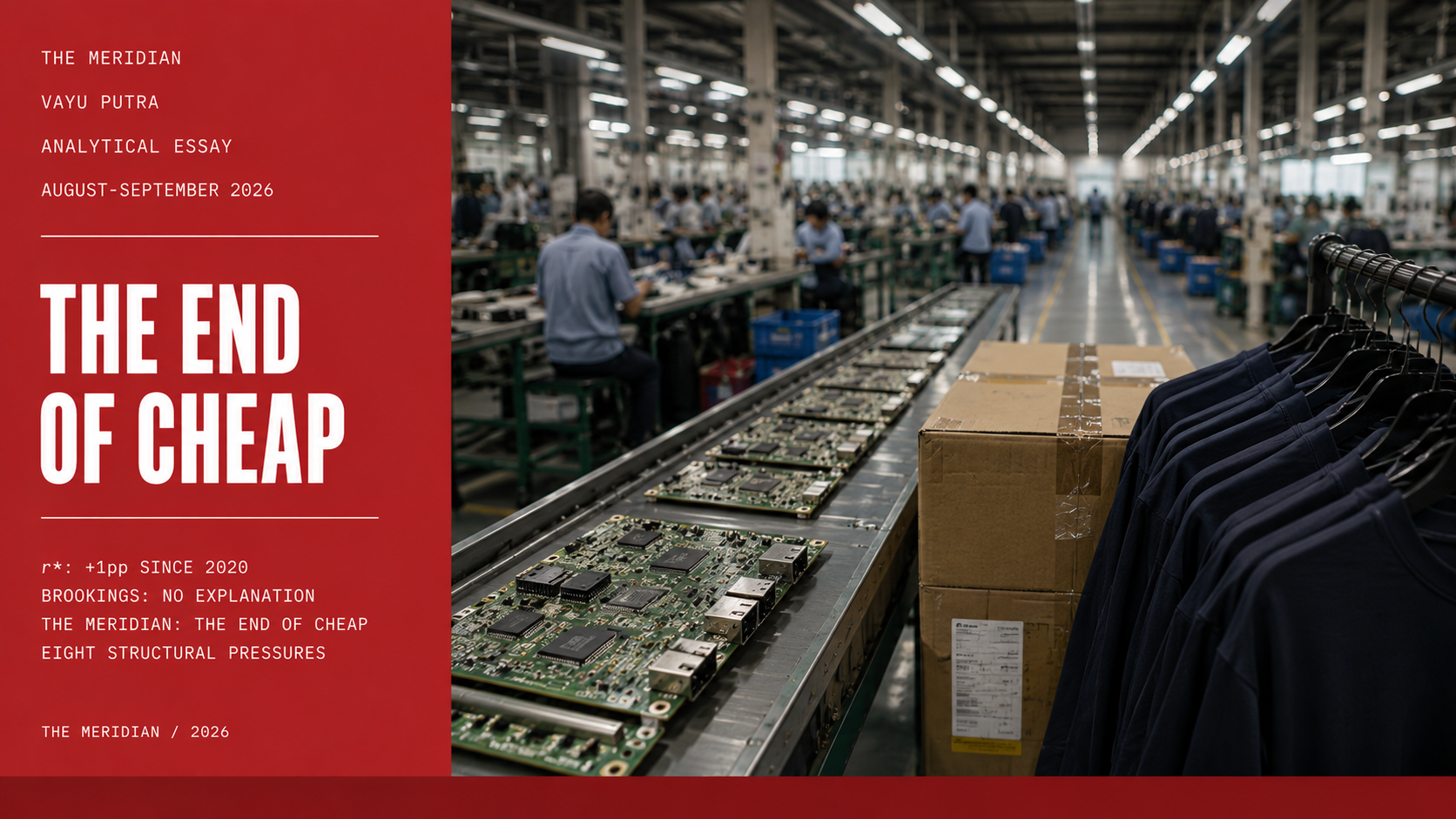
In August 2026, the Hutchins Center on Fiscal and Monetary Policy at the Brookings Institution published Working Paper 112. The authors tested three explanations for why r*, the natural rate of interest, has risen by approximately one percentage point since 2020. Fiscal expansion: modest contribution only. AI productivity: a slight decline. Monetary policy news: does not account for the rise. Something else is pushing the natural rate up. The Meridian has a candidate. It is not in the bond market. It is in the factories of Guangdong, the rice fields of the Mekong Delta, and the wage demands of a Global South workforce that has decided that cheap is over.
In August 2026, the Hutchins Center on Fiscal and Monetary Policy at the Brookings Institution published Working Paper 112. The authors are Jens H. E. Christensen of the Federal Reserve Bank of San Francisco and Glenn D. Rudebusch of Brookings and CEPR. The paper is titled "Can Fiscal, AI, or Monetary News Explain the Rise in r*?" The answer, established through a rigorous high-frequency event study, is no. Following decades of secular decline, r*, the natural or neutral real interest rate, the rate at which monetary policy is neither tightening nor loosening, the most important single number in macroeconomics, has risen by approximately one percentage point since 2020. Christensen and Rudebusch tested the three most prominent explanations that serious economists have offered for this rise. None of them holds. The fiscal debt expansion of the COVID era provides only a modest upward contribution. The AI productivity revolution, contrary to intuition, is associated with a slight decline in r* measures around major model release announcements. Monetary policy news does not account for the recent rise. Something else is pushing the natural rate of interest up. Something large enough to offset all the downward forces that drove r* steadily lower for forty years. Something that the most sophisticated monetary economists at the Federal Reserve and Brookings have not yet identified.
The Meridian has a candidate. It is not found in the bond market data that Christensen and Rudebusch examined. It is not found in Congressional Budget Office debt projections or in the compute clusters of OpenAI and Anthropic. It is found in the structural transformation of the global labour market that has been underway for a decade and accelerated sharply since 2020. The candidate is the end of cheap.
For forty years, the global economy was organised around a single extraordinary structural condition: an effectively unlimited supply of extremely cheap labour. China's integration into the global trading system, accelerated by its WTO accession in 2001, made available to global manufacturers a workforce of hundreds of millions of workers whose wages were a fraction of those in the advanced economies. The same condition existed, to varying degrees, in Vietnam, Bangladesh, Cambodia, Indonesia, India, Mexico, and across the broader Global South. The economics of this arrangement were simple and powerful. A manufacturer in Germany, the United States, or Japan could produce a garment, a circuit board, a toy, a piece of furniture, or an automotive component at a fraction of the domestic cost by contracting production to a factory in Shenzhen, Dhaka, or Ho Chi Minh City. The wage differential was so large, and the productivity of the global supply chain so well established, that it was rational for virtually every globally traded manufacturing sector to reorganise production around cheap labour arbitrage.
The macroeconomic consequences of this arrangement were equally powerful and equally sustained. Cheap labour arbitrage meant cheap goods. Cheap goods meant low consumer price inflation across the advanced economies for four decades. Low consumer price inflation meant central banks could maintain lower interest rates than they otherwise would have, because the inflation threat that interest rates are designed to contain was being suppressed by the structural conditions of global production. Lower interest rates meant cheaper capital, which meant higher asset prices, more borrowing, more consumption, and the long expansion of financialised capitalism that defined the advanced economy experience from the mid-1980s to 2020. The fall in r* that Christensen and Rudebusch document from the 1980s to 2020 is, in significant part, the r* signature of the era of cheap. The global economy was disinflationary because global production was cheap. The natural rate of interest was falling because the structural condition that makes inflation persistent, rising labour costs, was being continuously suppressed by the integration of cheaper and cheaper labour into the global supply chain.
This is not a controversial account. It is the mainstream explanation for the so-called Great Moderation, the period of low inflation and relative macroeconomic stability that preceded 2020. What has not been integrated into the mainstream analytical framework is the implication of that account for the post-2020 period. If the era of cheap labour arbitrage was a structural disinflationary force that suppressed r* for forty years, then the end of that era is a structural inflationary force that will push r* higher for however long the transition takes. The question is not whether the era of cheap is ending. The question is whether it has already ended and whether the consequences are showing up in the data that Christensen and Rudebusch are examining. The answer to both questions is yes.
The end of cheap is not a single event. It is the cumulative result of eight simultaneous structural pressures that have been building for a decade and converged after 2020. No single pressure is sufficient to explain the rise in r*. Taken together, they constitute a structural supply-side repricing of global production whose macroeconomic consequences are precisely what Christensen and Rudebusch have measured without identifying the cause.
The first pressure is the political unsustainability of low wages across the Global South. Chinese manufacturing wages have risen dramatically since 2010. The Pearl River Delta wage levels that made Guangdong the workshop of the world in 2005 are no longer the wage levels of 2026. Vietnam, which absorbed significant manufacturing relocation from China between 2015 and 2022, has itself experienced rapid wage growth. Bangladesh's garment workers have staged repeated and increasingly successful strikes for higher wages. The political economy of cheap labour has changed. Governments across the Global South face populations whose aspirations have been raised by two decades of growth and whose tolerance for subsistence wages in export processing zones has reached its political limit. The wage floor is rising not because productivity has risen sufficiently to justify it, but because the political conditions that sustained very low wages have changed. This is a structural shift, not a cyclical fluctuation.
The second pressure is automation as the corporate response to rising wages. As wages rise in the Global South, manufacturers have two options: relocate production to wherever the next pool of cheap labour exists, or automate. The pool of available cheap labour is shrinking. The next Bangladesh, the next Cambodia, the next lower-wage alternative to wherever wages have just risen, is harder to find than it was in 2005. Automation is the corporate response. But automation requires capital expenditure. Capital expenditure raises the capital intensity of production. Higher capital intensity means higher demand for investment capital, which pushes up the equilibrium return on capital. A higher equilibrium return on capital is a higher r*. The automation response to rising wages is itself a mechanism through which the end of cheap translates into a higher natural rate of interest.
The third pressure is corporate profit compression from the narrowing of labour arbitrage. The profit model of globalised manufacturing was built on the wage differential between production locations and consumption markets. As that differential narrows, the profit margin on globally produced goods compresses. Compressed margins mean lower retained earnings, less internal capital generation, and greater reliance on external capital markets. Greater reliance on external capital markets increases the demand for investment capital, which puts upward pressure on the equilibrium real interest rate.
The fourth pressure is consumer demand destruction from cost-of-living pressures in the advanced economies. The inflation that followed 2020, driven initially by supply chain disruption and subsequently sustained by the structural factors this article identifies, has compressed real consumer purchasing power in the advanced economies. Compressed purchasing power means lower demand for the globally produced goods whose cheap production was the engine of the disinflationary era. Lower demand for globally produced goods reduces the incentive for the investment that would expand cheap production capacity. Reduced investment in cheap production capacity is a supply constraint that puts upward pressure on the prices of globally traded goods, which is upward pressure on inflation, which is upward pressure on r*.
The fifth pressure is fiscal capacity at its post-COVID minimum. Advanced economy governments entered the post-2020 period with debt levels significantly higher than their pre-2020 positions, after the largest peacetime fiscal expansion in modern history. Higher government debt means higher future tax requirements or higher future borrowing requirements. Higher future borrowing requirements push up the sovereign risk premium embedded in long-term interest rates. This is the fiscal channel that Christensen and Rudebusch tested and found to provide only a modest contribution. The reason their estimate of the fiscal contribution is modest is that they are measuring it through the market's immediate response to fiscal news announcements, which captures the short-term signal but misses the structural accumulation. The fiscal pressure on r* from post-COVID debt levels is not a news event. It is a structural condition.
The sixth pressure is the misalignment of central bank tools. The monetary policy frameworks of every major central bank were designed during the era of cheap, when inflation was primarily demand-pull: the result of too much money chasing too few goods, addressable by raising the cost of borrowing to reduce demand. The inflation of the post-2020 period is substantially cost-push: the result of structural supply-side conditions that make production more expensive regardless of demand levels. Raising interest rates reduces demand. It does not reduce the cost of Vietnamese wages, does not increase the speed of automation, does not lower the price of energy, and does not rebuild the supply chains that COVID disrupted. Central banks have been applying demand-pull tools to a cost-push problem, which means they have been raising rates higher and for longer than a correctly calibrated response would require. The over-tightening of monetary policy in the post-2020 period has itself contributed to r* estimates rising, because markets are pricing in a permanently higher policy rate environment that reflects central bank reaction to a structural condition rather than the structural condition itself.
The seventh pressure is the suppression of exchange rate adjustment. In a textbook international adjustment mechanism, countries experiencing rising production costs should see their exchange rates appreciate, which makes their exports more expensive and their imports cheaper, restoring the trade balance and distributing the adjustment across the global economy. This mechanism is substantially suppressed across the Global South. The CFA franc is pegged to the euro. Large parts of Africa and Latin America are effectively dollarised or maintain managed exchange rate regimes. IMF programme conditionality frequently discourages large devaluations as inflationary. The suppression of exchange rate adjustment means that the rising cost of production in the Global South is not being offset by currency appreciation. It is being transmitted directly into the price of globally traded goods. Cost-push inflation without exchange rate adjustment is structurally more persistent and more difficult for central bank policy to address. Persistent cost-push inflation is consistent with a persistently higher r*.
The eighth pressure is the deepening of trade imbalances. The era of cheap created large and persistent trade imbalances: manufacturing surpluses in the Global South, consumption deficits in the advanced economies. As the era of cheap ends, these imbalances do not automatically self-correct. The advanced economies have lost the manufacturing capacity that would allow them to substitute domestic production for imports as import prices rise. The Global South is in the early stages of building the domestic consumption base that would make it less dependent on export-led growth. The transition between these two equilibria is a period of structural dislocation in which trade imbalances persist at levels inconsistent with stable exchange rates and sustainable current account positions. Structural trade dislocation is consistent with higher equilibrium interest rates as capital flows seek to finance persistent imbalances.
The end of cheap is not a news event. There is no announcement. There is only the gradual, continuous repricing of global production that shows up in trade price indices, wage data from across the Global South, and the persistent inflation that central banks have been unable to suppress with the tools at their disposal.
The Hutchins Center methodology is rigorous and the finding is genuine. Fiscal news, AI news, and monetary policy news do not explain the rise in r*. The methodology's limitation is not its execution but its scope. High-frequency event studies measure the market's immediate response to identifiable information events: a budget announcement, a model release, a Federal Reserve meeting. They are designed to isolate the causal effect of specific news shocks on financial market prices. They are not designed to measure the effect of slow-moving structural transformations that have no announcement date, no press release, and no identifiable moment at which they constitute news.
The end of cheap is not a news event. It is a structural transformation that has been underway for a decade, that accelerated after 2020, and whose macroeconomic consequences are accumulating continuously rather than arriving in identifiable shocks. It does not appear in a high-frequency event study because there is no event to study. There is no announcement of the end of cheap. There is only the gradual, continuous repricing of global production that shows up in trade price indices, in manufacturing cost surveys, in wage data from across the Global South, and in the persistent inflation that central banks have been unable to suppress with the tools at their disposal. Christensen and Rudebusch found that something is pushing r* up that their methodology cannot identify. The something is structural. It is supply-side. It is global. It does not arrive in news events. It arrives in the slowly rising cost of everything that the global economy produces. That is the End of Cheap. That is what is in the data.
If the End of Cheap is the primary driver of the post-2020 rise in r*, the policy implications are significant and uncomfortable.
It means the rise in r* is not transitory. It is structural. The natural rate of interest will remain elevated for as long as the transition from the era of cheap labour arbitrage to whatever comes next takes to complete. That transition is measured in decades, not quarters.
It means monetary policy tightening is a misdiagnosed response to a supply-side problem. Central banks cannot cure the End of Cheap by raising interest rates. They can reduce demand, which reduces inflation temporarily, but they cannot restore the structural disinflationary force of unlimited cheap labour by making borrowing more expensive. The appropriate policy response to a structural supply-side transition involves industrial policy, supply chain investment, productivity-enhancing technology deployment, and the managed integration of the next wave of labour market participation, not repeated interest rate increases that compress investment and slow the automation response that is the only genuine supply-side adjustment available.
It means the Global South is carrying the cost of a structural transformation whose benefits accrued primarily to the advanced economies. Forty years of cheap labour arbitrage produced cheap goods for Western consumers and cheap capital for Western financial markets. The end of that arbitrage is being experienced as inflation by Western central banks and addressed through interest rate increases that raise the cost of borrowing for the developing countries whose rising wages caused the structural shift. The country that gains higher wages pays higher borrowing costs for the infrastructure it needs to sustain them. This is the political economy of the End of Cheap, and it is the lens through which The Meridian will continue to analyse it.
It means r* is not going back to 2019 levels. The forty-year structural disinflationary force of cheap labour arbitrage is unwinding. The natural rate of interest will find a new equilibrium at a higher level than the one that prevailed during the era of cheap. The bond market, the equity market, and the real estate market all contain pricing that was calibrated to the era of cheap. The repricing of those assets to a world of structurally higher r* is the most significant macroeconomic transition of the current decade. Christensen and Rudebusch have measured the symptom with precision. The Meridian has named the cause.
The End of Cheap is the analytical frame The Meridian applies to its coverage of the global political economy. The September 2026 edition, The Rentier Trap, examines how one small island economy, Mauritius, built its prosperity on the era of cheap and now faces the structural consequences of its ending: a monetary bind because its inflation is imported, a tourism ceiling because the European household that made it profitable is under cost-of-living pressure from the same structural forces, and an offshore sector whose treaty advantages are being renegotiated in a world where the tax optimisation of the cheap era is no longer politically or legally sustainable.
The Brookings paper asked whether fiscal, AI, or monetary news explains the rise in r*. The correct answer is: none of the above. The correct explanation is structural, supply-side, global, and decades in the making. It is not found in the news flow that a high-frequency event study is designed to capture. It is found in what a factory worker in Guangdong earns today compared to what she earned in 2005, in what a garment worker in Dhaka demands compared to what her predecessor accepted, and in the political decision that governments across the Global South have made, one election cycle and one strike at a time, that cheap is over.
Christensen and Rudebusch found the one percentage point. The Meridian named what produced it. The two contributions are complementary. The analysis is incomplete without both.
Add comment
Comments