China Is Building 37 Nuclear Reactors. America Is Building None. The SCO Summit Just Explained Why.
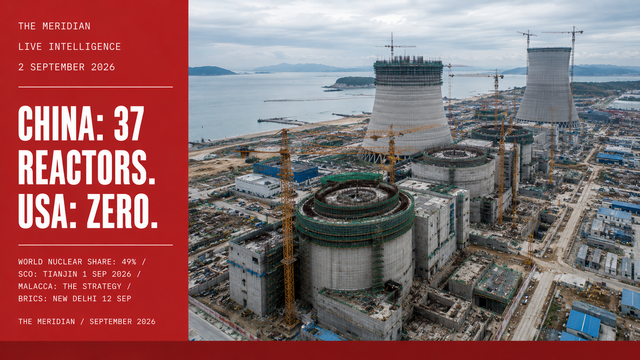
The 26th Shanghai Cooperation Organisation Heads of State Council Summit closed in Tianjin, China, on 1 September 2026. Modi, Putin, and Xi were in the same room. They held bilaterals. They took the family photo. Modi has now invited Xi to the BRICS Summit in New Delhi on 12-13 September. As of February 2026, China has 37 nuclear reactors under construction, accounting for 49 per cent of all world nuclear construction, according to IAEA data cited by Statista and the US Energy Information Administration. The United States has zero reactors under construction. The two stories are not unrelated.
On 1 September 2026, Indian Prime Minister Narendra Modi addressed the plenary session of the 26th SCO Summit in Tianjin, then held bilateral meetings with both Chinese President Xi Jinping and Russian President Vladimir Putin on the sidelines. The photograph of the three leaders sharing what the Tribune of India described as "bonhomie" ahead of the plenary session was circulating within hours. This is the second consecutive year that the Tianjin image has generated international attention: in 2025, a clip of Xi, Modi, and Putin laughing together at the SCO Summit went viral and prompted Donald Trump to claim the United States had "lost India and Russia to deepest, darkest, China." A lot has changed in twelve months, and yet the photograph keeps being taken. The same week, China's nuclear programme crossed the 37-reactor construction threshold. The Meridian Intelligence Desk does not believe these two data points should be read separately.
The numbers are precise and publicly verified. As of February 2026, China had 37 nuclear reactors under construction, according to Statista, citing the International Atomic Energy Agency's PRIS database. The US Energy Information Administration, in its 5 June 2026 analysis, confirmed 36 reactors under construction (as of May 2026), accounting for more than 49 per cent of all world nuclear construction globally. By end of 2025, China had 62 gigawatts of nuclear capacity in commercial operation, with a further 43 gigawatts under construction, according to the World Nuclear Association. The China Nuclear Energy Development Report 2026, published by the China Nuclear Energy Association in April 2026, confirmed a combined operational or approved capacity of 125 million kilowatts, securing what the report described as "the global top spot." Seven reactors are scheduled to enter commercial operation before the end of 2026. One of the major projects, Unit 1 of the San'ao Nuclear Power Plant in Zhejiang province, is the first Hualong One reactor in the Yangtze River Delta region and the first Chinese nuclear project with significant private capital participation.
The policy context is the 15th Five-Year Plan for 2026-2030, approved by the State Council in March 2026, which targets 110 gigawatts of operational nuclear capacity by 2030. This represents a near-doubling of the current operational fleet within four years. The long-term trajectory is more ambitious still: the China Nuclear Energy Association projects 150 gigawatts by 2035, and one government research institute has modelled a scenario reaching 335 gigawatts by 2050, which would make nuclear approximately 28 per cent of China's total electricity generation. The current share is approximately 4.5 per cent. China is building its way from the margin to the backbone of its electricity system, and it is doing so at a pace and scale that has no equivalent anywhere else in the world. Its average construction time for a nuclear plant between 2012 and 2021 was six years, against a global average of nine years, according to the World Nuclear Industry Status Report.
The strategic context for China's nuclear build is not primarily climate policy, although climate commitments are the officially stated rationale alongside energy security and industrial competitiveness. The structural driver is what Chinese strategists have called the Malacca Dilemma since at least 2003, when President Hu Jintao first articulated it explicitly. Approximately 80 per cent of China's oil imports transit the Strait of Malacca, the 2.7-kilometre-wide chokepoint between the Malay Peninsula and Sumatra. The US Navy's 7th Fleet operates extensively in the waters surrounding the Strait. In any scenario involving military confrontation between China and the United States, particularly over Taiwan, the Strait of Malacca is the first pressure point: a blockade or interdiction of tanker traffic would sever China's primary oil supply within weeks.
Nuclear power does not run on oil. Each of the 37 reactors under construction removes a portion of China's electricity generation from fossil fuel dependency and therefore from Malacca exposure. The 37 reactors collectively represent tens of gigawatts of electricity generation capacity that will be immune to any interdiction of the Strait. When China's planners approved the 15th Five-Year Plan target of 110 gigawatts by 2030, they were not only making an investment in carbon reduction. They were building a portion of the national energy system that is structurally invulnerable to the primary strategic pressure instrument available to the United States and its allies in a conflict scenario. The nuclear build is, among other things, a hedge against the scenario in which China's economic relationship with the West deteriorates to the point where the Strait of Malacca becomes a coercive instrument rather than a commercial route.
The 26th SCO Heads of State Council Summit ran from 31 August to 1 September 2026 in Bishkek, Kyrgyzstan. The SCO now has 10 full members: China, Russia, India, Belarus, Iran, Kazakhstan, Kyrgyzstan, Pakistan, Tajikistan, and Uzbekistan. The heads of state present included Xi Jinping as host, Vladimir Putin, Narendra Modi, Iranian President Masoud Pezeshkian, Pakistani Prime Minister Shehbaz Sharif, and Turkish President Recep Tayyip Erdogan. The bloc collectively represents a substantial share of global population, landmass, and GDP, and it sits outside every Western-led multilateral institution.
The bilateral between Modi and Xi Jinping, held on the summit's sidelines, produced a joint statement from India's Ministry of External Affairs that is worth reading in full for what it chooses to emphasise. Both leaders "reaffirmed that the two countries were development partners, not rivals, and that their differences should not escalate into disputes." They "called for a stable relationship and cooperation between India and China based on mutual respect, mutual interest and mutual sensitivity, necessary for the growth and development of the two countries, as well as for a multipolar world and a multipolar Asia befitting the trends of the 21st century." They agreed on the importance of "people-to-people ties through direct flights and visa facilitation," and on the Kailash Manasarovar Yatra. "On economic and trade relations, they recognised the role of their two economies in stabilising world trade. They underlined the need to proceed from a political and strategic direction to expand bilateral trade and investment ties and reduce trade deficit." Modi then invited Xi to the BRICS Summit in New Delhi on 12-13 September. Xi accepted.
Modi subsequently held a bilateral with Putin, following the plenary session, after which he departed for India. The formal interaction between Modi and Putin, described by present journalists as a warm hug before walking to the stage for the group photograph, was the visual that Western analysts were watching for. It came, as expected. Neither leader appeared to find it awkward.
The United States government is watching the Bishkek summit closely, for reasons that CNBC's reporting on 31 August 2026 made explicit. Richard Rossow of the Center for Strategic and International Studies told CNBC that visible warmth between Modi and Putin "could shape the President's calculations over using potential new secondary tariff authorities" over India's purchases of Russian oil. India has been buying discounted Russian crude throughout the Ukraine conflict, a practice Washington has tolerated because the US-India strategic relationship is too valuable to rupture over Russian oil purchases. The Tianjin warmth complicates that calculation.
The broader US concern is the one Trump articulated after the 2025 SCO image: that the non-Western multilateral architecture, the SCO bringing together China, Russia, India, Iran, and Pakistan, and the BRICS grouping hosting its own summit in New Delhi on 12-13 September, represents an alternative institutional layer that is neither aligned with the United States nor implacably hostile to it, but is building its own internal coherence regardless. India's position is the variable that makes this architecture strategically significant: New Delhi is simultaneously negotiating a bilateral trade deal with Washington (with tariffs scaled back from 50 to 18 per cent as of February 2026), hosting Xi and Putin at BRICS in September, and using both summits to signal to Washington that India has strategic options. Pramit Pal Chaudhuri of the Eurasia Group told CNBC the message India is sending: "There will be a price if you continue to remain uncertain."
1. China's nuclear build is the most consequential energy investment in the world, and it is almost entirely absent from US financial media. 37 reactors under construction, 49% of world nuclear construction, a 15th Five-Year Plan targeting 110 GW by 2030, and an average build time of 6 years against a global average of 9. The electricity generation capacity being built in China over the next decade will determine the structural cost of compute in the global AI race. Chinese data centres powered by sub-4-cent nuclear electricity will have a structural cost advantage over American data centres powered at 8-12 cents per kilowatt-hour. This is not a theoretical concern. It is the arithmetic of the AI infrastructure buildout.
2. The SCO is not a threat organisation. It is an institutional architecture for a world that does not require Western approval. The 10 SCO members plus dialogue partners represent a significant share of global population, energy reserves, and now an increasing share of global GDP. None of them are building their policy around Washington's preferences, though several of them are simultaneously negotiating bilateral arrangements with Washington. The summit in Tianjin was not a declaration of hostility to the United States. It was a demonstration that the world has more than one centre of institutional gravity.
3. India is the swing factor and Modi knows it. New Delhi is in Bishkek with Xi and Putin on September 1. New Delhi hosts Xi and Putin at BRICS on September 12-13. New Delhi is simultaneously negotiating a trade deal with Washington. This is not confusion or inconsistency. It is the most sophisticated multi-vector foreign policy being practised by any major democracy. Whoever commissions the most accurate read of India's strategic decision-making in the next 24 months will be ahead of the institutional consensus on what the multipolar order actually looks like from the inside.
The data centre operators in Ashburn, San Jose, and Prineville who are reading this article are not reading it because they are interested in the SCO as a multilateral institution. They are reading it because the structural cost of electricity is the single most important variable in the economics of AI compute, and because China's nuclear buildout is the most significant structural change in global electricity supply happening right now. The major American technology companies have understood this: Amazon signed a deal with Talen Energy to power AWS data centres from the Susquehanna nuclear facility in Pennsylvania. Microsoft signed a deal to restart Three Mile Island. Google has signed agreements for small modular reactor power. The US technology sector is reaching for nuclear because the grid cannot deliver the electricity that AI infrastructure requires at a competitive price.
China does not need to make deals with independent power producers. It is building the reactors. The Chinese state is constructing 37 nuclear plants simultaneously, with a 6-year average completion time, targeting 110 gigawatts by 2030. The Chinese AI and data centre sector, operating in an economy where the state is simultaneously the electricity regulator, the grid operator, and the nuclear plant builder, will have access to that capacity at administered prices that the market cannot replicate. The Hualong One reactor, commissioned at Taipingling Unit 1 in April 2026, is also China's flagship nuclear export product. Countries that buy a Hualong One acquire Chinese-dependent fuel supply chains, maintenance relationships, and technical expertise for the 60-year operational life of the reactor. China is building domestic energy independence while simultaneously creating long-term energy dependency in its export markets. That is the strategic logic of the nuclear buildout, and it is what the SCO summit in Tianjin was implicitly about: the construction of a world in which China's strategic autonomy is built into the physical infrastructure of the energy system.
37 reactors under construction. 49 per cent of all world nuclear construction. Six-year average build time. 110 gigawatts by 2030. The United States is building zero. This is not an energy story. It is a geopolitical story with an energy mechanism.
China's nuclear build and the SCO summit in Tianjin are the same strategic project read from two different angles. The nuclear build is China constructing the physical preconditions for strategic autonomy: an electricity system that cannot be interdicted at the Strait of Malacca, a domestic energy base that does not depend on fossil fuel imports, and a nuclear technology export industry that creates long-term dependency in partner states. The SCO summit is China hosting the institutional architecture within which that strategic autonomy is exercised: a multilateral forum that includes Russia, India, Iran, Pakistan, and Central Asia, operating entirely outside the Western-led institutional order.
What connects them is the observation that neither story is being told as a unified strategic narrative in US financial media. The nuclear build is covered as an energy or climate story. The SCO is covered as a diplomatic story. The data centre operators and institutional investors trying to price AI infrastructure costs, supply chain risk, and geopolitical exposure over a 10-year horizon need both stories read together, because the structural variable they share is China's systematic construction of a world in which it does not need to ask permission.
BRICS convenes in New Delhi on 12 September. Xi Jinping is expected to attend. The conversation that Bishkek began will continue there. The Meridian Intelligence Desk will cover it.
Add comment
Comments