How Putin Weaponised BRICS and Why He Just Stopped
To dollar, or not to dollar. The man who declared war on the currency he cannot live without.
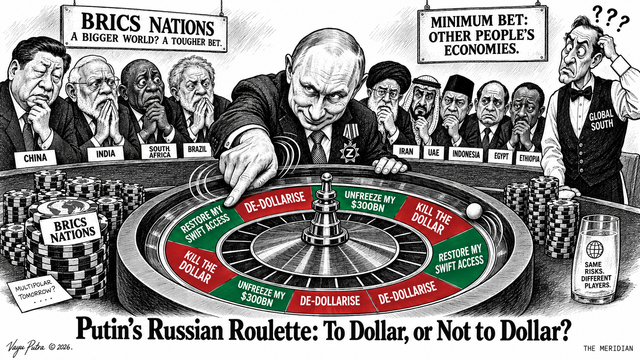
Five days before the New Delhi BRICS summit, the Kremlin quietly announced that Russia is not seeking de-dollarisation. I noticed. For three years, Vladimir Putin had been the loudest voice at every BRICS table calling for the dollar's death. Then, days before the most important summit of his BRICS presidency cycle, Moscow walked it back. This is what that retreat tells us about what the game was always actually about, and why an economist watching from inside the Global South sees it differently from anyone writing about it from London or Washington.
I want to start with a game. It is called Russian Roulette, and Vladimir Putin has been playing a version of it at every BRICS summit for the past three years. The gun is loaded with two options. One chamber says "de-dollarise." The other says "unfreeze my $300 billion." He spins the wheel at each summit, fires into the room, and then watches to see which chamber came up. The Global South watches from the audience and assumes the game is about them. It is not. It has never been. The game is entirely about Russia, and five days before the New Delhi summit, Putin quietly put the gun down.
Kremlin spokesman Dmitry Peskov stated that Russia is not seeking de-dollarisation. This, from the government whose president has spent three years calling the dollar a weapon, a mistake, and an instrument of Western aggression. This, from the country whose foreign ministry spokeswoman Maria Zakharova had just told reporters that Western sanctions were accelerating the shift away from the dollar across the Global South. The retreat was quiet, carefully worded, and almost entirely unreported. I noticed it because I have been watching this game from a vantage point that most commentators covering BRICS do not have: from inside the system being played.
When I analysed which BRICS member stands to gain most from de-dollarisation, the answer was not the Global South. It was not India, whose diaspora sends approximately $125 billion home every year through Western financial infrastructure, almost all of it in dollars and pounds. It was not China, whose export machine still invoices the majority of its trade in dollars because dollar liquidity is deeper and cheaper than yuan liquidity. It was not Brazil, which has been to the IMF three times in a decade for dollar-denominated emergency financing. It was not South Africa, whose rand is priced against the dollar every single trading day on markets it does not control.
The country that needs the dollar to die is Russia. And only Russia. Because Russia is the only BRICS member that has already been expelled from the dollar system. Its reserves were frozen. It was excluded from SWIFT. Its ability to conduct normal international trade in dollars was severed in February 2022. For every other member of BRICS, de-dollarisation is a preference, a negotiating position, or a theoretical hedge against future sanctions risk. For Russia, it is an existential necessity. Putin is not leading a Global South monetary revolution. He is solving a Russian problem from a Global South platform, and the two things are not the same.
I saw something else when I looked at the broader pattern. The de-dollarisation campaign was not Putin's only weapon. It was one blade of a multi-pronged strategy, and when I connected the dots from a Global South perspective, the picture was clearer than anything I was reading in Western financial media.
The Ukraine war is not, from Putin's strategic perspective, primarily a territorial conflict. It is an economic siege of Europe. I watched this unfold in the data. European energy costs surged after February 2022 as Russian gas supplies were disrupted or weaponised. European defence spending was forced upward, consuming fiscal space that European governments would have spent elsewhere. European inflation spiked, forcing the European Central Bank to raise rates at a pace not seen in decades, slowing the European economy and tightening financial conditions for every country that trades with Europe. At the same time, Europe absorbed millions of Ukrainian refugees, adding social and fiscal pressure that continues. Putin did not need to defeat Europe militarily. He needed to bleed it economically, and for two years, it worked.
From the Global South, I watched this with a specific concern that European analysis rarely articulates. When European economies slow and European fiscal space tightens, European development finance contracts. European bilateral aid to Africa, Asia, and the Indian Ocean slows. European demand for Global South exports weakens. The war in Ukraine is not a European story that the Global South watches from a safe distance. It is a European story whose economic consequences travel directly into the fiscal positions of countries that had no part in starting it. The same mechanism I described in our dollar tax article, where a Federal Reserve decision in Washington becomes a debt servicing problem in Lusaka, applies here: a war in Kyiv becomes a budget constraint in Nairobi.
Putin did not need to defeat Europe militarily. He needed to bleed it economically. The war in Ukraine is a financial siege as much as a territorial one. From the Global South, we have been watching this with a specific anxiety that Western analysis rarely names.
Here is the connection that I analysed and found nowhere else written plainly. When Russia began selling discounted oil to India after Western sanctions took effect, the narrative inside BRICS circles was one of solidarity. Russia was helping India access cheap energy during a difficult global moment. India was exercising its sovereign right to trade with whomever it chose. This was presented as BRICS multilateralism at work: the developing world standing together against Western economic coercion.
What actually happened was considerably less heartwarming.
The United States imposed 50% tariffs on Indian goods, explicitly citing India's Russian oil purchases. India's exports to the United States, which stood at approximately $87 billion in 2024, were projected by the Global Trade Research Initiative to fall to approximately $50 billion in 2026 as a result. Textiles, gems, jewellery, chemicals, and shrimps faced a projected 70% collapse in exports, endangering hundreds of thousands of jobs in sectors that are, in the words of one Indian analyst quoted by Al Jazeera, "very, very labour-intensive" and unable to absorb such a hit.
India ultimately agreed, in the February 2026 bilateral trade deal with Washington, to halt Russian crude oil purchases and shift sourcing to the United States. The tariff was reduced to 18% in exchange. In other words: the Russian solidarity discount cost India its largest trading partner relationship, forced it to abandon its energy arrangement with Russia, and required it to commit to buying more expensive American oil instead. Putin's cheap oil was the most expensive gift India ever received. The BRICS solidarity narrative dissolved the moment India had to choose between Russian oil and American markets. It chose American markets.
I sat with the list of BRICS leaders and I noticed something that the official communiques never acknowledge. This is not simply a forum for economic cooperation. It is, functionally, the most consequential mutual non-accountability pact in contemporary diplomacy.
Russia is conducting a military campaign in Ukraine that the United Nations General Assembly has repeatedly demanded, by majority vote, be halted. Combined casualties from the war, according to the Centre for Strategic and International Studies, are approaching two million across both sides. Verified civilian deaths in Ukraine alone exceed 16,000 by UN count, with the actual figure acknowledged to be significantly higher. The war has been ongoing since 2022. No BRICS leader has called for it to stop in terms that carry any consequence.
China has what the United Nations Human Rights Office described in 2022 as conditions in Xinjiang that potentially constitute crimes against humanity. Iran emerged from a conflict in which it launched missile strikes on fellow BRICS member UAE, and has documented cases of lethal force used against its own civilian population during the 2022 protests. India has the documented caste system, with approximately 200 million Dalits still facing structural discrimination despite constitutional prohibition since 1950. Brazil's former president attempted a coup on 8 January 2023. South Africa's president faces documented questions regarding undeclared cash found concealed on his farm. Ethiopia experienced a devastating internal conflict in Tigray that produced what the UN described as mass atrocity crimes.
Not one of these matters has been raised at a BRICS summit. Not once. The communiques speak of sovereignty, of non-interference, of respecting each member's right to determine its own path. What this means in practice is that the grouping that claims to speak for the Global South has constructed an architecture in which its members' worst governance failures are structurally protected from collective scrutiny. The Global South deserves better representation than a forum whose first rule is that nobody mentions what is actually happening inside its own membership.
Russia's Ukraine war is being paid for, in part, by the Global South. European economies slowed by the energy and fiscal shock of the war reduced development finance, aid budgets, and demand for emerging market exports. The war-driven energy inflation that forced the Federal Reserve to raise rates this week makes dollar-denominated debt more expensive for 75 developing countries already in or near distress. Pakistan spends more than half its federal budget on debt repayment. Fifteen sovereign defaults occurred between 2020 and 2023.
None of this was on the BRICS agenda. The summit that claims to speak for the Global South discussed BRICS Pay, the Unit token, national currency settlement, and supply chain resilience. It did not discuss the war that is making the Global South's debt more expensive, its development finance scarcer, and its food and energy costs higher. Putin chairs a forum in which the economic consequences of his own decisions are never named.
I observed something else when I stepped back from the immediate news cycle and looked at the political timelines. Vladimir Putin has just extended his hold on Russian power for another presidential term. His position is stable in the specific sense that matters for this analysis: he will still be in power when Modi is not, and when Xi faces whatever succession questions his political system eventually generates.
Modi won his third term in 2024 but with a significantly reduced parliamentary majority that now requires coalition management. India's democratic system will produce a new government at the next election whether he stands or not. Xi Jinping has consolidated more personal power than any Chinese leader since Mao Zedong, but the Chinese political system's succession mechanisms remain opaque and the absence of a clear successor introduces uncertainty that does not exist in Russia's current arrangement. Putin is playing a longer game than anyone else at the BRICS table. He knows it. They know it. The de-dollarisation campaign, the Ukraine war's slow economic siege of Europe, the naval provocations that periodically redirect Western media attention, the BRICS expansion that brings Iran and UAE into the same forum and immediately creates the contradiction that produced the failed foreign ministers' joint statement in May: these are the moves of a player with a longer time horizon than his counterparts.
The retreat from de-dollarisation language five days before the New Delhi summit is the most revealing move of all. It tells me that Putin read the room correctly. India was not going to endorse a common BRICS currency. China was not prepared to open its capital account to make the yuan a credible reserve alternative. The New Delhi Declaration was going to say nothing meaningful about monetary reform. The de-dollarisation language had served its purpose for this cycle: it kept the pressure on Western financial institutions, it gave Russia a narrative of solidarity with the Global South, and it produced enough anxiety in Washington to prompt threats of 100% tariffs on countries that abandon the dollar, which themselves generated Global South resentment that Russia could instrumentalise. Having extracted those benefits, Peskov walked the language back days before it would have produced public embarrassment at the summit itself.
This is not a defeat for Putin. It is evidence of discipline. He plays Russian Roulette with other people's monetary systems and he knows when to put the gun down.
I write from the Global South because I am from it, and because the analysis that reaches the Global South from Western financial media almost never includes this vantage point. The BRICS story as told from London or Washington is a story about whether the dollar is threatened. The BRICS story as told from Mauritius, from the Indian Ocean, from the positions of the countries most exposed to what this forum actually produces, is a different story entirely.
It is a story about a forum that uses the Global South's legitimate grievances, the weaponisation of the dollar system, the colonial inheritance of external debt denominated in currencies we do not control, the IMF conditionality that applies austerity without asking what the debt was used for, as the rhetorical scaffolding for a Russian strategic project. The grievances are real. The solidarity is not. India discovered this when its cheap Russian oil produced American tariffs that cost it $37 billion in projected export losses. The Global South discovers it every time a BRICS summit produces a communique about sovereign equality and a chair's statement instead of consensus.
There is a version of BRICS that could genuinely serve the Global South. It would require a New Development Bank that does not suspend Russian lending to protect its dollar credit rating. It would require a Contingent Reserve Arrangement that has actually been activated during a member's crisis. It would require a forum willing to name what Russia's war is costing the developing world in energy prices, development finance, and dollar debt servicing. It would require the accountability loop that this column has argued throughout the September 2026 edition of The Meridian is the prerequisite for any institution that claims to serve people rather than political economy.
What BRICS has produced instead is a diplomatic waiting room with an expanding membership list and a leader whose primary interest in the forum is using it as leverage to unfreeze his $300 billion and restore his SWIFT access. In dollars. The same dollars he has spent three years telling us he wants to kill.
I started this essay with a game of Russian Roulette. The ball has landed. Five days before the New Delhi summit, Peskov spun the wheel one final time and it landed on the chamber that was always most likely: Russia wants its dollar assets back. Russia wants SWIFT restored. Russia wants to rejoin the financial system it has been telling the Global South to abandon.
That is not hypocrisy in the political sense. It is strategy in the chess sense. The de-dollarisation campaign was never the objective. It was the move. The objective was always the release of frozen assets and the restoration of normal financial functioning for Russia. BRICS was the platform from which to build enough geopolitical pressure on the dollar system to make that release feel, in Washington, like the path of least resistance. It has not worked yet. But the game continues, and Putin is the only player at the table who has unlimited time to play it.
From the Global South, I notice this clearly: we are not BRICS's constituency. We are its audience. Our genuine grievances about the dollar system, about IMF conditionality, about the colonial architecture of external debt, are being used as the backdrop against which a Russian strategy is being performed. The performance is sophisticated. The backdrop is real. The two things are not the same, and the Global South deserves an analysis that names the difference.
Add comment
Comments