When America Raises Interest Rates, Poorer Countries Pay the Bill. Here Is How.
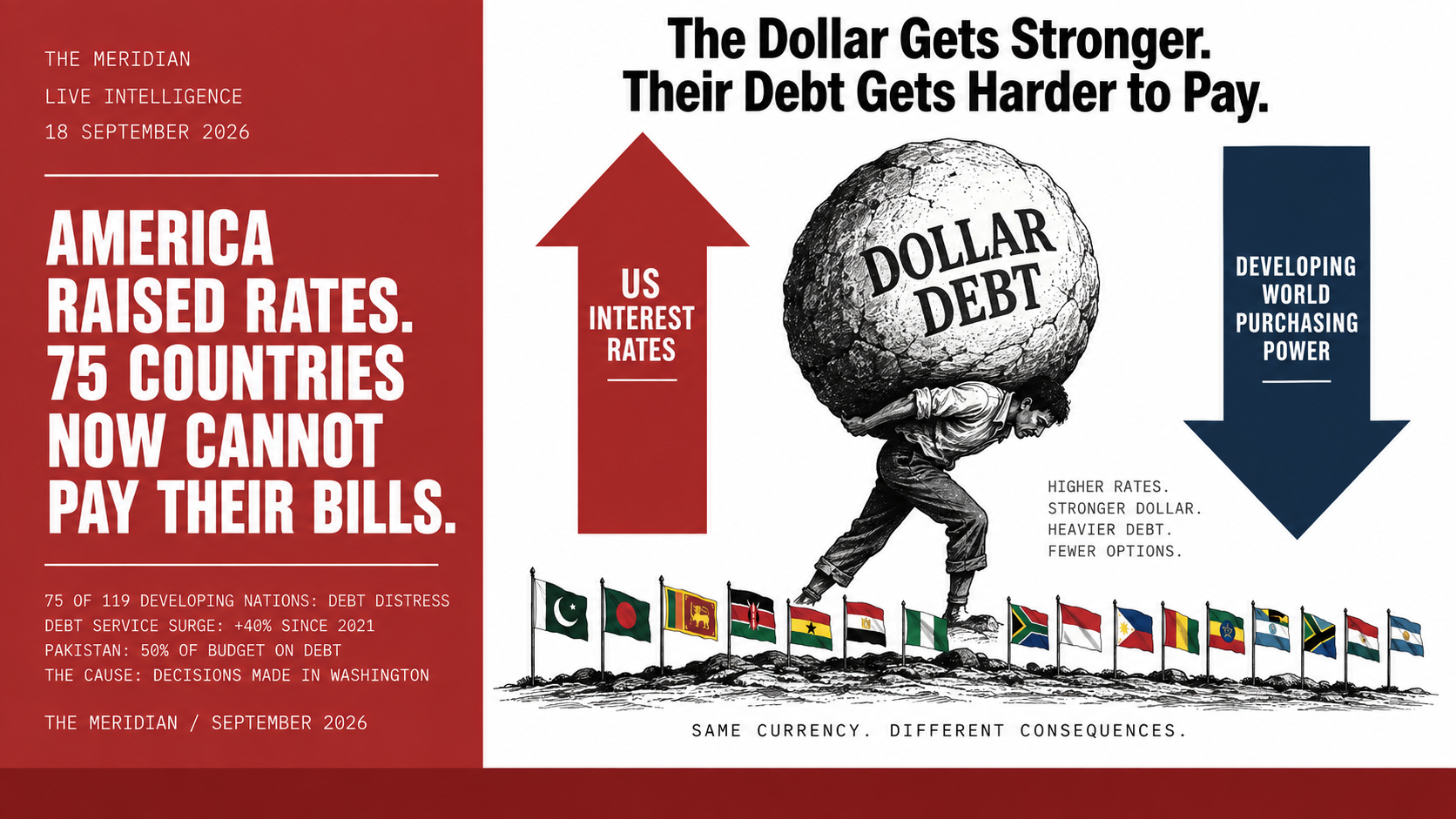
On 16 September 2026, the United States Federal Reserve raised interest rates to 4%, its first increase since 2023. The decision was made for American reasons: inflation in the United States was running above target, driven partly by energy prices from the war in the Middle East. But the consequences of that decision do not stop at America's borders. Seventy-five developing countries are already in or near debt distress. Payments on developing country debt have surged 40% since 2021. Pakistan now spends more than half its entire federal budget on debt repayments alone. This article explains the direct connection between a decision made in Washington and the ability of governments on the other side of the world to pay for schools, hospitals, and food.
To understand why an American interest rate decision matters in Nairobi, Colombo, or Lusaka, it helps to start with a simple fact: most of the world's developing countries have borrowed money in US dollars. Not because they wanted to, but because they had to. International lenders, global bond markets, and institutions like the World Bank and the International Monetary Fund have historically offered the largest loans in dollars. The dollar is the world's reserve currency, the language in which global finance speaks. When a government in Ghana or Sri Lanka needed to build a road, fund a hospital, or manage a budget shortfall, it borrowed in dollars because that was where the money was.
Borrowing in a foreign currency creates a hidden risk that is easy to overlook in good times and impossible to ignore in bad ones. The government earns its tax revenue in its own currency: Ghanaian cedis, Sri Lankan rupees, Zambian kwacha. But it must repay its loans in US dollars. To do that, it must convert its local currency into dollars on the foreign exchange market. And the cost of that conversion depends entirely on how strong the dollar is at the moment it needs to make the payment.
When the Federal Reserve raises interest rates, it makes holding dollars more attractive. Investors around the world who were placing money in developing countries, where returns were higher, now find that American assets offer a better return without the risk of investing in a poorer country. Money flows back toward the United States. Demand for dollars rises. The dollar gets stronger relative to other currencies.
For a developing country with dollar-denominated debt, this creates an immediate problem that has nothing to do with anything it has done. Its own currency buys fewer dollars than it did before. Its debt, measured in dollars, has not changed. But the amount of local currency it must spend to buy those dollars has gone up. The debt has become more expensive to repay, not because the country borrowed more, but because a decision made in Washington changed the price of the currency it borrowed in.
Imagine a country that owes $1 billion in annual debt payments and has a currency that exchanges at 100 to the dollar. It needs 100 billion units of local currency to buy the dollars for its annual payment.
After America raises rates and the dollar strengthens, the same currency now exchanges at 115 to the dollar. The country still owes $1 billion. But now it needs 115 billion units of local currency to buy the same dollars. It must find 15% more money from somewhere, without having borrowed a single dollar more.
That extra 15 billion units of local currency must come from somewhere. In practice, it comes from spending cuts elsewhere: fewer teachers hired, fewer medicines purchased, fewer infrastructure projects funded. The debt payment has not changed. The cost of meeting it has.
These numbers represent a structural condition that existed before this week's rate rise and has now worsened. According to the Centre for Economic and Policy Research, 75 out of 119 developing countries with available assessments are currently in debt distress or at significant risk of it. The United Nations Conference on Trade and Development stated in March 2026 that as borrowing costs rise and fiscal space shrinks, developing countries are finding that the cost of finance is not merely financial. It is measured in postponed investments, constrained budgets, and development goals drifting further from reach.
Pakistan's situation illustrates the extreme end of what debt distress looks like in practice. More than half of Pakistan's entire federal government budget goes to debt repayment before a single rupee is spent on education, healthcare, or infrastructure. This is not the result of reckless borrowing in recent years. It is the accumulated result of decades of borrowing in dollars, combined with a rupee that has lost substantial value against the dollar, combined with interest rates that have risen sharply. Pakistan is spending the majority of its public resources servicing the past rather than building the future.
The currency effect is the most immediate consequence of America's rate rise for developing countries. But there is a second and a third problem that compounds it over time.
The second problem is what happens when existing loans come up for renewal. Loans and bonds have maturity dates. When they expire, governments must repay the principal and take out new loans to replace them. Before this week, the interest rate on new dollar-denominated borrowing for a developing country was already high, because lenders charged a premium above the US Treasury rate to compensate for the risk of lending to a poorer country. Now that the US Treasury rate has risen to 4%, that premium sits on top of a higher base. A country that was borrowing at 7% before may now face borrowing costs of 9% or more when its current loans mature. The debt burden has not changed yet. The cost of renewing it has risen substantially.
The third problem is the most insidious. The same institutions that lend to developing countries and charge higher rates also charge additional fees when countries fall into difficulty. The IMF currently charges surcharges, additional fees on top of the standard interest rate, to its most indebted borrowers. According to the Centre for Economic and Policy Research, developing countries are expected to pay an estimated $5.2 billion in these surcharges between 2025 and 2030. These are countries that are already struggling to service their debt. They are being charged extra because they borrowed heavily to begin with, at the same time that rising US interest rates are making that debt more expensive to service.
The cost of finance is not merely financial. It is measured in postponed investments, constrained budgets, and development goals drifting further from reach. United Nations Conference on Trade and Development, March 2026.
The Federal Reserve's rate-setting committee, the Federal Open Market Committee, has twelve voting members. All twelve voted to raise rates on 16 September 2026. They are all American. They were appointed to make decisions about American monetary policy for the American economy. That is precisely what they did.
The governments of Ghana, Sri Lanka, Zambia, Pakistan, Egypt, Kenya, and the other seventy-odd countries now facing harder debt repayments as a result of this week's decision had no seat at that table. They were not consulted. They did not vote. Their economic circumstances were not part of the Federal Reserve's mandate or its deliberations. They will feel the consequences nonetheless.
This is not a criticism of the Federal Reserve, which was doing exactly what it is designed to do. It is an observation about the architecture of the global financial system. The dollar's status as the world's reserve currency gives the United States extraordinary economic power: the ability to set the price of money for the entire world. That power carries consequences that extend far beyond America's borders, and those consequences fall most heavily on the countries with the least ability to absorb them.
Fifteen countries defaulted on their debt between 2020 and 2023. The debts that broke them were not new. They were old obligations, contracted when interest rates were low and dollars were cheap, that became impossible to service when the dollar strengthened and rates rose. This week's Federal Reserve decision does not guarantee a new wave of defaults. But it tightens the conditions for the countries that were already closest to the edge.
The World Bank's July 2026 Global Economic Prospects report projected global growth of 2.5% in 2026, with developing economies facing the weakest per capita income growth since the pandemic. The Middle East conflict that drove America to raise rates is the same conflict driving that growth slowdown. The poorest economies are absorbing both the direct economic shock of higher energy prices and the indirect financial shock of higher dollar borrowing costs, simultaneously.
There is no straightforward solution to this architecture. The dollar's role in global finance is not going to change because it is inconvenient for developing countries. What can change is the awareness, among the people who read this article and the institutions they work within, that the line between an interest rate decision in Washington and a cancelled school building in Lusaka is not abstract. It is direct, it is documented, and it plays out every time a major central bank changes the price of money.
Add comment
Comments