One Harvest Feeds Southern Africa. It Is Being Planted Now.
A strong El Niño is forecast to dry southern Africa and flood East Africa in the same season. The last time it happened, six governments declared disasters and the appeal raised fourteen pence in the pound. This time the region holds the largest grain stock in its history, and farmers are planting the smallest maize area since 2019.
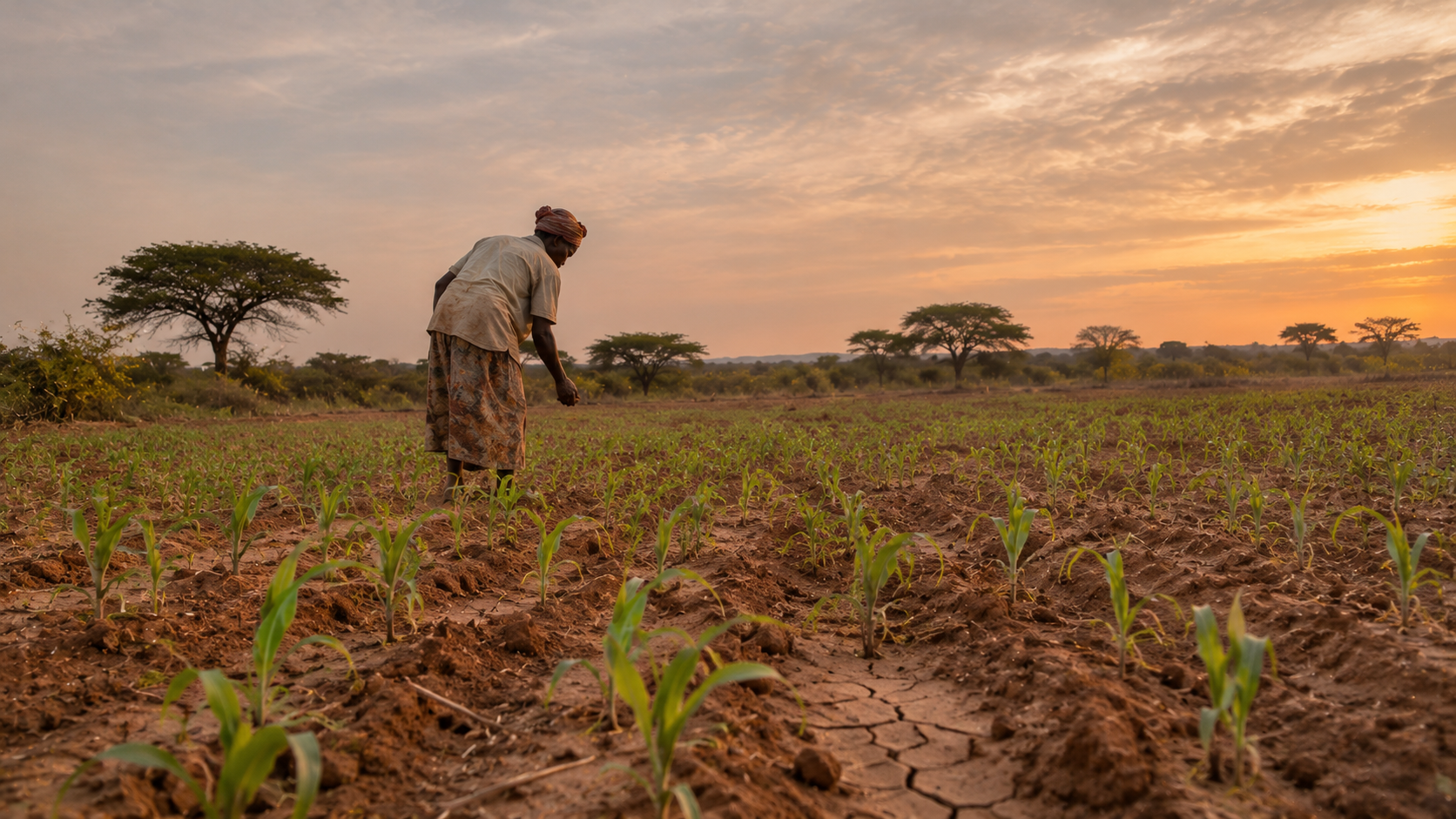
Across southern Africa the maize goes into the ground between late October and December. It is harvested from April. Everything about the regional food supply in 2027, the price of the staple, the size of the import bill, the number of people who need feeding, is being decided in fields right now, by farmers who have read the same forecast everybody else has read.
What they have read says the rain will not come.
El Niño does not do the same thing everywhere in Africa. It does opposite things, and the opposition is the most reliable feature of its African signature: floods in East Africa during the October to December short rains, drought in southern Africa during the December to February growing season. Two forums, meeting a week apart in August, forecast exactly that.
This is not an accident of two bad years coinciding. The dipole between eastern and southern African rainfall is the defining feature of how the Pacific reaches Africa, and it means the continent cannot pool its way out: the surplus region and the deficit region swap places with the ocean, and when one half needs grain the other half is usually under water.
One distinction matters throughout what follows, and it is routinely lost. Southern Africa grows two maizes. Yellow maize is largely animal feed. White maize is what people eat, milled into the meal that is the staple across the region, and it is not interchangeable in any practical sense: a Zimbabwean household will not switch to yellow because it is cheaper, and governments know it. So the figure to watch is never total maize. It is white maize, grown on about 1.66 million hectares in South Africa in 2026, and concentrated in exactly the provinces now cutting back.
The 2023-24 El Niño is the case everyone in the region is working from, and it went badly.
Zambia declared a national disaster on 29 February 2024, the first to move. Malawi followed on 24 March, declaring a state of emergency across 23 of its 28 districts, with a preliminary government assessment putting up to two million farming households and 44 per cent of the national cropping area under drought. Zimbabwe declared in early April. Botswana, Lesotho and Namibia also declared. Six countries in six weeks.
In Zambia, 982,765 hectares of maize were destroyed, 43 per cent of the planted area. Across ten SADC member states the maize harvest came in around 28.1 million tonnes, nine per cent below the five-year average. Then came the asking.
Fourteen pence in the pound, against a disaster that had already happened, in countries whose governments had formally declared it. That is the benchmark against which every decision now being taken in the region should be read.
The price effects followed the harvest with the lag that defines these events. In Malawi maize prices reached 130 to 160 per cent above the five-year average. Across the region the shortfall had to be bought in, and the scale of that trade is easy to underestimate: SADC maize imports excluding Zambia ran to 3.56 million tonnes in 2025, worth about 1.13 billion dollars. A regional harvest failure does not merely create hunger. It creates a hard-currency bill, payable by treasuries that are generally short of hard currency, in the same year their tax receipts fall because the farm economy has contracted.
Nobody in Lusaka or Harare is planning on the assumption that the money will arrive. They watched what arrived last time.
Here the story departs from 2024, and it departs sharply.
Southern Africa has just had the best maize year in its recorded history. South Africa's commercial crop was confirmed at 17.7 million tonnes on 27 October, the largest ever, against annual national usage of about 12 million. Zambia harvested 4.94 million tonnes, also a record, against human consumption of 2.09 million. Zimbabwe's government confirmed 2.82 million tonnes, against domestic consumption of roughly 2.2 million.
12.00
2.09
2.20
That chart quietly disposes of a common assumption, including one this publication held when it commissioned the piece. Southern Africa is not a region with one granary and eight dependants. Zambia's projected exports of 2.49 million tonnes exceed Zimbabwe's entire harvest. There are at least two genuine surplus producers, and in 2026 a third country that normally imports did not need to.
Zimbabwe cut its grain import bill by 93.9 million dollars in the first seven months of 2026 on the strength of its own crop. The United States Department of Agriculture expects it to import about 600,000 tonnes of maize in the 2026-27 marketing year, down from roughly 800,000 the year before.
The stock exists. It was not free, and the way it was accumulated tells you something about how a state behaves when it has been frightened.
A state grain agency that overshoots its purchase target by a factor of five is not running a market operation. It is insuring against a repeat of 2024, and it has borrowed to do so. The supplementary budget approved on 4 November was in substantial part a bill for grain the government had already taken delivery of and not yet paid for.
This is the part of the story that will not appear in a food security bulletin. The buffer protecting the region in 2027 is sitting in Zambian silos, financed by Zambian borrowing, and the cost of holding it falls on one treasury while the benefit, if the drought arrives, spreads across the region.
There is real evidence pointing the other way, and it would be dishonest to leave it out.
The season has not started badly. Soil moisture in September was above average across eastern Botswana, South Africa, Lesotho, Eswatini, southern Zimbabwe, southern Malawi and central and southern Mozambique. Parts of Lesotho and South Africa recorded up to 200 millimetres above average, and several southern and eastern areas, including Zimbabwe, Botswana, South Africa and Mozambique, saw early pre-season rains, with onset in places running as much as three dekads early. Pasture and grazing conditions in the south are good, following a wet 2025-26 season.
This is why South African agricultural economists spent October arguing against cutting area, recommending instead that farmers switch to shorter-growing cultivars that can finish before the heat arrives. Favourable soil moisture at planting is a genuine asset, and a seasonal forecast is a statement of probability rather than a prediction that it will not rain.
The counterweight is that moisture at planting cannot substitute for rain in January and February, when the crop fills. The Climate Hazards Center expected erratic, below-average rainfall across much of the central region between 19 October and 17 November, which raises the risk of a broken onset: rain that is enough to germinate a crop and not enough to carry it. That is the worst of the possible outcomes, because the seed and the fertiliser have already been spent.
The clearest evidence that the lag is real, and that people are acting on it, is in the futures curve.
Read in one line: the market is saying that today's grain is abundant and next April's is not. A farmer deciding what to plant this month, a miller deciding what to contract, and a finance ministry deciding whether to import now or later are all looking at that curve.
South African farmers have made their call, and it is the single most consequential number in this article.
On 27 October the Crop Estimates Committee published its first report on intentions to plant for the 2027 crop. Commercial growers intend to plant 2,387,200 hectares of maize, down 337,000 hectares or 12.4 per cent on the 2,724,200 hectares of 2026. That is the smallest maize area since 2019 and roughly ten per cent below the five-year average. The contraction is concentrated in the Free State and North West, which are the major white maize provinces, and white maize is what people in the region eat.
Two forces drive it: the El Niño forecast, and input costs that have risen on the back of this year's disruption to global fertiliser and fuel markets. The logic is sound at the level of the individual farm. Planting a large area into a forecast drought, at high input cost, with prices already soft from a record crop, is a good way to lose money twice.
The aggregate consequence is that the 2027 harvest will be smaller than 2026 before the weather has done anything at all. Roughly an eighth of the area is gone by decision. Whatever the rain does from here is applied to a smaller base.
Everything above concerns the dry half of the dipole. The wet half has no equivalent cushion.
The pattern in East Africa is the ugly one: drought legacy in the north, flood risk in the south-east, simultaneously. Suppressed rains during the June to September season left Ethiopia, Sudan, South Sudan, Karamoja and western Kenya dry, and those effects do not reverse because the short rains arrive heavily somewhere else. A flood does not undo a failed harvest. It destroys a different one.
The region is better placed than at any point in living memory to absorb a dry year, and the reason is luck rather than policy. Two consecutive good seasons produced records in South Africa, Zambia and Zimbabwe at the same moment, and one government chose to buy and hold an unusually large share of it. Had this El Niño arrived in 2024 or 2025, the position would be very different.
The buffer covers one bad year. It does not cover two. A region holding record stocks going into a drought is in a good position; the same region in late 2027, having drawn those stocks down to cover a failed harvest, with an area already cut by an eighth and no guarantee the following season is better, is in a poor one. The exposure is not 2027. It is 2028, and nothing currently in place addresses it.
Two further things follow. The cost of regional insurance is being carried by a single treasury, and no mechanism exists to share it: Zambia borrowed to hold grain that may end up feeding its neighbours, and will be repaid by selling it to them rather than by any arrangement agreed in advance. And the humanitarian channel should not be expected to fill gaps. On the 2024 evidence it delivers about fourteen per cent of what is asked for, after the harvest has already failed, which is both too little and too late to be planned around.
First, the Crop Estimates Committee area estimate on 27 January 2027. Intentions are not plantings. In 2017 farmers fell short of their stated intentions because the rain did not cooperate in exactly these provinces. If the January figure comes in below 2.39 million hectares, the 2027 crop is smaller again.
Second, whether Zambia sells or holds. A government that has borrowed 980 million dollars against a grain pile has an incentive to sell into a rising regional market. If it exports aggressively into early 2027, the regional buffer is smaller than the stock figures suggest.
Third, Zimbabwe's import licensing. The government opened the door to private grain imports on 16 September, before any crop had failed. That is a tell.
Fourth, the January to March rainfall. The below-normal signal expands northward in that window, reaching Zambia and Malawi, which are precisely the areas the August forecast had spared. If that verifies, the northern producers lose their crop too and the dipole stops being a story about trade and becomes a story about shortage.
The harvest that answers all of this is in the ground by Christmas. The answer arrives in April.
Data notes: The southern African seasonal forecast is from the SADC Climate Services Centre and the Thirty-Third Southern Africa Regional Climate Outlook Forum, held 25 to 28 August 2026 in Swakopmund, Namibia, and released on 28 August 2026, with sub-regional detail taken from the FEWS NET Southern Africa Seasonal Monitor of October 2026. The East African forecast is from the ICPAC GHACOF 74 technical statement of 18 August 2026. The east-south rainfall dipole is a documented feature of ENSO's African expression rather than a coincidence of two forecasts. The 2024 disaster declarations, the Zambian figure of 982,765 hectares, the Malawian district and cropping-area figures and the regional harvest of 28.1 million tonnes are from the SADC Regional Humanitarian Appeal of May 2024 and its November 2024 addendum. Appeal and funding figures are from UN OCHA and from a United States Government regional drought update dated 30 September 2024; the 156 million dollar figure is the amount provided as of that date against the 1.1 billion dollar United Nations appeal, and later disbursements are not captured. The 5.5 billion dollar SADC figure is the regional appeal total and is not directly comparable with the UN appeal, which covered five countries. Production figures are from the South African Crop Estimates Committee ninth estimate of 27 October 2026, the Zambian Ministry of Agriculture food balance sheet for the 2026-27 marketing year, and the Government of Zimbabwe; FEWS NET's second-round crop assessment put the Zimbabwean crop at 2.35 million tonnes against the government's 2.82 million, and this publication has not been able to reconcile the two, so both are stated. Zambian Food Reserve Agency purchases, the record stock figure and the supplementary budget approved on 4 November 2026 are from Zambian parliamentary proceedings and agency figures. Price data are JSE SAFEX settlement prices via Grain SA for 10 November 2026, with the 16 and 30 October comparisons from contemporaneous market reporting; near-term quotes vary between sources and the forward curve should be read as indicative. Planting intentions are from the Crop Estimates Committee report of 27 October 2026, the first for the 2027 season. Eastern African caseload figures are from the UN OCHA Regional Office for Southern and Eastern Africa, with the Somalia displacement projection from IOM and the Ethiopian drought figure from national disaster authorities as reported in October 2026. Where figures from different official bodies conflict, both are given rather than averaged.
Content Protected
This article is the original work of The Meridian and is protected by copyright. Please link to it rather than reproducing it.