Mauritius Imports Its Dinner. The State Pays the Difference.
A loaf of pain maison has cost 2.60 rupees since 2022. It costs 4.80 to make. The gap is not in the national budget: it sits on the balance sheet of a state trading company that now carries negative equity and 8.1 billion rupees of foreign-currency debt. Here is how an island converts a food price into a solvency question.
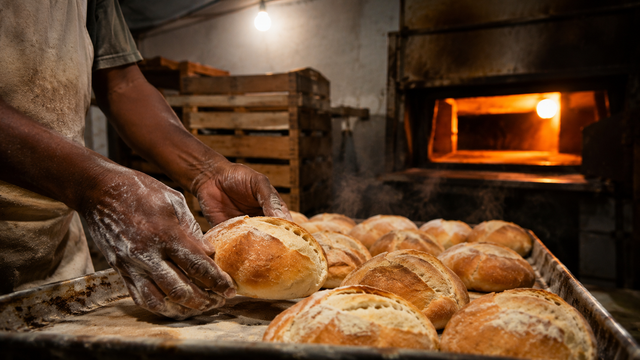
Three prices in Mauritius have not moved since 2022. A hundred-gram loaf of pain maison costs 2.60 rupees. A kilogram of ration rice costs 10.80. A twelve-kilogram cylinder of cooking gas costs 240. Through four years of global food and energy disruption, a currency that has lost almost a tenth of its value against the dollar, and a war in the Middle East, those three numbers have held exactly still.
This did not happen by itself, and it was not free. Understanding where the cost went is the most useful thing anyone can know about Mauritian economic policy, because it is not where almost anyone looks.
The State Trading Corporation was created by the State Trading Corporation Act of 1982 and began operating the following year. It is wholly state-owned, reports to the Ministry of Commerce and Consumer Protection, and holds an exclusive legal monopoly on importing four things: petroleum products, liquefied petroleum gas, long grain white rice, and wheat flour.
That monopoly is the instrument. Because one entity buys all the fuel and all the staple grain, the state can set the shelf price of each at whatever it chooses, and absorb the difference internally. Flour works through a further arrangement: the STC procures half the national requirement by international tender and buys the other half from the single domestic mill, Les Moulins de La Concorde, which mills imported wheat.
The scale is large. In the audited year to June 2023 the corporation turned over 46.6 billion rupees and moved 1,111,057 tonnes of petroleum products, 98,780 tonnes of flour, 91,825 tonnes of LPG and 25,062 tonnes of ration rice. By 2024 it was paying foreign suppliers around four billion rupees a month.
Read the national budget looking for the cost of cheap bread and you will not find it.
The mechanism is a cross-subsidy. Motorists pay more for petrol and diesel than the fuel costs, and the margin funds cheap rice, flour and gas. In the year to June 2023 that transfer was 3.7 billion rupees, against a total subsidy of four billion. The consumer price of bread is therefore set, in substantial part, by the price of fuel, and neither relationship appears anywhere a voter would look for it.
The price of bread in Mauritius is a political commitment. The bill for it is an accounting entry in a company most voters could not name.
A cross-subsidy works while the margin on fuel covers the loss on food. From 2022 both sides moved the wrong way at once, and the corporation absorbed it.
By the end of June 2023 the STC had recorded a net deficit of 622.9 million rupees and was carrying negative equity of 311.2 million. Its Price Stabilisation Account, which exists to smooth fuel prices, was 4.6 billion rupees in deficit, having peaked at 5.2 billion in September 2023 after retail increases on petrol and diesel were capped at ten per cent.
Those last two bars deserve to be read together. In April 2025 the corporation that buys the nation's fuel and staple grain held 1.7 billion rupees in cash against 8.1 billion in foreign-currency debt, and its cash position had fallen by a billion rupees in nine months. It had also recorded a surplus of 1.5 billion on its non-subsidised lines in the year to June 2024, which is to say that the commercial side of the business was working and being consumed by the subsidised side.
The foreign-currency borrowing is the part that connects this to everything else. The STC borrowed in dollars because dollars were scarce. A state trading company that funds a domestic price commitment with foreign-currency debt has taken on exactly the exposure that the price commitment was meant to protect households from, and moved it one level up.
Every figure above is denominated in rupees and almost every cost behind it is denominated in dollars. That gap is where the pressure comes from, and it has been widening steadily rather than dramatically.
The rupee traded at about 43.80 to the dollar in early 2022. It was around 46 a year ago. In November 2026 the mid-rate was 47.53. Against the euro the move is similar, from about 49.90 to 52.53. Neither is a collapse. Taken over five years it amounts to somewhere between eight and ten per cent against the dollar, which is a perfectly ordinary depreciation for a small open economy running a persistent trade deficit.
It is ordinary, and it is still the problem, because the shelf price of the loaf did not move eight per cent. It did not move at all. Every rupee of depreciation over four years has been absorbed somewhere, and the ledger it was absorbed on is the one in Chart 3. The Bank of Mauritius does not publish a pass-through elasticity for food specifically, but its own modelling treats imported food and fuel through a real marginal cost of imports that combines world dollar prices with the exchange rate, and finds that shocks reach unsubsidised retail prices within one to two quarters. For subsidised items, the shock does not reach the shelf at all. It reaches the corporation.
This publication went into the research with two assumptions. The evidence contradicted both, and the corrections matter.
The first is that staple prices in Mauritius have been held flat. They have not. Three narrow items are frozen. Everything else is market-priced, and more than nine-tenths of a food import bill of roughly 57.7 billion rupees falls outside the subsidy entirely: dairy, meat, edible oil, non-ration rice, processed food. Food inflation peaked above fifteen per cent in late 2022 and early 2023, and it has not gone away. Headline inflation measured year on year ran at 4.4 per cent in July 2026, 4.9 in August, 5.7 in September and 6.4 in October. Food prices rose 5.5 per cent in the year to October, which the Governor of the Bank of Mauritius attributed principally to bread and cooking oil, meaning the unsubsidised bakery products rather than the controlled loaf.
The second assumption was that Mauritius has been letting its food-growing land disappear. The land that disappeared was sugar cane.
42,000
8,000
The conversion was lawful and deliberate. The Sugar Industry Efficiency Act of 2001 requires a permit and a conversion tax to take land out of cane, but exempts a long list of schemes: the Integrated Resort Scheme of 2002, the Real Estate Scheme of 2007, the Property Development Scheme and the Smart City Scheme of 2015, voluntary retirement housing and decentralisation projects. Those exemptions describe, fairly precisely, what replaced the cane.
So the failure is not that food land shrank. It is that an area larger than four times the entire national food-crop estate came free over two decades, and the food-crop estate grew by six hundred hectares.
The pattern is consistent and it is not an accident of climate. Mauritius is self-sufficient in everything that can be grown on a small plot, harvested quickly and sold fresh, and self-sufficient in nothing that requires scale, storage and bulk handling. Those are precisely the crops that need the land that came out of cane.
Which brings us to the question this edition has been asking of several countries, and which produces the starkest finding in this article.
Zambia, as this edition reported two articles ago, holds 3.1 million tonnes of maize in a state reserve and borrowed 980 million dollars to do it. Mauritius holds between thirty and sixty days of rice and flour in a working commercial inventory, under no statute, with no obligation on any private importer to hold anything at all. Fuel, by contrast, has a numbered performance target in the budget estimates.
That asymmetry is a statement of priorities made decades ago and never revisited.
The bill itself is substantial and growing. Food and live animals, with edible oils, account for somewhere between 18.5 and 19.2 per cent of total merchandise imports, on a total import bill of around 315 billion rupees in 2025. Food alone rose 6.2 per cent that year to roughly 57.7 billion. Rice comes overwhelmingly from India, with Pakistan second. Dairy comes principally from New Zealand, and Mauritius imports more than ninety per cent of what it drinks and spreads. Beef and mutton come from India, Australia, New Zealand, South Africa and Brazil. Edible oil comes from Argentina, Brazil, Malaysia and Indonesia. Onions, garlic and pulses come largely from India.
That list is a map of the island's exposure, and it is worth noticing how little of it is African. Mauritius sits off the coast of a continent that grows maize, and buys its staples from South Asia, the Southern Cone and Oceania.
One finding cuts against the alarm, and it should be stated plainly: the world grain market is currently about as open as it has been in five years.
India, which supplies between 75 and 85 per cent of Mauritian rice, has no export ban, no export duty and no minimum export price in force. The ban on non-basmati white rice imposed in July 2023 was lifted on 28 September 2024, the minimum export price was scrapped on 23 October 2024, the duty on parboiled rice went to zero on 22 October 2024, and the ban on broken rice was lifted on 7 March 2025. A new inspection certificate requirement introduced on 9 November 2026 applies to European destinations and explicitly exempts Mauritius. Pakistan, Thailand and Vietnam are all operating open export regimes. Russia cut its floating wheat export duty to zero until the end of 2026.
So the immediate threat to the Mauritian dinner table is not that the rice will be unavailable. It is that the rupee buys less of it, and that the entity doing the buying is short of cash and holding dollar debt.
Mauritius has run an unusual and, on its own terms, successful policy. Through the worst global food price episode in fifteen years, the price of bread, rice and cooking gas for a Mauritian household did not change once. Very few countries managed that. It is a real achievement and it protected real people.
It was achieved by moving the risk rather than removing it. The exposure now sits in three places. It sits on the STC's balance sheet, which carries negative equity, a cash position that halved in nine months, and foreign-currency debt taken on during a dollar shortage. It sits in the fuel price, because the cross-subsidy means a motorist is paying for the loaf. And it sits in the exchange rate, because a currency that has depreciated by around nine per cent against the dollar in five years raises the cost of everything the corporation buys while the shelf price it is permitted to charge stays fixed.
None of those three is a food problem. They are a balance sheet problem, a fuel pricing problem and a monetary problem, and they will be managed by institutions that do not think of themselves as being in charge of dinner.
The Bank of Mauritius raised its key rate to 5.00 per cent on 10 November and projects headline inflation at 5.5 per cent by December 2027, above the upper bound of its target range. It has sold 155 million dollars into the domestic market this year, 90 million of it since September. The Treasury intends to narrow the deficit from 3.7 per cent of GDP to 3.0 per cent. Each of those is a reasonable decision on its own. Together they describe a state tightening on three fronts while a parastatal holds a price commitment it cannot fund from its own trading.
The June 2026 budget created a Purchasing Power Shield and launched a food security plan called 25by35, targeting 25,000 arpents of land under food production by 2035, up from about 19,000. It is the fourth such strategy since 2008. The first targeted 30 to 35 per cent self-sufficiency and full self-sufficiency in potatoes and onions; the outcome was below 30, around 60 and around 40 respectively. The third, covering 2016 to 2020, targeted a 10 to 15 per cent reduction in food imports; imports rose. A plan with a 2035 horizon is a reasonable thing to publish and it should be judged against that record.
First, the STC's audited accounts for 2023-24 and 2024-25. At the time of writing the 2023-24 report was not publicly retrievable and the 2024-25 accounts were still with the National Audit Office. Those two documents contain the answer to whether the position has stabilised or deteriorated, and their absence is itself informative.
Second, the fuel price. Because the cross-subsidy runs from petrol to bread, any decision to cut pump prices tightens the food subsidy, and any decision to raise them is a hidden food tax. Watch for a change in either and read it as a food policy decision.
Third, whether the three frozen prices move. Four years is a long commitment, and the first increase in any of them, whenever it comes, will be a political event considerably larger than its arithmetic.
Fourth, the Food Security Bill promised in the June 2026 budget. If it creates a statutory minimum stock requirement, Mauritius will have a food reserve for the first time. If it does not, the island will continue to run on thirty to sixty days of rice held in a shed at Mer Rouge.
Data notes: The STC's statutory basis and commodity monopolies are from the State Trading Corporation Act 1982 and the corporation's own published material. Turnover, volumes, the net deficit of 622.9 million rupees, negative equity of 311.2 million, the four billion rupee subsidy and the 3.7 billion rupee cross-subsidy from fuel are from the audited STC Annual Report for the year ended 30 June 2023. Volumes for July 2023 to April 2024 and the administrative grant figures are from Ministry of Finance Estimates, Vote 22-1. The subsidy account deficit, Price Stabilisation Account figures, cash position and the 8.1 billion rupees of foreign-currency loans are from the Minister of Commerce and Consumer Protection's answer to the National Assembly on 15 April 2025, recorded in unrevised Hansard, Debate No. 11 of 2025. The STC's audited report for 2023-24 could not be retrieved and the 2024-25 accounts were under National Audit Office review at the time of writing, so no figure later than April 2025 is given for the corporation's balance sheet. Frozen retail prices, unsubsidised costs and the 167 per cent increase in the per-loaf bakery subsidy are from the Mauritius Revenue Authority Budget Highlights of 7 June 2024 and the BDO Budget Brief 2023-24; the unsubsidised costs of rice and LPG are published as ranges and the percentages in Chart 2 use range midpoints. Exchange rates, the key rate decision of 10 and 11 November 2026, the foreign exchange interventions and the inflation projections are from the Bank of Mauritius. Inflation outturns are from Statistics Mauritius; the October 2026 food figure of 5.5 per cent is taken from the Governor's statement of 10 November 2026 citing that month's release, as the monthly publication itself was not retrieved in full. Trade values are from Statistics Mauritius external trade statistics; the 2025 total merchandise import figure is published as 315,464 million rupees in the revised series and 318,962 million in the preliminary release, and both are official. Category values and supplier shares are given as verified ranges rather than point estimates because the three-digit annex tables were not retrievable. Export restriction status for India, Pakistan, Thailand, Vietnam, Russia, Ukraine and Argentina is as at November 2026 from national trade notifications and the FAO-hosted Agricultural Market Information System monitor of 5 November 2026. Reserve arrangements are from the STC Annual Report, Vote 22-1 and the WTO Trade Policy Review of Mauritius; the finding that no standalone national strategic food reserve exists is stated as the result of that review. Land and self-sufficiency figures are from the Mauritius Academy of Science and Technology with FAREI and the InterAcademy Partnership, August 2024, and Statistics Mauritius agricultural digests. Food security strategy targets and outcomes are from the respective strategy documents and the June 2026 Budget Speech. Two working assumptions held by this publication before research, that retail food prices generally had been held flat and that food-crop land had been shrinking, were contradicted by the evidence and are corrected in the text above rather than quietly dropped.
Content Protected
This article is the original work of The Meridian and is protected by copyright. Please link to it rather than reproducing it.