Mortgages on Homes No Insurer Will Cover
A bank in Seychelles audited where its collateral physically sits. Ninety-two per cent of its top-tier loan book is within fifty metres of the sea or five metres of sea level, and over half of it is at one metre. The loans run thirty years. The insurance policy holding them up runs twelve months.
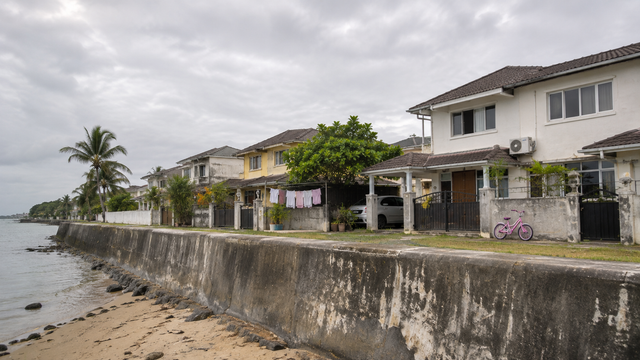
Every residential mortgage in Mauritius, the Caribbean and the Pacific islands carries the same clause. The borrower must keep the building insured, for its full reinstatement value, with the bank named as first loss payee, for the entire life of the loan. In Mauritius it is authorised by the Borrower's Protection Act 2007. In Fiji it sits at section 1.11 of ANZ's consumer lending terms, requiring a certificate of currency every year. In the Caribbean it is written into the Conveyancing and Law of Property Acts.
Nobody reads it, because for forty years it has been a formality. It is about to stop being one.
That is a duration gap of up to thirty-nine years, and it is not an oversight. It is structural, and the attempt to close it failed.
In 2010 three economists, Dwight Jaffee, Howard Kunreuther and Erwann Michel-Kerjan, proposed long-term property insurance running three to ten years or matched to the mortgage itself, attached to the building rather than the owner. Pilots were run, including a multi-year homeowners policy by Lexington Insurance. They were abandoned or confined to non-catastrophe perils for three reasons that have not changed: reinsurers will not write fixed-price catastrophe cover beyond a few years, and even catastrophe bonds top out at five; regulators block mid-term repricing when hazard models move; and solvency capital charges on multi-year unhedged catastrophe commitments destroy the return on equity.
So the mismatch is permanent. The question is only what happens when the short leg breaks.
Here is the part that makes this a banking story.
Under the Basel framework, a residential mortgage qualifies for its preferential risk weight only if it satisfies six operational criteria. One of them, at CRE20.73, requires that the property is valued prudently and is adequately insured against the risk of damage. Fail any of the six and the exposure loses its status as regulatory residential real estate, and reverts to the unsecured risk weight for that counterparty.
Read that as a sequence rather than a table. An insurer declines to renew. The borrower cannot find replacement cover, or can but not at a price they can pay. The bank either force-places a policy and adds the premium to the loan, which is permitted everywhere and makes the borrower's position worse, or it accepts that its security is uninsured. At that moment the capital it must hold against that loan goes from 35 to 75 per cent, and if the added premium tips the borrower into arrears, to 100.
None of that requires a cyclone. It requires an underwriter in London deciding not to renew a treaty.
The flood does not have to arrive. The withdrawal of the promise to pay for the flood is sufficient.
The obvious assumption is that island premiums are rising because global catastrophe reinsurance is expensive. In 2026 the opposite was true, and the gap between the two is the most revealing number in this article.
Two mechanisms explain the divergence, and both work against small islands specifically.
The first is cession. A Caribbean or Pacific primary insurer has neither the capital nor the geographic spread to carry cyclone risk itself, so more than eighty per cent of property premiums written in these markets are passed straight to international reinsurers. The local company retains perhaps fifteen to twenty per cent of the risk and almost none of the pricing power.
The second is attachment points. In 2023 reinsurers raised the level at which their cover begins, and through the softening of 2025 and 2026 they cut prices on the upper layers while refusing to lower those retentions. Moody's put it plainly in September 2026: most recent losses were retained by primary insurers rather than ceded, larger primaries secured better terms, and smaller insurers saw attachment points hold or rise.
So a cheaper reinsurance market delivers its savings to whoever was already large. A small island insurer pays more for the working layer, retains more frequency losses from events like Cyclones Belal and Garance or Hurricanes Beryl and Melissa, and recovers it from households. The headline index and the household bill move in opposite directions, and the household has no way of knowing why.
Mauritian insurers have not withdrawn, and it matters to say so clearly. SWAN, MUA, SICOM, Eagle and Quantum all continue to write residential property cover. What they have done is reprice the risk through the terms rather than the headline.
Cyclone and flood are not included in a standard Mauritian buildings policy. They come through an allied perils extension, which mortgage lenders make compulsory. On that extension the standard deductible is ten per cent of every claim. At SICOM that excess runs from a minimum of 5,000 rupees to a maximum of 25,000, with temporary rehousing capped at 7.5 per cent of the building's sum insured for up to twelve months. Other insurers apply the ten per cent without a cap, or impose sub-limits, such as the 100,000 rupee ceiling Quantum places on certain water damage clauses.
A ten per cent deductible with no upper limit is not a smaller policy. It is a different product. On a ten million rupee reinstatement, a severe cyclone claim carries a million rupee excess before the insurer pays anything, which for most households is the difference between a repair and a default.
Household credit in Mauritius reached roughly 205 to 210 billion rupees by June 2026, growing 11.2 per cent in a year. Housing loans are around two-thirds of that, so somewhere between 135 and 142 billion rupees, which is a quarter or more of all domestic private sector bank credit. The Bank of Mauritius does not publish a separate line for lending against the coastal villas built under the integrated resort, property development and smart city schemes, though its Financial Stability Reports for June 2025 and June 2026 both warn that foreign-driven luxury residential valuations are raising collateral valuation risk.
Seychelles went and measured it, and the result is the most important document in this subject.
The central bank also named the mechanism, in its own words: "If 92 per cent of the collateral is coastal, a significant climate event could trigger a localised real estate market collapse. If the banks try to liquidate multiple properties at once in a damaged area, they will find few buyers, leading to fire-sale and significant recovery losses." It called this collateral contagion.
That is a national supervisor stating that its banking system's security is concentrated in one place and that the place can be damaged all at once. Very few regulators anywhere have published anything so direct. Barbados is working along similar lines, feeding coastal storm surge and wind damage rates into its solvency stress tests with IMF assistance, in a system where loans are 44 per cent of bank assets and over half of those are household mortgages.
When property becomes uninsurable in a rich country, the state steps in. This is not a marginal arrangement; it is enormous.
Now the comparison this article exists to make.
Réunion and Mauritius sit in the same stretch of the south-west Indian Ocean and are struck by the same systems. One of them has an unlimited sovereign guarantee standing behind every household policy. The other has the commercial market and nothing else. The difference is constitutional history, not risk.
It is not that nothing exists. It is that what exists was built for a different purpose and is routinely described as though it solved this one.
The Caribbean Catastrophe Risk Insurance Facility has paid out more than 390 million dollars across 65 events since 2007, including record payments after Hurricane Beryl. The Pacific Catastrophe Risk Insurance Company does the same for seven Pacific states. African Risk Capacity does it for African Union members. All three are excellent at what they do, and what they do is pay rapid parametric liquidity to a finance ministry.
None of them insures a house. The closest thing is a micro-policy: the Caribbean facility's livelihood protection policy pays an individual up to about 4,000 dollars, and the Pacific programme pays roughly 450 to 1,800. Those are relief payments, not buildings cover, and no bank will accept one against a mortgage covenant.
Only one body anywhere in the region has actually absorbed this cost for borrowers, and it did so under duress. On 13 November 2026 Jamaica's National Housing Trust announced it had taken on 585 million Jamaican dollars of peril insurance renewal increases for its own mortgagors for 2026-27, specifically so they would not default after Hurricane Melissa. That is a state housing agency improvising a backstop in the middle of a crisis, for its own borrowers only. Commercial bank mortgages were not covered.
The sequence from premium to default to price collapse is no longer hypothetical. It has been quantified, in the only market with data good enough to do it.
Keys and Mulder, working from over 74 million insurance payments inferred from American mortgage escrow records between 2014 and 2024, found that real premiums rose more than thirty per cent after 2020 and that the pass-through of disaster risk into pricing doubled. Those premiums are capitalised straight into house prices, cutting price growth by more than 40,000 dollars per home in the most exposed postcodes.
Ge, Johnson and Tzur-Ilan, using household-level renewal and credit records, measured the next step. Every additional 1,000 dollars of annual premium raises the probability of a mortgage going sixty days past due within a year by 0.38 percentage points, which against a baseline of 1.7 per cent is a 22 per cent increase, and it raises foreclosures. The 2023 renewal season alone pushed roughly 42,000 American mortgages into sixty-day arrears. It also makes people leave: a 1,000 dollar rise lifts the probability of relocating by 0.82 percentage points, and the vacated homes are bought disproportionately cheaply by cash investors.
The Financial Stability Board mapped the loop in January 2025, noting that 62 per cent of global natural disaster losses in 2023 were uninsured and that insurer withdrawal raises both the probability of default and the loss given default at the same time. The chairman of the United States Senate Budget Committee was blunter in December 2024, warning of a 2008-style crash with one difference: "Only unlike in 2008, these property values will likely never recover."
Three things are established and one is not.
Established first: the mismatch is real, permanent and unfixable by the insurance industry. A thirty-year loan rests on a twelve-month promise, the attempt to write longer promises failed for sound actuarial reasons, and nothing in the current market structure will change that.
Established second: small islands are being squeezed from both directions at once. Their insurers cede over eighty per cent of premium to reinsurers who have cut headline prices while holding retentions high, so the savings of a softening market flow to large insurers in large markets and the retained frequency losses flow to island households. A Caribbean homeowner paid roughly a third more in 2026 in a year when global catastrophe reinsurance fell by a sixth.
Established third: there is no residential backstop anywhere in the independent Global South. Rich countries carry around four and a half million households in statutory schemes underwritten by legislatures and, in the French case, by an unlimited sovereign guarantee that happens to cover Réunion. Mauritius, Seychelles, the Maldives, Fiji and the independent Caribbean have sovereign parametric pools that pay governments, and nothing at all that pays a household or satisfies a bank.
What is not established is that this has become a credit event yet. In Mauritius cover is still available and still being written. The repricing has come through deductibles and sub-limits rather than withdrawal, which is a meaningfully better position than Florida or California. Nor have supervisors been idle: Seychelles has published a more candid geospatial audit of its own banking system than most rich-country regulators have attempted, Barbados is building coastal damage into its stress tests, and the Bank of Mauritius has required banks to incorporate physical climate risk into credit decisions and collateral valuation since April 2022.
The gap is narrower and more specific than the alarm usually suggests. Supervisors now know where the collateral is. What none of them has done is connect that knowledge to the capital rules. No central bank in Mauritius, the Eastern Caribbean or Fiji has issued a circular requiring a bank to reclassify a mortgage's risk weight or to add provisions when the buildings policy is not renewed, even though the Basel framework makes insurance an eligibility condition. The trigger is written into the rulebook and nobody has wired it up.
First, the January 2027 reinsurance renewal, and specifically the attachment points rather than the headline rates. Rates are expected to soften again by five to ten per cent. If retentions hold where they are, island primaries face a fourth consecutive year of absorbing frequency losses, and the Caribbean retail premium increases of 2026 repeat in 2027.
Second, whether any supervisor issues the circular. The first central bank to require an automatic risk weight reclassification on insurance non-renewal will force every bank in its jurisdiction to find out, quickly, how much of its mortgage book is uninsured. Seychelles has the evidence base to do it.
Third, deductibles in Mauritius. The thing to track is not whether cyclone cover is available but what it actually pays. A ten per cent excess with no cap is already a substantial transfer of risk back to the household, and the next cyclone season will show how many claims it defeats.
Fourth, Jamaica. The National Housing Trust has absorbed one year of premium increases for its borrowers. Whether it does so again in 2027-28, and whether any commercial lender or government elsewhere copies it, will indicate whether an improvised backstop is becoming a permanent one.
Fifth, whether anyone proposes a regional pool. The actuarial case for pooling residential risk across small states has been made and published. Nobody has built one. The reason is that it requires several governments to commit money before a disaster rather than after, which is the single hardest thing to get any government to do.
Data notes: Mortgage insurance covenants and enforcement remedies are from ANZ Fiji's Consumer Lending Terms and Conditions of September 2023 and 1 July 2026, BSP Financial Group's standard home loan terms, the Mauritian Borrower's Protection Act 2007, the Chambers Banking and Finance Guide for Mauritius of 8 October 2026, and the Caribbean Conveyancing and Law of Property Acts, with Caribbean Court of Justice judgment [2015] CCJ 16 (AJ) documenting standard covenants. Risk weights are from the Basel Committee's CRE20, the Bank of England's PS9/24 of 12 September 2024 and the Bank of Mauritius Guideline on the Standardised Approach to Credit Risk. Reinsurance movements are the Guy Carpenter property catastrophe rate-on-line indices reported via Artemis at the January and mid-year renewals of 2024, 2025 and 2026, with Howden Re's 1.1.26 market report of 2 January 2026; the Caribbean retail figure is the midpoint of a reported 20 to 35 per cent range and is a retail premium movement rather than a reinsurance index, so the two are not directly comparable and the chart states both. The cession figure of over 80 per cent is from the Commonwealth Secretariat and World Bank study Management of Economic Risks in Small States. The attachment point commentary and the quotation are from Moody's Ratings, 2 September 2026. Mauritian policy terms are from SICOM General via Expat Mauritius, 25 July 2026, and the Quantum Insurance home policy wording of September 2026; insurance penetration of 4.8 per cent of GDP is total, from the Bank of Mauritius Financial Stability Report of June 2026, of which non-life is roughly 1.6 to 1.8 per cent, and this publication's earlier figure in Article 19 referred to non-life penetration only. Mauritian household and housing credit figures are from the Bank of Mauritius Monthly Statistical Bulletin of September 2026, the Financial Stability Reports of December 2024 and June 2026 and the 79th Monetary Policy Committee minutes of 26 August 2026; the housing share of household credit is published as a range of roughly two-thirds and the exact number of mortgage accounts is not published, so no point estimate is given. The Bank of Mauritius does not publish a separate statistical line for lending against integrated resort, real estate, property development or smart city units, and its absence is stated rather than estimated. Seychelles figures are from the Central Bank of Seychelles Climate-related Financial Risk Exposure Assessment Report and Banking Sector Climate Risk Exposure Assessment Report of 2025 and 2026, with the quotation taken verbatim from the first. The Barbados work is from IMF Country Report 26/007 of 30 January 2026. Backstop figures are from the OECD of 5 March 2026, the California FAIR Plan statistics of October 2026, Florida Citizens monthly reporting, the Flood Re annual report, and Law 82-600 of 13 July 1982 with the surcharge increase effective 1 January 2025. Sovereign pool characteristics are from the Global Shield Solutions Platform stocktake of June 2024 and the Asian Development Bank's Disaster Risk Financing in the Pacific of May 2026; the finding that no residential backstop exists in the independent small island states is stated as the result of that review rather than as proof that none exists anywhere. The Jamaican National Housing Trust absorption was announced on 13 November 2026. Empirical findings are from Keys and Mulder, NBER Working Paper 32579; Ge, Johnson and Tzur-Ilan, Federal Reserve Bank of Dallas Working Paper 2505r1; Gourevitch and others in Nature Climate Change, 2023; and the Financial Stability Board of 16 January 2025. The long-term property insurance proposal and the reasons for its failure are from Jaffee, Kunreuther and Michel-Kerjan, Journal of Insurance Regulation, 2010, with market context from AM Best, 2026.
Content Protected
This article is the original work of The Meridian and is protected by copyright. Please link to it rather than reproducing it.