Africa's Youth Bulge: The Demographic Window and the Jobs Gap
12 million young people enter Africa's labour market every year. The formal economy creates 3 million jobs. The remaining 9 million go somewhere -- and where they go determines whether this is a dividend or a crisis
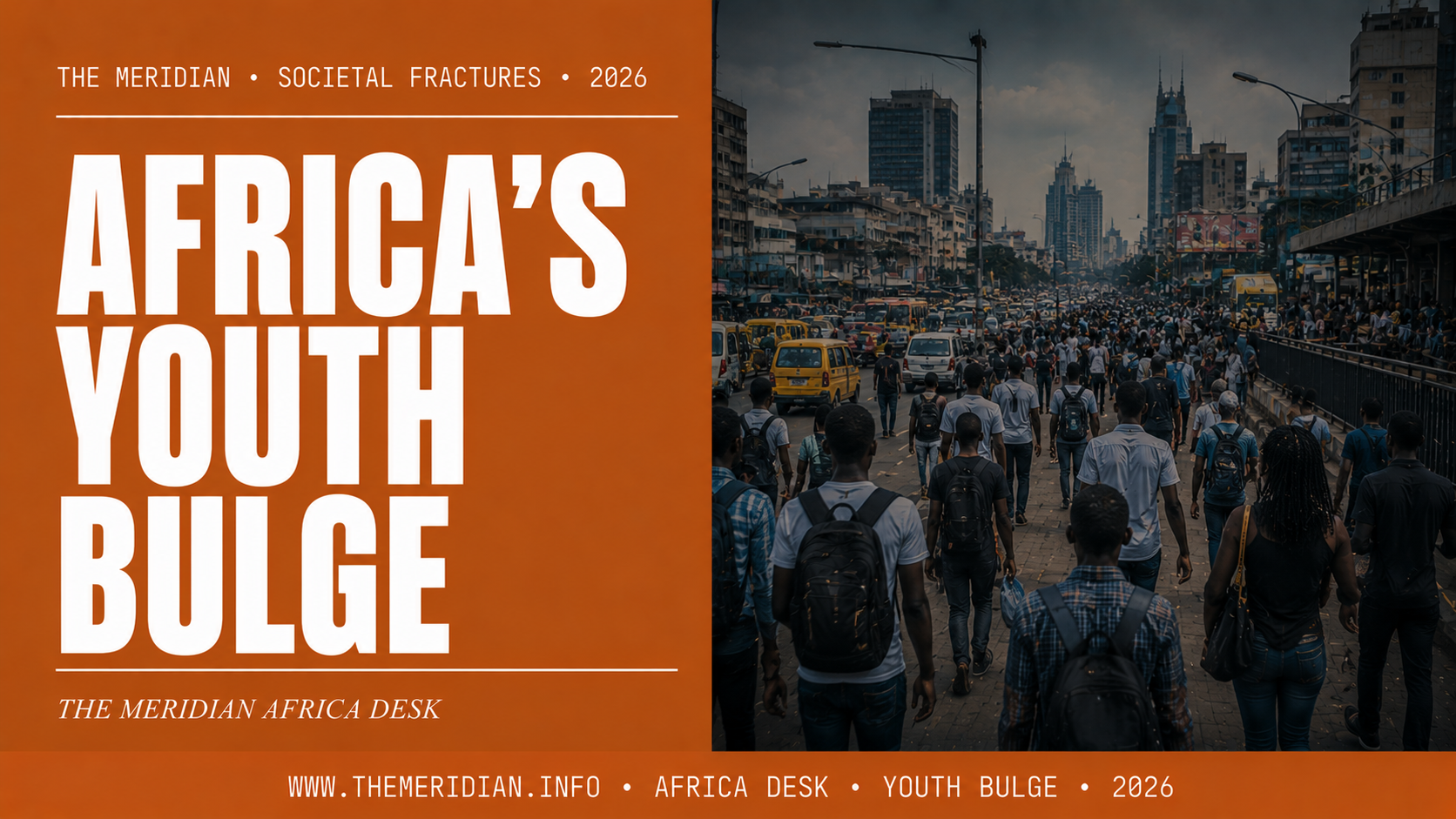
12 million young people enter Africa's labour market every year. The formal economy creates 3 million jobs. The remaining 9 million go somewhere -- and where they go determines whether this is a dividend or a crisis.
Africa is routinely described as holding a demographic dividend -- the world's youngest, fastest-growing working-age population, at precisely the moment when the Global North and East Asia are ageing and contracting. The word "dividend" implies the outcome is already decided, that the payout simply arrives on schedule. The job creation data suggests otherwise. According to the African Development Bank, approximately 12 million young people enter the continent's labour market annually, while the formal economy generates only 3 million new jobs over the same period. That absolute shortfall -- 9 million formal positions a year -- is arguably the single most consequential number in Africa's development trajectory, because of what it implies about every other number in this series. UN DESA projections confirm the scale is not a temporary spike: Africa is on track to house the world's largest working-age population by mid-century, the only region where this group will keep expanding while every other major region's shrinks.
A demographic window is a temporary period during which a country's working-age population significantly outnumbers its dependents -- children and the elderly. It is, in itself, neutral. The window does not generate wealth; it generates labour capacity, which can be converted into wealth if the economy is capable of absorbing it productively, or which can simply sit idle, or be absorbed unproductively, if it is not. A window that opens once, on a schedule set by birth rates two decades earlier, and closes again on its own schedule as the population ages -- regardless of whether anything was built to pass through it while it was open. Historical macroeconomic data is unambiguous on this point: capturing the dividend requires formal sector employment and productivity to grow in step with the population, not after it. Africa is currently the only region in the world experiencing continuous expansion of its working-age population over coming decades. Whether that becomes the foundation of accelerated capital accumulation, or the foundation of structurally elevated underemployment, depends entirely on what happens in the years the window remains open -- not on the window itself.
Because the formal market cannot mathematically absorb these millions of new entrants, the resulting surplus is pushed into the unregulated economy. ILO data indicates that informal employment accounts for over 85 per cent of all work across sub-Saharan Africa. This informal architecture functions as a vital socio-economic shock absorber -- it is, for the large majority of young Africans, the difference between some income and none. But it is simultaneously a defective fiscal engine. Workers operating outside the formal regulatory framework do not pay direct income taxes; informal micro-enterprises do not typically pay corporate levies or contribute to social security. Governments are left building infrastructure, funding education, and servicing external debt for rapidly growing populations, while drawing revenue from a narrow and largely static base of formal taxpayers. And without a formally employed youth demographic paying into pension systems now, the state's capacity to support this same population once the demographic window closes and the population ages is compromised before that day even arrives.
Escaping this cycle has a historical precedent, though not yet an African one. During their own demographic windows in the late twentieth century, economies such as South Korea and Taiwan captured the dividend by aggressively directing both foreign and domestic capital into labour-intensive, export-oriented manufacturing -- creating millions of formal, taxable jobs at exactly the scale and speed their own youth bulges required. The mechanism was not subtle: it was industrial policy deliberately designed to absorb a demographic surplus into the formal sector before that surplus could settle into informality. World Bank assessments are consistent that the structural transition required of African economies is broadly the same -- dismantling regulatory barriers to private sector growth, and substantial investment in the human capital (skills, education) that formal industrial and service expansion requires. The gap between Africa's current trajectory and this precedent is not a gap in population. It is a gap in the rate at which formal capacity is being built underneath that population.
Not every part of this picture points only toward a closing window. World Data Lab's research on African youth employment finds that 57 per cent of young Africans are already employed -- a higher rate than the global average -- though roughly 90 per cent of that work is informal, and a third of those employed still live in extreme poverty. The same research projects that by 2033, services will overtake agriculture as the continent's largest employer of young people, a structural shift already underway regardless of policy. And one gap stands out as more immediately addressable than the others: women remain disproportionately represented among those not in employment, education or training, particularly in West and North Africa. World Data Lab's founder has estimated that closing the gap between female and male labour force participation in Africa to parity would add more than $100 billion a year to African economies -- income that would flow directly into the pockets of young Africans and their households. Of the structural problems this piece documents, this is the one for which the policy lever is the most clearly identified and the least dependent on decades of industrial transformation to begin pulling.
| Source | Relevant Point |
|---|---|
| African Development Bank | Approximately 12 million young people enter Africa's labour market annually, against approximately 3 million new formal jobs created over the same period. |
| UN Department of Economic and Social Affairs (UN DESA) | Africa's working-age population will continue expanding through mid-century, positioning the continent to house the world's largest working-age demographic, while other major regions contract. |
| International Labour Organization (ILO) | Informal employment accounts for over 85% of all work across sub-Saharan Africa; the 2024 Global Employment Trends for Youth report projects approximately 72.6 million new jobs will be needed for sub-Saharan Africa's young people by 2050. |
| World Data Lab | 57% of young Africans are employed, of whom approximately 90% work informally and one in three live in extreme poverty; services are projected to overtake agriculture as the largest youth employer by 2033; closing the female labour participation gap to parity could add more than $100 billion annually to African economies. |
| World Bank | Comparative assessment of East Asian "tiger economy" demographic dividend capture via labour-intensive export manufacturing; identifies regulatory barriers and human capital investment as the key constraints on replicating this in Africa. |
Add comment
Comments