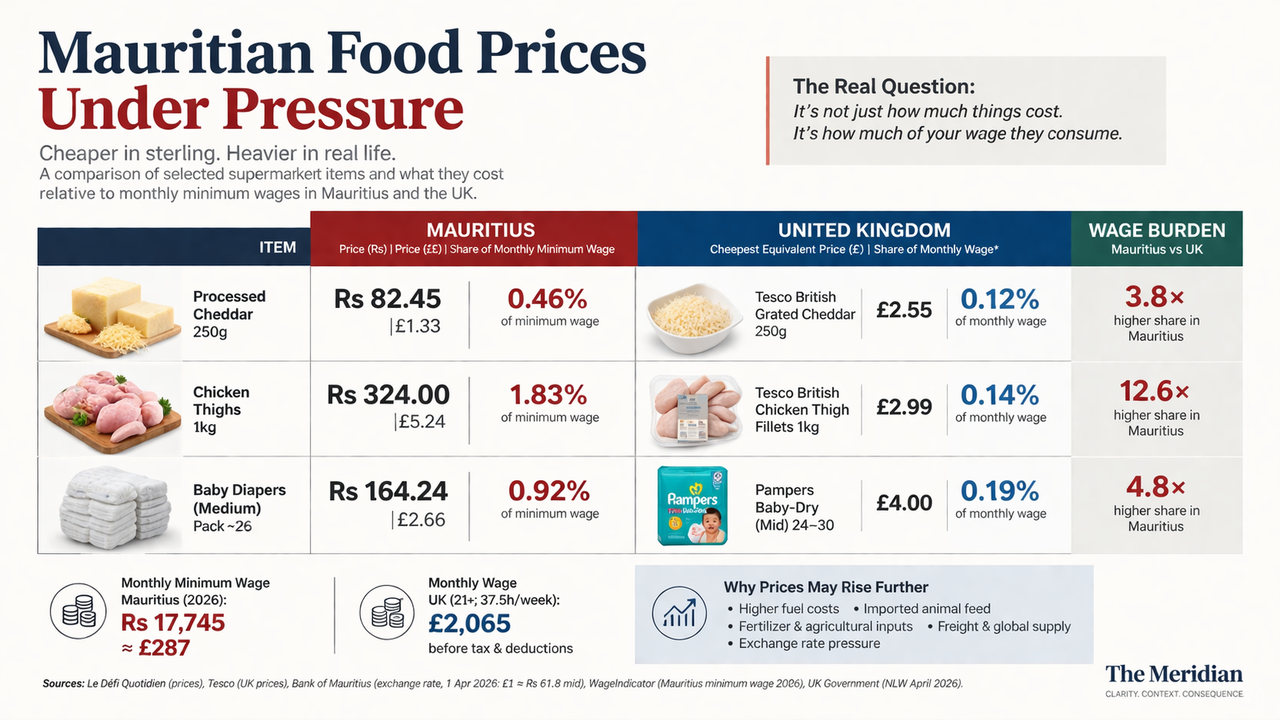
A newspaper price table can be deceptive. It offers neat rows, small numbers and a false sense of order. A block of cheese rises by a few rupees. Chicken shifts a little higher. Household products edge up again. It all seems manageable when viewed one line at a time. But the real burden is not visible in the price tag alone. It appears only when price is measured against income. That is where the Mauritian basket begins to look much heavier than it first appears.
Take a simple comparison. A 250g cheddar item in Mauritius can be converted into around one pound and change. A kilo of chicken can still look modest in foreign currency terms. That is exactly where many people stop the argument. They see the sterling conversion and assume the island’s costs remain tolerable. But the proper comparison is not between currencies. It is between sacrifice. A food price means almost nothing until one asks what share of a worker’s month it consumes.
Nominal cheapness is one of the great illusions of small, lower-wage economies. A product can look cheap in pounds while being deeply expensive relative to local earnings.
Too many price discussions in Mauritius begin and end with exchange rates. If something costs only a little more than one pound, it does not sound dramatic. If a kilogram of chicken converts into a few pounds, it does not look like crisis. But that comparison quietly borrows the perspective of a higher-income economy. It asks what the item means to an outside observer rather than what it means to the household that actually has to buy it.
The right comparison is not, “How much is this in sterling?” The right comparison is, “How much of a monthly wage disappears when I buy it?” Once the question is framed that way, the tone changes immediately. What looked modest in currency begins to look much harsher in real life.
A price is not just a number. It is a claim on a worker’s time.
The Meridian · April DispatchOn a Mauritian monthly minimum wage, a basic cheddar item now absorbs close to half of one percent of monthly earnings. A kilo of chicken takes well over one and a half percent. Looked at separately, those shares may still seem small. Looked at as part of a wider household basket that also includes rice, oil, transport, electricity, rent, mobile credit and school needs, they become something else entirely: signs of tightening room.
That is the part official inflation language often misses. Households do not consume the average index. They consume specific goods repeatedly. They feel the cost of protein, not the elegance of CPI methodology. If items that sit close to daily life keep rising, the basket gets heavier even before headline statistics tell a dramatic story.
Britain is not cheap. Food inflation and cost-of-living pressure have not disappeared there. But the same item still often claims a much smaller share of the income floor. That is what matters. A kilo of chicken bought by a British minimum-wage worker still takes money. A kilo of chicken bought by a Mauritian minimum-wage worker takes a larger part of the month. The burden is not identical simply because the product exists in both markets.
| Item | Mauritius Price | Share of Monthly Wage | UK Cheapest Match | Share of Monthly Wage | Burden Ratio |
|---|---|---|---|---|---|
| Processed cheddar 250g | Rs 82.45≈ £1.33 | 0.46%of Mauritian minimum wage | £2.55Tesco grated cheddar 250g | 0.12%of UK NLW monthly income | 3.8×heavier in Mauritius |
| Chicken 1kg | Rs 324.00≈ £5.24 | 1.83%of Mauritian minimum wage | £6.95Tesco chicken thigh fillets 1kg | 0.34%of UK NLW monthly income | 5.4×heavier in Mauritius |
That is the heart of the article. Mauritius can still look cheaper on a tourist conversion and harsher on a worker’s budget at the same time. Those two things are not contradictory. They are the same reality viewed from different income positions.
Cheap in foreign currency can still mean expensive in local dignity.
The Meridian · April DispatchThis is not happening in isolation. Fuel pressure matters because food does not travel for free. Freight matters because import dependence remains high. Feed and agricultural inputs matter because protein is not insulated from wider energy and trade shocks. Exchange-rate pressure matters because even a stable shelf can conceal a more fragile supply chain behind it.
That is why the food story cannot be separated from the broader economic story. Energy stress feeds into logistics. Logistics feed into shelves. Shelves feed into household compromise. And compromise is where inflation becomes social reality. The household does not describe this as imported inflation or second-round effects. It describes it more simply: less meat, fewer branded goods, more substitution, more anxiety, fewer margins for mistakes.
- Fuel costs rise.
- Freight and input costs harden.
- Everyday foods edge upward.
- Wages lag behind lived costs.
- Households downgrade quality.
- Nutrition becomes a budgeting problem.
Food prices are never merely technical. They shape mood, trust and legitimacy. If a society begins to feel that ordinary work no longer secures ordinary nourishment, something deeper starts to fray. It is not just purchasing power that declines. It is confidence in the promise that effort still leads to stability.
That is why the cost-of-living question matters so much in Mauritius. It connects wages to food, food to dignity, and dignity to governance. The basket is not simply an economic indicator. It is the place where policy becomes intimate. It is where the national model reaches into the kitchen.
If earlier dispatches showed how fuel, debt and harvest pressures are tightening the Mauritian system, this piece shows what that tightening looks like inside a household basket.
Macro stress is ultimately felt in ordinary purchases. That is where structural pressure becomes personal.
Mauritian prices can still look modest when translated into pounds. That is precisely why the wrong comparison remains seductive. But the worker does not live inside sterling. The worker lives inside a monthly wage, and inside that wage the basket is becoming harder to carry.
That is the real issue. The problem is not that the numbers look dramatic abroad. It is that they have started to feel heavier at home. And when a basket gets heavier faster than dignity can keep up, the country is no longer dealing with price alone. It is dealing with the moral economics of daily life.
The basket is getting heavier.
April 2026 · Cost of Living · Daily Dispatch