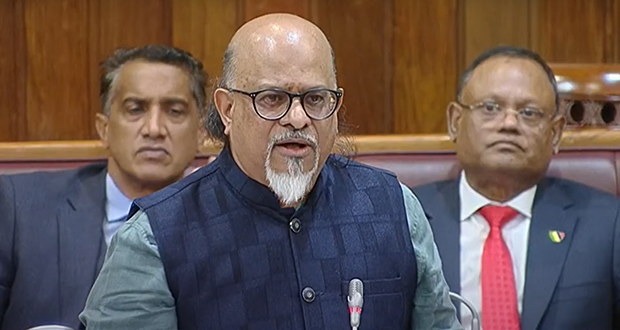
Ashok Subron is the Minister of Social Integration, Social Security and National Solidarity in the Alliance du Changement government formed in November 2024. He is the leader of Rezistans ek Alternativ, a party whose foundational argument is that the Mauritian state has been captured by conglomerate capital. He spent thirty years making that argument from the street, organising strikes in construction, sugar, cargo handling and public transport. He entered government to change the system from inside. What he found when he walked through the door is now a matter of public record.
In an interview published by Le Mauricien on 6 April 2026, the minister stated: "Le secteur prive a trop d'influence sur l'action gouvernementale." The private sector has too much influence on government action. He did not say this as a historical observation or a theoretical concern. He said it as a description of what he found operating inside his own government, in real time, in the first seventeen months of the administration he is part of.
"The implementation of the government programme contained in the President's speech was to be done by a governmental committee where, to our surprise, we discovered it was also composed of private sector representatives. The same was true for the port committee, where a Business Mauritius representative also sat."
Ashok Subron · Minister of Social Integration · Le Mauricien · 6 April 2026The specific examples the minister cited deserve to be read precisely. The committee responsible for implementing the government's own programme -- the programme the Alliance du Changement campaigned on and won a majority to deliver -- was composed in part of private sector representatives. This is not a committee advising the government. It is a committee implementing the government's programme. The distinction is not academic. A committee that advises government can be listened to or ignored. A committee that implements the government programme shapes what gets done and how. Private sector representation on an implementation committee is not consultation. It is participation in the exercise of governmental authority by interests whose commercial position is directly affected by the decisions being made.
The port committee example is equally specific. Business Mauritius, the umbrella body of the Mauritian private sector, had a representative on the committee examining port policy. The port is the single most critical infrastructure node in the import dependency loop that The Meridian has documented across this April edition. Every container of imported food, every tonne of imported fertiliser, every consignment of imported fuel passes through the port. The conglomerates that dominate import distribution have a direct commercial interest in port policy: in the tariffs, the operating hours, the licensing arrangements, the priority given to different vessel types and cargo categories. A Business Mauritius representative on the port committee is a conglomerate representative on the committee that sets the conditions of the conglomerate's own supply chain.
Role: Minister of Social Integration, Social Security and National Solidarity in the Navin Ramgoolam government since November 2024. Leader of Rezistans ek Alternativ (ReA), a junior coalition partner in the Alliance du Changement.
Background: Trade unionist since 1992. Organised strikes in construction (1992), sugar (2010), cargo handling (2011) and public transport (2014). Contested general elections in 1983, 1987, 1995 and 2000 without being elected. Won his seat in November 2024 in Constituency No. 4 (Port-Louis Nord/Montagne-Longue).
Historical position on conglomerates: Consistent and documented across three decades. During COVID in 2020, he publicly questioned the use of MIC funds to subsidise private sector wages at Rs 25,000 per employee while informal sector workers received Rs 2,250. His words then: "Is one going to make me believe that all these big companies that have accumulated fortunes for years do not have the money to pay one month's salary to their employees?"
The irony of his current position: He is now a member of the government that received the MIC funds he criticised, governed by the same Prime Minister whose 1995-2000 administration first structured the cheap labour and coal-permit arrangements that the April 2026 trilogy identified as the foundation of the import dependency trap.
Separate reporting from the same week identified a parallel example that adds institutional depth to the minister's observation. Gilbert Gnany, who served as chief economist and head of Strategy, Research and Development at MCB until March 2024, is now Chief Economic Advisor at the Prime Minister's Office. The same institution whose FX trading profits The Meridian documented in Who Booked the Profit, whose institutional leverage over the government's debt financing the FX policy note identified as the structural obstacle to spread regulation, has placed its former chief economist in the office of the Prime Minister who governs the institution that would regulate it.
This is not presented as a legal impropriety. It is presented as a structural illustration of the mechanism that Subron named. The line between the institution that needs governing and the office that governs it is not a wall. It is a revolving door. The people who understand the financial system most deeply are the people the financial system has trained and employed. When governments reach for economic expertise, they reach into the pool of people the financial sector has produced. This is not corruption in the narrow transactional sense. It is the structural consequence of a political economy in which the private sector has cultivated the most capable people and the public sector has not.
He spent thirty years arguing that the state was captured by conglomerate capital. He entered government and found the conglomerate sitting on the committee implementing his own programme. His response: ReA will perhaps write a book. The elastic political hysteresis has absorbed another reformer.
Vayu Putra · Editor-in-Chief & Founder · The Meridian · April 2026The most analytically important element of the minister's interview is not what he said. It is what he did not say. He did not name a specific reform that ReA has delivered that broke the conglomerate influence he describes. He did not announce a policy change that would remove private sector representatives from government implementation committees. He did not say that the port committee composition had been changed after the Business Mauritius representative was identified. He described the problem. He cited the examples. When pressed on what ReA would do if the PM did not reorient policy toward social priorities before the next budget, he said: "We are not issuing ultimatums. But we are watching carefully. ReA will act." How? "Perhaps we will write a book on the subject."
This is the elastic political hysteresis mechanism that The Meridian documented in WP-2026-01, applied now to a minister rather than a policy reform. The mechanism absorbs reformers as effectively as it absorbs reforms. The reformer enters the system. The system accommodates them with a ministry, a portfolio, a salary and a seat at the table. The reformer describes the problem they came to solve. The problem remains. The reformer considers writing a book. The system continues. This is not a personal criticism of a minister who has given thirty years to the labour movement. It is a structural observation about a system that is specifically designed to accommodate the description of its own problems while preventing their resolution.
The Elastic Political Hysteresis, introduced in The State of the Mind's HIU Working Paper WP-2026-01, describes a political system that absorbs reform pressure without delivering structural correction. The mechanism operates through co-optation: the reformer is invited inside the system, given formal authority and institutional presence, and thereby made responsible for the system's outputs without being given the structural power to change its inputs. The reformer's credibility is absorbed by the system. The system's structure is preserved. Minister Subron's interview is a real-time primary source illustration of this mechanism operating at cabinet level.
The April 2026 edition of The Meridian has published four structural analyses of the Mauritian political economy: the Import Dependency Trap, the four conglomerate extraction mechanisms, the human capital displacement model and the FX spread regulation question. In each case, the central finding was the same: the interests that profit from the structural arrangement have the political access to prevent it from being changed. In each case, that finding was based on structural analysis of verified economic data.
On 6 April 2026, a sitting minister of the current government provided primary source confirmation of that finding from inside the cabinet room. He did not use the language of structural analysis. He used the language of personal experience. He said: to our surprise, we discovered the private sector was already inside the committee implementing our own programme. That surprise is the most important word in the interview. A man who spent thirty years arguing that the state was captured by conglomerate capital entered government and was surprised to find the conglomerate inside the room. The system is so complete, so institutionally embedded and so structurally normal that even those who built their careers opposing it are surprised by its reach when they encounter it from inside.
The egg is still ungrown. The profit is still booked. The nurse is still abroad. The spread is still wide. And the committee implementing the government programme still has a private sector representative on it. The minister knows. He was surprised. He may write a book. The loop runs.
The Egg Mauritius Never Grew (Import Dependency Trap) · Who Booked the Profit (conglomerate extraction mechanisms) · Private Schools, Public Debt (human capital displacement) · One Rate for All (FX spread regulation) · A Minister Confirms What the Analysis Already Said (this article).
Five articles. One structural argument. A sitting minister has now provided primary source confirmation of the central finding. The April 2026 edition is complete.
April 2026 · Daily Analysis · themeridian.info