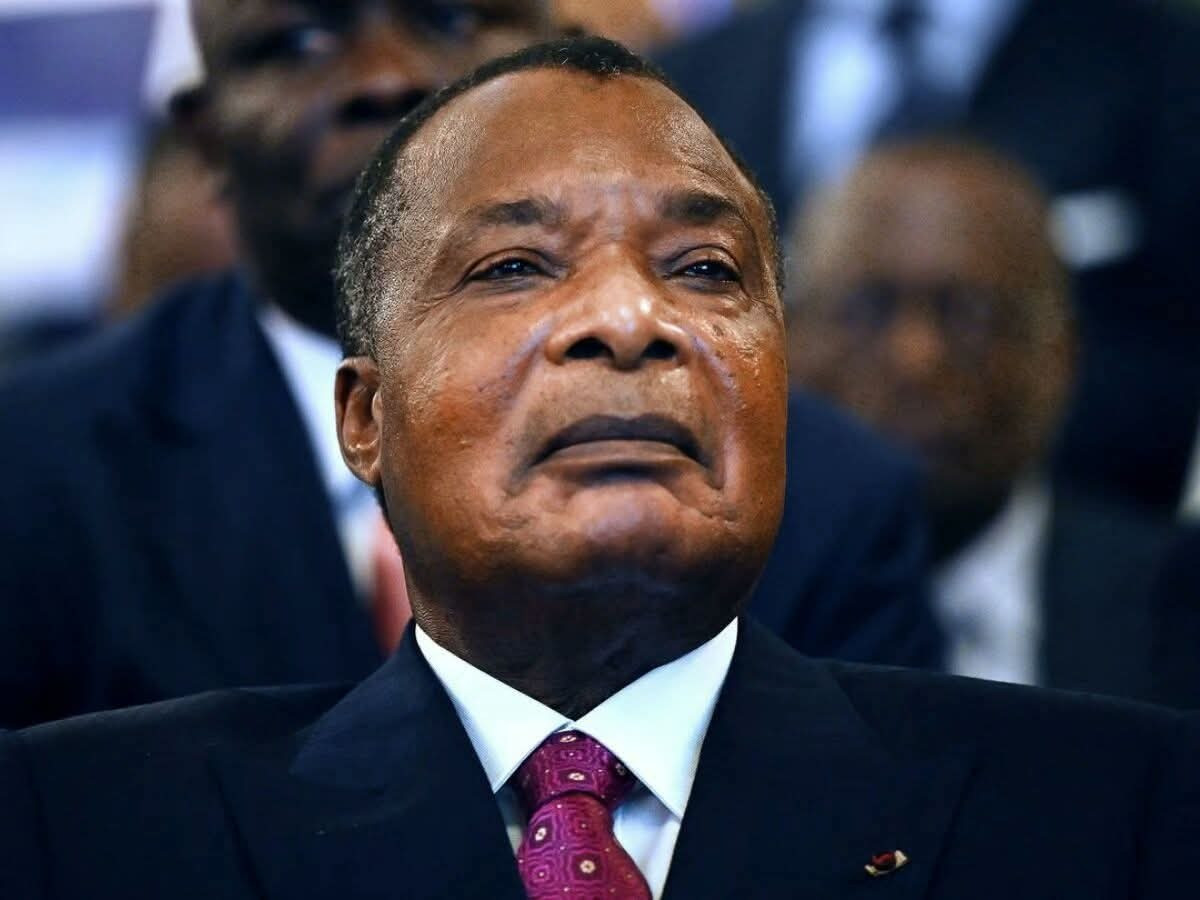
Denis Sassou Nguesso was born in 1943 in Edou in the north of the country, trained as a military officer in Algeria and France, and rose through the armed political networks that shaped post-independence Congo. His first presidency belonged to the one-party era. His second began in 1997 after a civil war in which Angolan military support helped restore him to power. That origin matters because it reveals the operating logic of his rule: military foundation, party control, and a presidency habituated to survival through force and political dominance rather than open democratic competition. A president whose first return from political exclusion came through war does not typically build institutions designed to constrain him.
A simple timeline is enough to see the pattern. In 1979, he becomes president of a one-party state. In 1992, he loses office after multiparty elections during Congo's brief democratic opening. In 1997, he returns through civil war, with Angolan military support helping him defeat his rivals. In 2015, he rewrites the constitution to remove the age and term limits that threatened to end his eligibility. In 2021, he wins re-election with more than 88 percent of the vote. In March 2026, he wins again with 94.82 percent, in an election Reuters described as tightly managed and widely expected to deliver him an easy victory.
Across these turning points, the central fact is not just that Sassou Nguesso remained in power. It is that the legal and political system repeatedly bent in the direction of prolonging his rule. The constitutional rewrite of 2015 is the clearest single indictment. In a functioning republic, constitutions exist to restrain rulers: to define the limits of their term, the boundaries of their power, and the conditions under which they must leave office. Under Sassou Nguesso, the constitution was made to accommodate the ruler. Human Rights Watch documented that the referendum campaign was accompanied by intimidation and harassment of opposition figures. The rule of law was preserved in form. Its substance was hollowed in practice.
In a functioning republic, constitutions restrain rulers. Under Sassou Nguesso, the constitution was made to accommodate the ruler. That was not a technical adjustment. It was a statement about where sovereignty really sat.
The Meridian · Political Analysis · April 2026That constitutional history helps explain why international watchdogs assess his system so harshly. Freedom House says Sassou Nguesso has maintained near-uninterrupted power for over four decades by severely repressing the opposition, and links his rule to corruption, poor economic performance, poverty, and security-force abuses that are frequently reported and rarely investigated. The United States State Department likewise records serious human-rights concerns in the Republic of the Congo, including credible reports of unlawful or arbitrary killings, torture or cruel treatment, arbitrary detention, and restrictions on freedom of expression and association. These are not partisan assessments. They are formal institutional descriptions of how the state functions under his governance.
The gravest stain on Sassou Nguesso's record is the state's long association with political violence and the absence of accountability for it. His rule cannot be understood without the wars and crackdowns that shadowed it. He returned to power through the 1997 civil war, and the years that followed carried allegations of grave abuses. The most notorious episode remains the case of the Disappeared of the Beach in 1999, when returning refugees were alleged to have vanished after passing through Brazzaville's river port under official guarantees of safe passage. Human rights groups have long treated the case as emblematic of a system in which victims disappeared into the state and accountability never properly followed.
Later came the renewed violence in the Pool region. In 2016, Amnesty International accused government forces of carrying out air strikes on residential areas, including schools and medical facilities, during unrest linked to armed conflict. Reuters reported Amnesty's allegation that civilians were killed and that witnesses described multiple bodies after strikes near Soumouna. The government denied wrongdoing. Whether through denial, ambiguity or failed accountability, the political meaning remained the same: under Sassou Nguesso, the state repeatedly appeared willing to answer insecurity with methods that rights groups judged unlawful and indiscriminate.
The point is not that every allegation has produced a final judicial finding against Sassou Nguesso personally. The point is that his state has accumulated a record in which abuses by security forces, disappearances, crackdowns, and alleged unlawful killings recur with disturbing regularity across multiple decades. A president need not stand at the scene of every abuse to bear responsibility for the political order that permits them, protects perpetrators, or fails to investigate them seriously. The deeper charge is therefore not only repression, but normalised impunity: a republic in which grave acts are alleged, investigated unevenly, and too often left morally unresolved.
The sharpest case against Sassou Nguesso may lie not in war but in development. The Republic of the Congo is an oil-producing state with a relatively small population. In theory, that combination should have made progress considerably easier than in many poorer, more populous countries across the continent. Instead, Congo under his rule became a familiar petro-state paradox: wealth concentrated at the top, persistent weakness below. The World Bank reported that the economy grew by 2.6 percent in 2024, lifting per capita income for the first time since 2016, but stated that this growth had not translated into a significant reduction in poverty. Its April 2026 Macro Poverty Outlook found that GDP per capita remained flat in the first half of 2025, leaving the poverty rate unchanged. A 2025 World Bank document placed the poverty rate at approximately 52 percent. After decades of oil revenues and one dominant presidency, that is a devastating outcome.
Debt tells the same story from a different angle. The IMF stated in March 2026 that growth was still below potential, weakened by poor public investment, energy-supply disruptions, overspending, and slippages in fiscal management. This is not the record of a presidency that mastered oil wealth. It is the record of a state that repeatedly borrowed against its resource base, mismanaged it, and failed to convert it into durable resilience for ordinary citizens. When an international institution must keep telling a government, after decades of political continuity, to do the elementary work of governing cleanly and spending effectively, that continuity loses its claim to seriousness.
After nearly five decades at the centre of Congolese political life, the same basic weaknesses remain: fiscal fragility, uneven reform execution, weak public investment management, and an economy still too dependent on a single commodity whose price is set elsewhere.
Vayu Putra · Editor-in-Chief & Founder · The Meridian · April 2026The failure shows up concretely in education. UNESCO data reported that the primary school completion rate was 66 percent for girls and 64 percent for boys in 2018, while lower-secondary completion stood at just 14.1 percent for girls and 24.2 percent for boys. World Bank data place government expenditure on education at approximately 3.3 percent of GDP in 2023. These are not the indicators of a state that converted oil rents and political continuity into a human-capital revolution. They are the indicators of a country where too many children still do not move smoothly through the school system despite a ruler who has had nearly five decades to design otherwise.
Health is no more flattering. WHO data show current health expenditure at 3.88 percent of GDP in 2021, and World Bank data place health spending per person at approximately USD 75.55 in 2023. Congo has hospitals, doctors and clinics. But it does not have a standout public-health system whose condition reflects the privilege of decades of stable rule and a resource endowment that smaller, poorer countries on the continent lack. The World Bank's broader diagnosis captures the structural failure precisely: health and education spending has fluctuated with oil cycles, limiting improvements in learning, health outcomes and productivity. A serious developmental state protects schools and clinics from commodity volatility. A weaker state lets oil-price cycles pass directly into human vulnerability. Sassou Nguesso's Congo has too consistently looked like the latter.
Corruption shadows the entire record. Precision matters here: one must distinguish between allegation, investigation, and proven judicial finding. But even at the level of documented allegations and legal proceedings, the picture is serious. Freedom House notes that the Sassou family remains the subject of credible corruption allegations. Reuters reported in January 2026 that Norwegian authorities charged a PetroNor subsidiary and two executives over alleged multimillion-dollar bribes said to have gone to close relatives of Sassou Nguesso in relation to an oil licence. Congo's government rejected the allegations. The issue is larger than any single case: the presidency repeatedly appears in the orbit of opaque wealth, family-linked enrichment claims, and offshore suspicion that has attracted the attention of multiple foreign jurisdictions.
That is why the succession question matters so acutely. Reuters reported in March 2026 that attention was already shifting toward who might eventually replace Sassou Nguesso, with his son Denis-Christel Sassou Nguesso among the names most frequently discussed. Once the succession question resolves itself toward a family circle rather than an open institutional process, a republic has moved from the language of democracy into the practice of dynasty. Republics are meant to build procedures stronger than bloodlines. When the political future narrows toward the ruler's own family, institutions have already been made smaller than the presidency they were supposed to contain.
- Rights groups see repression, abuses, and impunity.
- The State Department documents serious human-rights concerns.
- The World Bank sees growth that fails to cut poverty decisively.
- The IMF sees weak governance and persistent fiscal fragility.
- Education and health data reveal sectors below the promise of resource wealth.
- Different evidence. Same direction. Same conclusion.
Why is Sassou Nguesso assessed so harshly by so many different institutions? Not because critics simply dislike long-serving African leaders. Not because every foreign assessment is above reproach or free of its own institutional interests. He is assessed this way because different kinds of evidence, from rights groups, the State Department, the World Bank, the IMF, UNESCO and WHO, all point in the same direction and arrive at compatible conclusions. Put together, they do not describe a successful elder statesman who mastered the development challenge. They describe a ruler who mastered the retention of power more effectively than the reconstruction of the republic he presided over.
This is also why association with him can carry political and reputational cost for foreign leaders, investors and public figures. Diplomacy requires engagement with difficult governments and no serious country can conduct foreign policy only with those whose records are clean. But warm political identification with Sassou Nguesso carries specific costs: it can signal indifference to democratic erosion, tolerance for corruption exposure, and comfort with a ruler whose legitimacy has become inseparable from the suppression of genuine political competition.
In the end, the real indictment of Denis Sassou Nguesso is not simply that he stayed too long. It is that while he stayed, Congo never became what a country with its wealth, its time, and its continuity of rule should have become. Stronger institutions. Lower poverty. Better schools. Sturdier hospitals. Cleaner public finances. A political order credible enough to survive a leadership transition without depending on the preferences of one family. Instead, after nearly five decades, the republic has an ageing presidency, a brittle developmental record, a state repeatedly cited for serious abuses, and a political future still shadowed by the ruler's own bloodline. That is not statecraft. It is the long postponement of the republic that continuity was supposed to build.
This article is part of The Meridian's April 2026 edition. All findings are sourced from named primary institutions: Freedom House, U.S. State Department, World Bank Macro Poverty Outlook April 2026, IMF Article IV March 2026, UNESCO country briefs, WHO Global Health Expenditure, Reuters, Amnesty International, and Human Rights Watch.
Allegations are presented as allegations. Judicial findings are presented as findings. The distinction is maintained throughout in accordance with The Meridian's editorial standards.
April 2026 · Political Analysis · themeridian.info
Add comment
Comments