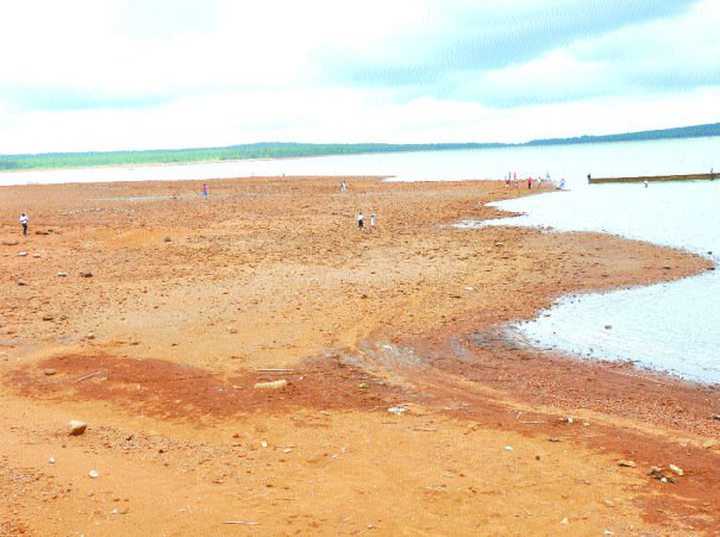
On the morning of April 20, 2026, Minister of Energy and Public Utilities Patrick Assirvaden visited Mare-aux-Vacoas, Mauritius's largest reservoir, and issued a declaration carried by every local publication within hours. The reservoir was sitting at approximately 50 percent capacity. Without intervention it could fall to 22 to 23 percent by mid-June. A water restriction plan was being prepared for Cabinet approval. On site, technicians briefed the minister that such a situation had not been observed in over 120 years. That figure has not been published, verified or attributed by the Mauritius Meteorological Services or any named scientific institution. It was communicated informally at a reservoir visit and entered public discourse as established fact. The minister's alarm about the reservoir level is real. The 120-year historical claim is unverified. And those are two different things.
The minister said the sky was the problem. The data says the pipes are. According to the minister's own ministry, and confirmed by the Le Mauricien, the CWA loses 62 percent of all treated water before it reaches consumers. The CWA treats 883,693 cubic metres of drinking water every single day through seven treatment stations and approximately 160 pumping stations across the island. Of that volume, 62 percent, approximately 548,000 cubic metres daily, disappears into the ground through cracked, ageing pipes before a single Mauritian turns on a tap. This is not a new figure. Academic analysis published in Le Mauricien in 2020 documented that the CWA's non-revenue water rate had been above 50 percent and increasing since 2011, peaking at 62.71 percent in 2019. The American Water Works Association standard for an acceptable non-revenue water rate is below 10 percent. Singapore, Germany and Denmark all operate below that threshold. Mauritius is operating at six times the acceptable loss rate and has been doing so for at least fifteen years. The minister did not mention the pipes.
| Indicator | Verified Figure | What It Means |
|---|---|---|
CWA Non-Revenue Water Rate 2014 |
58% (57.64%) | Out of every 100 litres of treated potable water produced in 2014, 58 litres were lost through pipe leaks, unregistered meters or theft before reaching a consumer. Source: Le Mauricien academic analysis, November 2020, citing official CWA data. |
CWA Non-Revenue Water Rate 2019 |
63% (62.71%) | The loss rate worsened over five years, not improved. By 2019, nearly two thirds of all treated water was lost before delivery. Source: Le Mauricien, November 2020, citing official CWA data 2011-2019. |
CWA Non-Revenue Water Rate 2020 |
60% | Confirmed by Newsmoris citing official CWA figures, November 2023. The minister himself stated in January 2025: "If 100 m3 comes from the CWA pipes, less than 40 m3 reaches consumers." Source: Mega.mu, January 2025. |
AWWA Standard (Acceptable NRW) |
Below 10% | The American Water Works Association standard for a well-managed water utility. Singapore, Germany and Denmark all operate below this threshold. Mauritius operates at six times this level. Source: Le Mauricien, November 2020, citing AWWA. |
Water Treated Daily by CWA |
883,693 m3/day | The total daily production of potable water across the CWA's seven treatment stations and approximately 160 pumping stations. Source: CWA official website, cwa.govmu.org. |
Water Lost Daily at 62% NRW |
~548,000 m3/day | The Meridian calculation: 62% of 883,693 m3 daily production. This volume of treated, potable water vanishes into the ground through the CWA's ageing pipe network every 24 hours, regardless of rainfall levels. |
Age of Pipe Network |
50+ years | Most pipes in the CWA network are underground and have not been replaced since installation. Expert Parmanand Moloye of Aqualfo Ltd confirmed to L'Express that many pipes have cracked due to decay. Source: L'Express, January 2016. |
Mare-aux-Vacoas Capacity Today |
~51% (April 20, 2026) | Minister Assirvaden's confirmed figure from his site visit. The same reservoir was at 87.1% at the same time in 2025. The year-on-year deficit is real. But losing 548,000 m3 of treated water daily through leaking pipes is equally real and entirely within human control. Source: Le Mauricien, April 20, 2026. |
The minister's language on April 20, 2026 followed a template that he has used before and that Mauritian political observers will recognise from previous administrations. In January 2025, during an earlier phase of the same water management crisis, the same minister told the public that the reservoirs had fallen below 40 percent, that water distribution would be cut to four or five hours per day, and that the situation required immediate emergency action. He cited the second-driest January in 25 years. He cited cyclone Garance's failure to bring sufficient rainfall. He called it catastrophic. Bloomberg ran the story on March 4, 2025. The international press ran photographs of La Ferme Reservoir showing more land than water. The minister issued a call for national solidarity.
In the same January 2025 press briefing, the minister confirmed that 62 percent of water treated by the CWA was lost before reaching consumers. He described this as a problem to be solved in the future. He noted that the CWA was doing its best to resolve it. He then continued to describe the rainfall deficit as the primary driver of the crisis. The rainfall deficit is real. It is a contributing factor. But a utility that loses 62 percent of its output through infrastructure failure is not primarily a victim of climate change. It is a victim of sustained governance failure. And the choice to frame the former as the cause while deferring the latter to a future solution is a political choice, not a technical assessment.
The 1,800 kilometres of pipes that constitute the CWA network were, according to expert testimony published in L'Express in 2016, mostly underground for more than 50 years without replacement. That testimony was published a decade ago. The pipes are now a decade older. The Rs 900 million allocated to the CWA in the 2023/2024 budget, of which approximately Rs 825 million was earmarked for pipe replacement, represented a genuine investment. It was also insufficient to replace a network whose full overhaul would cost multiples of that figure. And it was not accompanied by any emergency acceleration of the pipe replacement programme in the eighteen months that followed, despite the warning signs that the 2025 summer drought made visible. The crisis of April 2026 is not a surprise. It is the predictable consequence of decisions that were deferred because fixing pipes is politically unsexy, operationally disruptive and financially costly, while declaring a historic drought is immediate, sympathetic and provides cover for fast-tracked procurement contracts.
The minister said the sky was the problem. His own ministry's data says the pipes lose 62 percent of all treated water before it reaches a tap. Mauritius does not have a rainfall problem. It has a pipe problem that successive governments have chosen to manage rhetorically rather than structurally.
When the water restriction plan goes to Cabinet for approval, its burden will not fall equally. In January 2025, when Phase 2 restrictions were implemented, the Central Water Authority cut distribution in Port Louis to between four and twelve hours per day. Areas in the south and east received as few as three hours of water daily. These were residential zones. These were the households of the 1.3 million Mauritians whose daily lives depend on municipal water supply for cooking, bathing and drinking. The restrictions were real, documented and verifiable.
What was not publicly reported in any detail was what the restriction plan did not restrict. The northern region of the island, which the minister himself identified as requiring a UNESCO-backed aquifer protection project and an accelerated desalination plant, is the epicentre of Mauritius's luxury tourism infrastructure. Grand Baie, Trou aux Biches and the IRS villa enclaves that The Meridian has documented extensively in its April 2026 political economy series are all located in the north. The luxury resorts in this region maintain commercial laundries operating continuously, pools requiring daily chemical treatment and volume top-up, and lush landscaping of non-native tropical species. Many IRS and Smart City developments include 18-hole golf courses. Keeping a championship golf course green during the Mauritian winter dry season requires millions of litres of water per month. These operations do not depend primarily on the CWA municipal network. They maintain private boreholes, private storage tanks and, in the case of the larger resort operators, private desalination units. When the CWA cuts the municipal supply, the golf course remains green. When the minister calls for national solidarity and collective sacrifice, the nation that sacrifices is the household. The collective that is protected is the enclave.
The UNESCO Northern Aquifer project, which the minister cited as a response to saltwater intrusion into underground aquifers threatening local agriculture and hotel water supplies, follows this same logic. The agricultural framing produces political sympathy. The hotel framing produces foreign investment protection. The actual beneficiary of aquifer protection in the north of Mauritius, where sugar agriculture has largely been replaced by villa developments, is the luxury tourism and real estate sector. This is not an accusation of bad faith on the minister's part. It is a structural observation about whose interests the water management architecture of Mauritius has been designed, through decades of investment decisions and zoning choices, to protect first.
System One: The CWA Municipal Network. Serves 1.3 million Mauritians through 1,800 kilometres of pipes, most of which are over 50 years old and have not been replaced. Loses 62 percent of treated water before delivery. Distributes four to twelve hours per day during restrictions. This is the system that gets cut when the minister declares a water emergency. Its users are the households, the small businesses, the schools and the hospitals of the general Mauritian population.
System Two: Private Boreholes and Groundwater Extraction. Large commercial users including hotels, resorts, golf courses and IRS villa developments maintain independent access to groundwater through boreholes, of which there are 667 across the island excluding desalination. This system does not go dry when the CWA cuts supply. Its users continue operating during municipal restrictions. The northern aquifer that the minister is protecting with a UNESCO project is the aquifer that feeds this system for the luxury resort belt.
System Three: Private Desalination. The largest resort operators and IRS developers have invested in private reverse osmosis desalination units that produce drinking water from seawater entirely independently of the CWA and the aquifer system. These are capital-intensive installations whose ownership is concentrated among the conglomerate operators who have been converting cane land to villa enclaves since 2002. When the minister announces an accelerated government desalination project for the north, he is providing a publicly funded backup for a region where the private sector already has its own supply and where the public interest is secondary to the investment protection of the same conglomerates whose political donations and board networks shape the decisions being made in Cabinet.
The water crisis in Mauritius is solvable. Not this week, not through emergency procurement, and not through a desalination plant whose planning horizon is 2029. But it is solvable within a decade if the right sequence of decisions is made starting now. The sequence is known. The engineering is not complex. The politics are.
First: an emergency pipe replacement programme at wartime speed. The Rs 825 million allocated in the 2023/2024 budget for pipe replacement was a start. It was not a programme. A genuine pipe replacement programme for Mauritius's 1,800 kilometre network, prioritised by leak severity and volume loss, funded at the scale that a high-income country can afford, and managed with the urgency that the minister is currently applying to procurement contracts, would reduce the non-revenue water rate from 62 percent toward the 10 percent standard within a decade. Cutting the NRW rate from 62 to 30 percent would effectively double the water available for distribution without collecting a single additional drop of rainfall. That is the most powerful water conservation measure available to the CWA. It requires no desalination plant, no UNESCO project and no emergency Cabinet session. It requires political will to disrupt roads and endure the short-term chaos of large-scale infrastructure replacement.
Second: smart metering across the full network. The CWA's current metering is described in Le Mauricien's academic analysis as unreliable, unable to give consumers accurate readings and therefore unable to encourage water conservation behaviour. Smart meters that register real-time consumption give both the utility and the consumer the information needed to identify leaks, charge accurately and manage demand. Singapore's water utility operates below 5 percent non-revenue water loss partly because of investment in smart metering infrastructure. Mauritius has the fiscal and technical capacity to do the same. It has not done so.
Third: mandatory rainwater harvesting for all new IRS, Smart City and luxury hotel developments. Any building development approved on former cane land in Mauritius should be required, as a condition of its Environmental Impact Assessment permit, to install sufficient rainwater harvesting capacity to supply its own non-potable water needs. This reduces the demand pressure on the northern aquifer, reduces the borehole extraction rate, and internalises the water cost of developments that currently externalise it onto the public infrastructure system and the public environment.
Fourth: regulated disclosure of commercial water extraction. Every borehole in Mauritius is registered with the Water Resources Unit. The extraction volumes from those boreholes are not publicly disclosed. A mandatory annual disclosure of water extraction by large commercial users, hotels, golf courses, IRS developments, would give regulators, civil society and the public the information needed to understand where Mauritius's groundwater is actually going, and whether the restriction sacrifices being demanded of households are proportionate to the conservation being required of the commercial sector.
Fifth: Riviere des Anguilles dam on the confirmed 2029 schedule. The dam project is real and necessary. It is also being used as a rhetorical substitute for near-term action on pipes and metering. Building a dam while losing 62 percent of treated water through leaking pipes is not a water strategy. It is an infrastructure trophy whose benefit is substantially captured by the loss rate before it reaches the consumer it was built to serve.
What is true: Mare-aux-Vacoas is at approximately 51 percent capacity as of April 20, 2026, against 87 percent at the same time in 2025. The rainfall deficit from November 2025 to April 2026 is real and documented by the Mauritius Meteorological Services. The risk that reservoirs reach critical levels by mid-June without intervention is a genuine forecast, not a fabrication. The minister is correct that immediate action is required.
What is incomplete: The minister's framing attributes the crisis primarily to a 120-year drought and climate change while deferring the infrastructure failure that loses 62 percent of treated water daily to a future solution. This framing serves the political function of making the crisis appear externally caused and therefore politically blameless, while directing the immediate response toward procurement contracts for desalination and container filters that generate emergency spending without fixing the structural cause.
What the data says: If the CWA were operating at the AWWA standard of below 10 percent non-revenue water loss, the 883,693 cubic metres treated daily would deliver approximately 795,000 cubic metres to consumers instead of the current 335,000 cubic metres. That additional 460,000 cubic metres per day, more than the total daily delivery under the current system, would be available without any additional rainfall, any desalination plant or any new dam. The crisis is not that Mauritius lacks water. It is that Mauritius treats water and then loses most of it through pipes that successive governments have known were broken and consistently chosen not to fix at the pace and scale that the scale of the loss demands.
What the restriction plan will do: It will cut supply to Mauritian households. The golf courses will remain green. The IRS pools will remain full. The minister will announce emergency procurement contracts. Cabinet will approve them. The pipes will remain broken. And in the next dry summer, this article will be relevant again.
The water crisis of April 2026 is not a proven 120-year drought event. No meteorological institution has independently verified that claim. What is verifiable is the worst pipe network performance in living memory: intersecting with a genuine rainfall deficit that a functional utility would have absorbed without a ministerial visit and a Cabinet emergency. Mare-aux-Vacoas at 51 percent capacity is alarming. It is less alarming than a utility that has been losing more than half its daily output through cracked pipes for fifteen consecutive years while successive ministers have declared emergencies, issued calls for national solidarity and approved procurement contracts, and then described the pipe replacement programme as a problem to be solved in the future.
The political economy of the water crisis in Mauritius follows the same structural logic that The Meridian has documented across the energy crisis, the trade deficit, the modern slavery investigation and the political manipulation series published this April. The visible problem, drought, is named loudly and attributed to external forces. The structural cause, infrastructure failure and governance neglect, is acknowledged briefly, framed as a future priority and then subordinated to emergency spending that addresses the symptom without touching the cause. The burden of sacrifice is distributed downward, to the household whose supply is cut to four hours a day, while the commercial operations of the conglomerate sector maintain uninterrupted access through private systems that the public eye cannot see and the regulatory framework does not require them to disclose.
This article will be cited when the next restriction plan is announced, in 2027 or 2028, with the same language about historic drought and climate change and national solidarity. Unless the pipe replacement programme is treated with the same urgency that the minister is currently applying to the procurement of desalination containers, the arithmetic of 62 percent loss will continue to make every dry summer a crisis and every wet summer a temporary reprieve. Mauritius has enough rainfall to sustain its population. What it does not have is a government willing to spend the political capital that fixing fifty-year-old pipes beneath busy roads requires, because declaring a drought is easier, faster and generates better headlines.
Add comment
Comments