The Extraction Economy: The Price of Everything. The Value of Nothing.
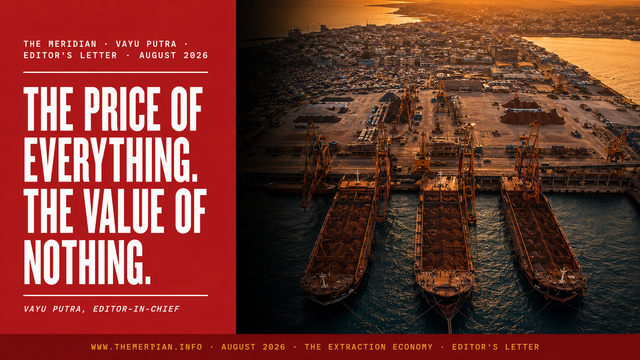
Start with a contradiction. Mauritius sits in the middle of the Indian Ocean. Its Exclusive Economic Zone covers 2.3 million square kilometres of ocean. It imports fish from China. Ghana and Ivory Coast grow 60 per cent of the world's cocoa. Neither can afford chocolate. The Democratic Republic of Congo holds the largest known cobalt reserves on earth. The average Congolese household income is $589 per year. These are not anomalies. They are the system working exactly as designed. This edition asks who designed it, how, and whether the design can be changed.
There is a question that does not appear in any G20 communiqué, any IMF Article IV consultation, any World Bank Country Partnership Framework, or any bilateral trade agreement between a high-income economy and a low-income one. The question is this: why does the price of what the Global South produces get set somewhere else? Not why is the price low, though it often is. Why is the determination of the price entirely outside the control of the people who did the work of producing the thing being priced? This edition of The Meridian is built around that question. Twenty articles. Four analytical layers. One sustained investigation into the architecture of a system that the language of development economics has spent seventy years describing as a problem to be solved while declining to name as a system that was designed.
The problem is not poverty. Poverty is the outcome. The problem is a specific set of institutional arrangements, trade rules, monetary architectures, legal frameworks, and ownership structures that systematically transfer value from the economies that produce primary commodities to the economies that process, brand, finance, and retail them. The problem is that those arrangements are not natural. They were built. By identifiable actors. At identifiable historical moments. In the service of identifiable interests. And they have been maintained, through successive rounds of reform that adjusted the terminology without altering the structure, because the interests that benefit from their maintenance are more powerful than the interests that bear their cost.
Mauritius in May 2026 imported Rs 31.64 billion worth of goods. It exported Rs 9.28 billion. The gap was Rs 22.36 billion. In a single month. Fuel alone cost Rs 11.31 billion, purchased through a state monopoly with zero competitors, priced in dollars that Mauritius does not print, refined in facilities that Mauritius does not own. This is not a fiscal emergency. It is the steady-state arithmetic of a structural position. A position that every government since independence has described as a problem and none has fundamentally altered, because the constraints that would need to be dismantled to alter it are more durable than the electoral cycles in which governments operate.
The first constraint is legal. The trade rules that govern the relationship between primary commodity producers and the economies that process and retail those commodities were written in negotiating rooms where the power was not evenly distributed. The WTO Agreement on Agriculture, signed in 1994, permitted the continuation of agricultural subsidies in high-income economies at levels that make it structurally impossible for African smallholders to compete in the markets those subsidies distort. The TRIPS Agreement, signed in the same round, extended patent protections for pharmaceutical products in ways that made life-saving medicines unaffordable in the economies where the diseases those medicines treat are most prevalent. These were not accidents of negotiation. They were outcomes of a process in which the legal architecture of global trade was written by economies whose interests were served by the architecture it produced.
The second constraint is monetary. Fourteen African nations conduct their monetary policy through a currency pegged to the euro, with reserves partially held in France and convertibility guaranteed by a former colonial power. The CFA franc was established in 1945 as the Colonies Françaises d'Afrique franc. The name changed at independence. The structure did not. The monetary sovereignty that independent statehood is supposed to confer, the capacity to adjust interest rates, manage exchange rates, and deploy monetary policy as a tool of economic development, was retained externally under an arrangement presented as a guarantee of stability. What the evidence shows about whether that stability was delivered, at what cost, and for whom, is what the CFA franc article in this edition examines.
The third constraint is institutional. A state that administers the price of fuel through a monopoly, the price of water through a parastatal, the price of electricity through a monopoly, and the price of food through a market dominated by a small number of distributors, is not a state that has failed to develop competitive markets. It is a state in which the political incentive to maintain administered pricing is stronger than the economic incentive to liberalise it, because administered pricing is a mechanism of political control as well as a mechanism of distribution. The constraint is not technical. It is political economy.
We do not begin with conclusions. We begin with contradictions. The contradiction precedes the analysis. The analysis precedes the verdict. The verdict follows from the evidence, not from the ideology.
Every institutional arrangement this edition examines was, at the moment of its creation, presented as a correction to a prior problem. The IRS villa scheme was a correction to insufficient foreign direct investment. The STC fuel monopoly was a correction to price volatility and the risk of private operator exploitation. The CFA franc was a correction to monetary instability in post-colonial African economies. The IMF structural adjustment programme is a correction to fiscal imbalance and balance of payments crises. The G20 Common Framework for debt restructuring is a correction to the disorderly sovereign defaults that preceded its creation.
Each of these corrections addressed a real problem. The IRS did attract foreign capital. The STC did create price predictability in the fuel market. The CFA franc did deliver monetary stability of a kind. The IMF did restore macroeconomic equilibrium in several economies that were in genuine crisis. The question this edition asks is not whether the correction worked in the narrow sense. It is what the correction amplified, at whose cost, and whether the institution that administered the correction was capable of processing the information that the correction was producing unintended consequences and altering its approach accordingly.
We are not studying why states fail. We are studying how states learn, adapt, and continuously repair themselves under conditions of scarcity, constraint, and change. Some states repair effectively. Some repair partially, maintaining the formal architecture of the correction while gutting its operational substance. Some adopt patchwork policies that address the symptom without touching the structure. Some stop repairing and begin protecting the failure, because the failure has become the source of someone's income, someone's political capital, or someone's institutional territory. The question in each case is the same: which correction mechanisms became unable to process information, recognise failure, and alter institutional incentives?
The evidence this edition assembles does not support the conclusion that the Global South is poor because its governments are incompetent. It supports a more specific and more uncomfortable conclusion: that the global institutional architecture within which those governments operate was designed to extract value from the economies of the Global South and transfer it to the economies of the Global North, that this architecture has been maintained through successive rounds of reform that adjusted the language without altering the structure, and that the domestic institutional failures visible within Global South economies are in significant part the predictable output of operating within an external architecture designed to prevent the accumulation of the productive capacity, monetary sovereignty, and legal leverage that would be required to alter that architecture from within it.
The Tin Tuna Index, published by the Human Intelligence Unit at The State of the Mind and applied across multiple countries in this edition, measures a simple thing: how many minutes of minimum-wage labour does a worker need to perform in order to buy a 170-gram tin of tuna? In Mauritius in July 2026, the answer was 10.9 minutes for the cheapest available tin. In the same economy, deep-sea fish from China retailed at Rs 235 for three to four fillets, while Mauritian fishermen operating in 2.3 million square kilometres of Exclusive Economic Zone sold their catch at prices determined by local buyers with better market information. The contradiction is not mysterious. It is the IRS villa economy operating at the level of a fishing family: the asset is local, the value chain is elsewhere, the price is set by whoever has more information, more capital, and more market access.
What is the problem? Not the conclusion. The observable contradiction. The thing that does not add up when you look at the evidence without a prior theory about what it should show.
What constraints exist? Who benefits from the problem persisting? What institutional, legal, financial, or political architecture makes the status quo more convenient than the available alternative?
What was the correction attempting to achieve? Every intervention was designed to fix something. What was it? Did it fix it? What did it amplify instead, and in whose interest?
What does the evidence suggest? Not what the theory predicts. Not what the government says. What do the trade statistics, the court judgments, the wage data, the price indices, the legislative responses, and the field observations actually show?
This edition is organised in four analytical layers. Layer One examines domestic monopoly in Mauritius: the administered prices, the fuel monopoly, the food oligopoly, the coastal land transfer, and the human capital drain that exports the graduates whose education the state financed. Layer Two examines the regional commodity chains of Africa: the CFA franc, the cocoa paradox, the mineral corridor, and the agricultural commodities that leave the continent as raw materials and return as finished goods at prices African consumers cannot set. Layer Three examines the global architecture: the shipping oligopoly that controls 60 per cent of container capacity, the dollar's function as a reserve currency that the Global South earns in commodities and pays in debt, the patent wall that makes medicines expensive where diseases are worst, and the IMF conditionality that restores macroeconomic stability for creditors while the population absorbs the adjustment.
Layer Four names the corrections that have been proposed, the demands that have not been met, and what a genuine sovereignty blueprint for the Global South would require. It includes the ten specific, costed, institutionally achievable demands to the G20 that no summit communiqué has yet produced. It closes with the balance sheet: what the extraction economy actually costs, in measurable terms, and what dismantling its architecture would require from the states, the institutions, and the corporations that currently benefit from it remaining intact.
Every article in this edition begins with a contradiction visible in the evidence. It names the constraint that explains why the contradiction persists. It examines the correction that was attempted and what happened to it when the institutional architecture processed it. It lets the evidence produce the verdict rather than the verdict organising a search for supporting evidence. This is the methodology. It is also the standard against which The Meridian's own analysis should be judged. If the evidence does not support the argument, the argument changes. Not the evidence.
Oscar Wilde's definition of a cynic was a man who knows the price of everything and the value of nothing. The extraction economy is not cynical in the moral sense. It is precise in the institutional sense. It knows the price of cobalt to the dollar. It has excellent mechanisms for setting that price. What it does not have, and what it has been specifically designed not to have, is a mechanism by which the people who extract the cobalt, the people in whose soil it sits and in whose communities the extraction takes place, can participate in the setting of its price.
That absence is not an accident. It is an architecture. This edition maps it, layer by layer, institution by institution, commodity by commodity, legal instrument by legal instrument. It does not claim the architecture cannot be changed. It claims that changing it requires naming it first, understanding how it was built, identifying who maintains it, and specifying what a different architecture would look like and cost.
The Global South is not poor because it lacks resources. It is poor because its resources leave. August 2026 is the edition that shows you exactly how.
Add comment
Comments