The Company Town: How STC, CEB and CWA Turned Mauritius Into an Economy Where the State Sets Every Price You Cannot Refuse to Pay
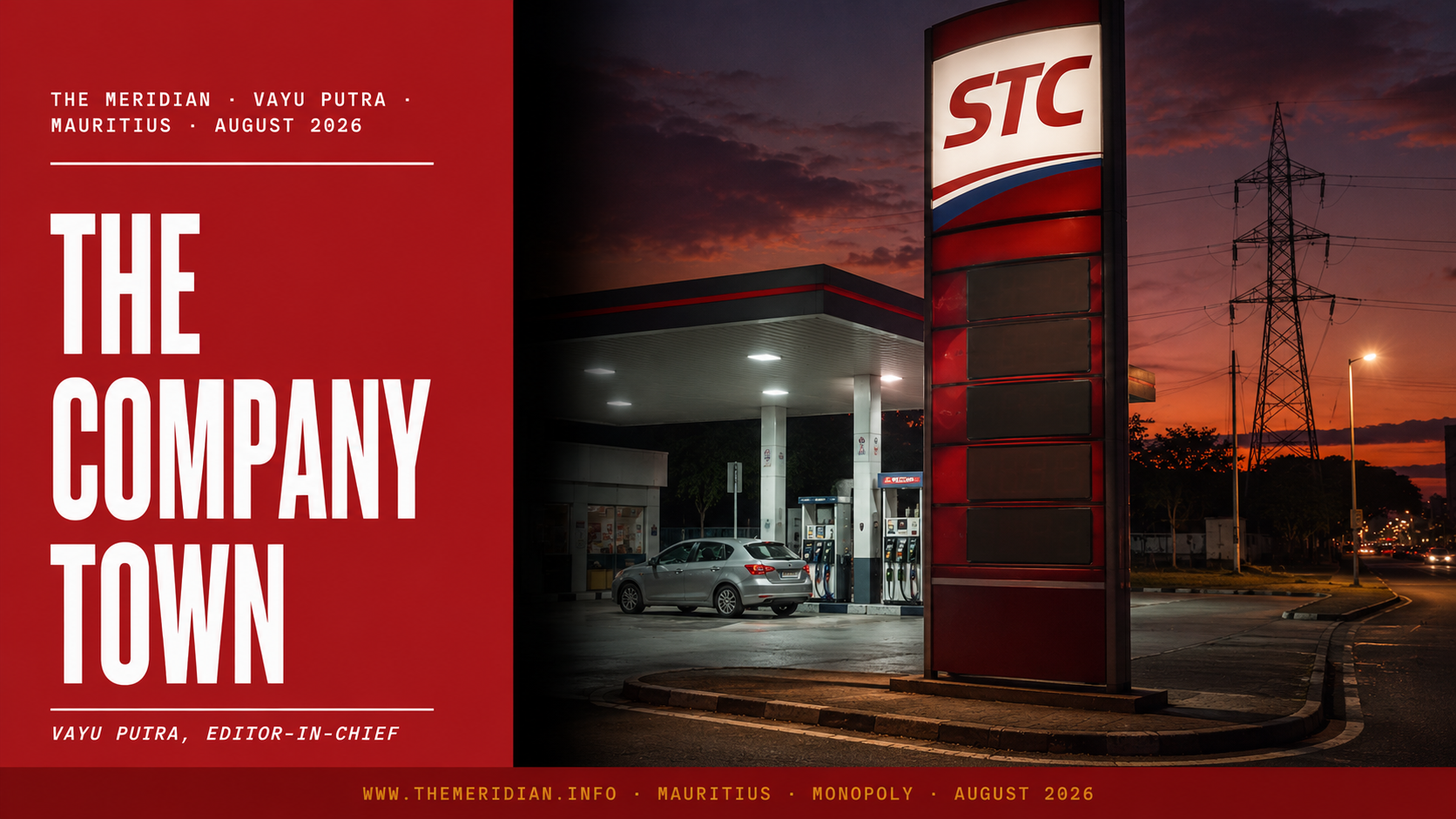
In April 2026 the Petroleum Pricing Committee met and increased the price of petrol in Mauritius from Rs 58.45 to Rs 64.25 per litre and diesel from Rs 64.80 to Rs 71.25 per litre. The market data warranted an increase of 20 to 34 per cent. The committee imposed 10 per cent, the regulatory maximum. No Mauritian household, business, or vehicle operator had any recourse. There is no alternative fuel supplier. There is no competitor price to check. There is one price board. You pay what is on it. This article asks not whether that system is unjust, but whether the evidence shows it is working as its designers intended, for whom it is working, and what correction mechanisms exist when it does not.
The company town was a nineteenth-century invention. A corporation built the houses, owned the store, supplied the water, and paid the wages. The worker earned in the company's currency, spent in the company's shop, and paid rent to the company for the house. The genius of the arrangement, from the company's perspective, was that competition was structurally impossible. You could not take your wage to a different store. There was no different store. Mauritius in 2026 is not a company town in the historical sense. It is a republic with a written constitution, a free press, an independent judiciary, and an elected government. But when a Mauritian household needs fuel, electricity, and water, it deals with three entities that hold, between them, the same structural position the company store occupied in 1880: they are the only seller, the price is their decision, and the alternative is doing without.
The observable contradiction is this. Mauritius describes itself as a market economy, a destination for foreign investment, a beacon of good governance in the African region, and a model of development for small island states. The Bertelsmann Transformation Index 2026 confirms that key public utility services, including electricity, water supply and wastewater, remain state monopolies, as do petroleum and essential goods imports. The same report notes that the Competition Commission of Mauritius cannot impose fines for abuse of a monopoly, does not receive mandatory notification of mergers, and lacks authority over state-owned enterprises. The importing and pricing of petroleum products by the STC are explicitly excluded from the scope of competition law.
A market economy with no competition in fuel, electricity, or water is not a market economy in the goods that determine every other price in the economy. Energy costs feed into transport costs, which feed into food costs, which feed into the cost of every product sold in every shop. Electricity costs feed into manufacturing costs, hospitality costs, and the cost of running every business that employs every worker. Water costs feed into agriculture, food processing, and household expenditure. The three monopolies do not sit alongside the market economy. They sit underneath it. They determine the floor on which everything else is priced.
The STC was established by Act of Parliament on 24 October 1982. Its stated purpose, as documented on its own website, was to regulate and rationalise trade in essential commodities, operating as the trading arm of the government on sound commercial principles. The constraint it was designed to address was real: a small island economy with no domestic energy production, no grain production at scale, and no pricing power over the international markets in which those commodities are traded. A private importer in that position would either make windfall profits in periods of low global prices and pass losses to consumers in periods of high ones, or charge a premium for the risk of operating in a small, volatile market. The PSA was designed precisely to smooth those cycles: accumulate a buffer when global prices are low, draw it down when they rise, and protect households from the full force of volatility.
The constraint that the correction created but did not resolve is the one the April 2026 PPC press release makes visible. The PSA for petrol was in deficit by Rs 3.2 billion at the time of the review. The STC was borrowing approximately Rs 4 billion per year in foreign currency to finance its fuel imports. The market-warranted price increase for petrol was 20.29 per cent. The regulatory maximum the PPC could impose was 10 per cent. The gap between what the PSA needed to recover and what the regulation permitted it to collect was absorbed neither by efficiency gains nor by structural reform. It was absorbed by debt.
This is the constraint in its precise form. The PSA was designed to smooth volatility. It has accumulated a structural deficit because global fuel prices, driven by Middle East conflict and the Hormuz supply disruption this edition has documented elsewhere, exceeded the PSA's capacity to absorb them. The 10 per cent regulatory cap, designed to protect households from sharp price increases, now prevents the PSA from recovering its deficit at a rate that would allow it to function in the next cycle. The instrument designed to protect consumers from volatility is itself now a source of fiscal risk.
The Competition Commission of Mauritius cannot impose fines for abuse of a monopoly and lacks authority over state-owned enterprises. The STC, CEB and CWA are explicitly excluded from the scope of competition law. The regulator that should examine whether the monopoly is serving the public interest has no jurisdiction to do so.
Every element of the current architecture was a correction to a prior problem. The STC monopoly on petroleum imports corrected for the risk of private operators exploiting a captive island market. The PSA corrected for the risk of global price volatility passing directly and immediately to Mauritian households. The 10 per cent regulatory cap on price increases corrected for the risk of sudden large adjustments that low-income households could not absorb. The CEB monopoly on electricity distribution corrected for the infrastructure investment problem: no private operator would build the national grid if another private operator could then use it to compete, so the state built it and retained monopoly rights over it. The CWA's monopoly on water distribution is the same argument applied to the same infrastructure logic.
Each correction addressed a genuine market failure. The evidence that they did so is in the outcomes they produced: Mauritius has 100 per cent electricity access. Water supply is universal. Fuel is available across the island including in areas that would be commercially unattractive to a private operator. These are not trivial achievements for a small island developing economy and they should not be dismissed as though the monopoly structure produced nothing of value.
The question is what the corrections failed to address, and what problems they created in the process of solving the ones they were designed to solve. The BTI 2026 report identifies the most consequential one precisely: micro, small and medium-sized enterprises are most affected by monopoly and unfair competition, as they often lack the resources needed to leverage institutional support to challenge anti-competitive practices. The household that cannot negotiate the price of petrol is an inconvenience. The SME whose entire cost structure is determined by energy prices it cannot influence, and whose competitors in regional markets buy energy from liberalised suppliers at lower administered costs, faces a structural competitive disadvantage that no private initiative can overcome. The correction that protected households from volatility created a permanent competitive disadvantage for the businesses those households depend on for employment.
The evidence suggests three things that the standard defence of the monopoly structure does not accommodate. First, the PSA deficit of Rs 3.2 billion is not a temporary consequence of exceptional global conditions. It is the accumulated result of a structural mismatch between the PSA's design, which assumed moderate and cyclical volatility, and the actual behaviour of global energy markets since 2020, which have been subject to supply disruptions of a different character and duration than the PSA was built to absorb. The STC borrowed approximately Rs 4 billion in foreign currency in a single year to finance imports. That is not volatility management. That is debt-financed price suppression.
Second, the 15 per cent CEB electricity tariff increase effective 1 May 2026, arriving within three weeks of the 10 per cent fuel price increase, demonstrates that the double blow the Mauritius Business Resource accurately identified is not a coincidence. Both increases were driven by the same underlying cause: 81.8 per cent of Mauritius's electricity was generated from non-renewable sources in 2024, almost entirely from fuel oil. The CEB's electricity cost is structurally linked to the STC's fuel cost. The two monopolies are not independent. A fuel price increase is, with a short lag, an electricity price increase. The household that absorbed the fuel increase in April absorbed the electricity increase in May. The correction mechanism that was supposed to smooth volatility delivered two sequential hits from the same underlying shock.
Third, and most significantly for the extraction economy argument this edition is making, the Competition Commission's explicit exclusion from jurisdiction over the STC, CEB, and CWA means that there is no institutional mechanism through which the performance of these monopolies against the public interest can be systematically examined and acted upon. The URA, the Utility Regulatory Authority, has a mandate over electricity tariffs and approved the May 2026 increases. But the URA's mandate is tariff determination, not market structure. It can approve or reject a price. It cannot require the CEB to compete with private generators on terms that might reduce the price. It cannot require the STC to benchmark its procurement costs against regional comparators. It cannot require the CWA to publish efficiency metrics. The regulator that approves the price is not the regulator that examines whether the structure producing the price is the most efficient available.
The Bertelsmann Transformation Index 2026 country report on Mauritius contains a sentence that should be on the wall of every ministry in Port Louis: "The Competition Commission cannot impose fines for abuse of a monopoly and does not receive mandatory notification of mergers. It also lacks authority over state-owned enterprises."
Read that again. The institution designed to protect the Mauritian public from monopoly abuse has no authority over the three entities that hold monopoly power over the three goods every Mauritian household and every Mauritian business cannot do without. This is not a regulatory gap that emerged accidentally. It is a design choice. The question the evidence raises is whether that design choice continues to serve the interests of the Mauritian public, or whether it now primarily serves the interests of the state entities it protects from accountability.
The STC, CEB, and CWA monopolies were corrections to genuine market failures. The evidence shows they delivered genuine public goods: universal electricity access, island-wide fuel supply, universal water distribution. These outcomes should be stated plainly before the critique is made, because a critique that ignores them is not an honest account of the evidence.
What the evidence also shows is a system whose correction mechanisms have degraded. The PSA is in structural deficit, not cyclical deficit. The regulatory cap that was designed to protect households now prevents deficit recovery. The double fuel-and-electricity shock of April and May 2026 is the same underlying disruption hitting the same household twice through two different monopolies, because those monopolies are structurally linked through fuel dependency that forty years of energy policy has not resolved. And the institution that should be examining all of this, the Competition Commission, has been explicitly excluded from jurisdiction over the entities it most needs to examine.
The company town of 1880 could not be reformed from within because the company owned the reform mechanism. The question for Mauritius in 2026 is whether the same structural position has been reached through different means. The evidence does not answer that question definitively. But it raises it with enough precision that refusing to engage with it is itself a policy choice.
Add comment
Comments