The Cocoa Paradox: Ghana and Ivory Coast Grow 60% of the World's Cocoa and Cannot Afford Chocolate
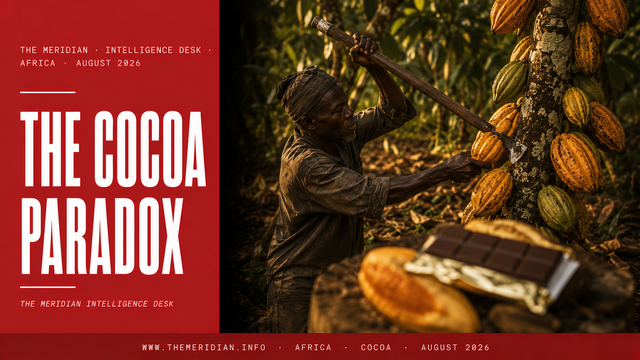
In the 1970s, cocoa farmers received 50 per cent of the value of a chocolate bar. In the 2023/24 crop year, with global cocoa prices hitting record highs above $6,330 per tonne, Ghanaian farmers received a fixed price representing 24 per cent of the global market average. Ivorian farmers received 53 per cent of the cost-insurance-freight price, despite the Living Income Differential introduced in 2020 to raise their share. Ghana and Ivory Coast account for around 60 per cent of global cocoa production. The cocoa price is set on futures markets in London and New York. Neither Ghana nor Ivory Coast has a seat at that table. The paradox this article examines is not that farmers receive less than the retail value of chocolate — every commodity chain contains a distribution of value across its participants. The paradox is that the share reaching the farmer has fallen by half over fifty years while the industry's global revenue has multiplied, and that every mechanism designed to correct this distribution has failed to deliver the correction it promised.
Begin with a specific price. In late 2024, the global cocoa price rose from $4,822 per tonne at the start of 2024 to nearly $12,065 per tonne by the end of the year — nearly tripling in twelve months. This was the largest single-year cocoa price increase in recorded commodity market history, driven by drought conditions in West Africa reducing supply. The cocoa futures market in London and New York registered the increase immediately. Traders holding long positions made extraordinary returns. The multinational chocolate manufacturers that had hedged their cocoa purchases at lower forward prices absorbed short-term losses before passing cost increases to consumers through chocolate price inflation. And the Ghanaian smallholder farmer who grew the cocoa that caused the price to spike because there was less of it received a fixed government price that captured a fraction of the market movement — because COCOBOD, Ghana's cocoa marketing board, sets the farmgate price in advance of the season, at a level it deems sustainable for the industry, irrespective of what the London futures market does between the price announcement and the harvest. The farmer grew scarcer cocoa. The price of scarcity was captured elsewhere.
The observable contradiction is this. Cocoa contributes about 15 to 20 per cent of Ivory Coast's GDP and supports millions of livelihoods. Approximately five to six million smallholder farms under five hectares in size produce 90 per cent of the global cocoa supply. These farms are the production base of a global chocolate industry whose retail value runs into hundreds of billions of dollars annually. The farmers who operate them have no pricing power, no forward contract access in their own names, no brand ownership in the finished product, no participation in the roasting, grinding, conching, and tempering that converts their cocoa beans into the product that Europeans pay premium prices for. They grow the raw material. The value chain — the aggregators, the traders, the processors, the manufacturers, the brands, the retailers — converts that raw material into value. The distribution of that value has moved steadily away from the grower for fifty years.
During the 1970s, cocoa farmers received 50 per cent of the value of a chocolate bar. The Living Income Differential, introduced jointly by Ghana and Ivory Coast in 2020, was designed to correct this. It adds $400 per tonne to the cost-insurance-freight price — a floor payment above the market price, funded by chocolate manufacturers who agreed to pay it as part of sustainability commitments. A peer-reviewed analysis published in the academic literature estimated that the LID could raise the incomes of Ivorian and Ghanaian cocoa farmers by 28 per cent in the best case — a fraction of the necessary increase of 93 and 113 per cent respectively to reach a living income. The volatility of global prices and ineffective redistribution mean that, despite the LID, farmers are receiving only 53 per cent of the CIF price. The correction designed to address the income gap has not closed it. The gap between what the correction promised and what the evidence shows it delivered is precisely measurable.
The first constraint is the price-setting architecture. The global cocoa price is determined on futures markets in London (the ICE Futures Europe exchange) and New York (ICE Futures US). The price reflects the expectations of traders, hedge funds, commodity merchants, and industrial chocolate buyers about future supply and demand. The farmers of Ghana and Ivory Coast who produce 60 per cent of the supply that those traders are pricing have no direct access to those markets in their own names. They sell to aggregators — local buyers who collect beans from multiple farms, provide immediate cash, and carry the price risk between farm and market. The aggregator captures the spread between the farmgate price and the market price. The farmer captures the farmgate price — fixed by COCOBOD in Ghana, set administratively in Ivory Coast — regardless of what the market does.
The second constraint is structural dependency. The cocoa value chain is complex. Farmers sell cocoa beans to aggregators, who gather them in volume from multiple regions to sell to traders and exchanges before they are acquired by processors. Ground beans are then sold to manufacturers, brands, and retailers, who face the challenge of tracing the commodity back to its plantation of origin. Each link in this chain — aggregator, trader, processor, manufacturer, brand, retailer — adds margin. The farmer, at the origin of the chain, has the weakest bargaining position, the least market information, the least access to credit, and the greatest exposure to price volatility. The chocolate bar that a European consumer buys for €3 contains approximately 40 grams of cocoa. At the 2024 peak price of $12,065 per tonne, the cocoa in that bar cost approximately 48 euro cents at the world market price. The farmer received substantially less than that — after COCOBOD deductions, aggregator margins, and transport costs, the farmgate value reaching the farmer for the cocoa in a single €3 chocolate bar is measured in cents, not euros.
The third constraint is the environmental trap. Ivory Coast has lost 45 per cent of its total tropical moist forest in the past two decades. Experts estimate that 70 per cent of the country's illegal deforestation is related to cocoa farming. The smallholder farmer whose yield is declining because the soil is exhausted, whose cocoa trees are ageing, and whose income is insufficient to invest in farm renewal, has one low-cost option for increasing output: clear more forest and plant more trees. The environmental cost of this strategy — deforestation, biodiversity loss, carbon emissions — is not borne by the farmer, the aggregator, the trader, or the chocolate manufacturer. It is borne by the global atmosphere and by future Ivorian generations. The extraction of value from the cocoa economy is accompanied by the extraction of ecological capital from the West African forest. The two extractions are structurally linked: the income insufficiency that drives deforestation is produced by the same value chain architecture that concentrates profit at the processing and branding end of the chain.
In the 1970s cocoa farmers received 50 per cent of the value of a chocolate bar. In 2023/24, with cocoa at record highs, Ghanaian farmers received 24 per cent of the global market price. The price tripled. The farmer's share halved. This did not happen by accident. It happened by architecture.
The Living Income Differential was the most ambitious correction to cocoa income distribution since the collapse of the International Cocoa Agreement in 1988. Announced jointly by Ghana and Ivory Coast in 2019 and implemented from the 2020/21 season, it added $400 per tonne to the reference price for cocoa purchases from both countries — a floor payment above the market price that chocolate manufacturers agreed to pay as part of their sustainability commitments. The mechanism was genuine. The intent was real. The evidence shows it was insufficient.
The peer-reviewed analysis found that the LID could raise incomes of Ivorian and Ghanaian cocoa farmers by 28 per cent in the best case, which is a fraction of the necessary increase of 93 and 113 per cent respectively to reach a living income. The correction closed the gap by less than a third of what closing it would require. The volatility of global prices and ineffective redistribution mean that, despite the LID, farmers are receiving only 53 per cent of the CIF price. The mechanism that was designed to ensure farmers received more of the market price produced a situation where, at record market prices, they received less than a quarter of what the market was paying.
The more promising correction is domestic processing. Each tonne processed in Ivory Coast adds an estimated $900 to $1,200 more value than exporting it raw. Ghana increased the amount of cocoa processed in the country from 30 to 34 per cent in 2023, with a goal of reaching 50 per cent by 2024. Côte d'Ivoire has pledged to attract private investment to reach 50 per cent local processing by 2025. In 2024, about 44 per cent of Ivory Coast's harvest was processed locally, with installed capacity exceeding 1.06 million tonnes. This is the correction with structural force: moving the value-adding processing step from Europe to West Africa retains the margin that processing generates within the producing economy. It does not solve the farmgate income problem for the smallholder farmer — the processing plants are owned by multinational companies and Ivorian industrial investors, not by cocoa farmers — but it begins to shift the value chain's centre of gravity.
The evidence suggests that the cocoa paradox is not a market failure in the narrow sense. The market is functioning as designed. The design allocates pricing power to the futures market, brand ownership to European and American chocolate companies, processing margin to industrial processors, and farmgate price to administrative boards whose political incentive is to keep the price high enough to prevent farmer exit from the sector without being high enough to threaten the competitiveness of the country's cocoa exports. The smallholder farmer sits at the intersection of all these incentive structures and captures what is left after each has taken its share.
The fifty-year trajectory from 50 per cent of chocolate bar value to 24 per cent of market price is not a drift. It is a structural shift produced by the consolidation of the chocolate industry, the concentration of brand ownership among a small number of multinational companies, the development of futures markets that allow price risk to be traded by parties with no agricultural connection to the cocoa crop, and the failure of successive international commodity agreements, sustainability certifications, and income differential mechanisms to reverse the directional movement of value away from the producer.
The 2023/24 cocoa price crisis is the most precise evidence of the paradox's structure. Cocoa prices nearly tripled in twelve months, driven by supply shortfalls in Ghana and Ivory Coast caused by adverse weather and ageing trees. On every measure of commodity market theory, this should have been a moment of exceptional income for cocoa farmers — scarcer supply, record prices, extraordinary market returns.
Ghanaian farmers received a fixed price representing 24 per cent of the global market average. COCOBOD had set the farmgate price before the season, on the basis of assumptions about what the market would bear. The market bore far more. The difference between the farmgate price and the market price — the spread that represents the value of the scarcity that the farmers' reduced harvest created — was captured by traders, processors, and manufacturers who held forward positions or whose hedging strategies allowed them to profit from the price movement.
The farmer whose drought-damaged crop caused the price spike received 24 cents of every dollar the market paid for their cocoa. The trader who held a long position in London received the rest. This is the cocoa paradox at its most precise: the producer of the scarcity does not own the scarcity premium. The market does. And the market is in London and New York, not Accra or Abidjan.
The cocoa paradox is the extraction economy's clearest case study. The raw material is African. The labour that grows it is African — including, by the evidence of 2.1 million child workers, child labour in conditions that international law defines as among the worst forms of exploitation. The forests cleared to grow it are African. The soil depleted by decades of monoculture is African. The carbon released by the deforestation is global but the ecological cost is African.
The price is set in London and New York. The brands are owned in Switzerland, Belgium, and the United States. The processing margin is captured in Europe and increasingly in Ivory Coast and Ghana — the one genuine structural correction that the evidence supports as directionally significant. The farmer who grew the cocoa received, in the year cocoa hit its highest price in recorded history, 24 per cent of what the market paid for their beans.
The Living Income Differential was the most serious attempt to correct this in a generation. It closed the gap by less than a third of what closing it requires. Ivory Coast's domestic processing target — 50 per cent of output processed locally — is the correction with structural force. It will not reach the smallholder farmer directly. But it will shift a portion of the value that currently leaves West Africa as raw beans back into the economies that grew them. That is not justice. It is a start. The evidence suggests it is the only correction currently on the table that the architecture of the cocoa economy cannot absorb without changing.
Add comment
Comments