Cotton, Timber, Fish: How Africa Exports Its Raw Materials and Imports the Finished Products Back at Ten Times the Price
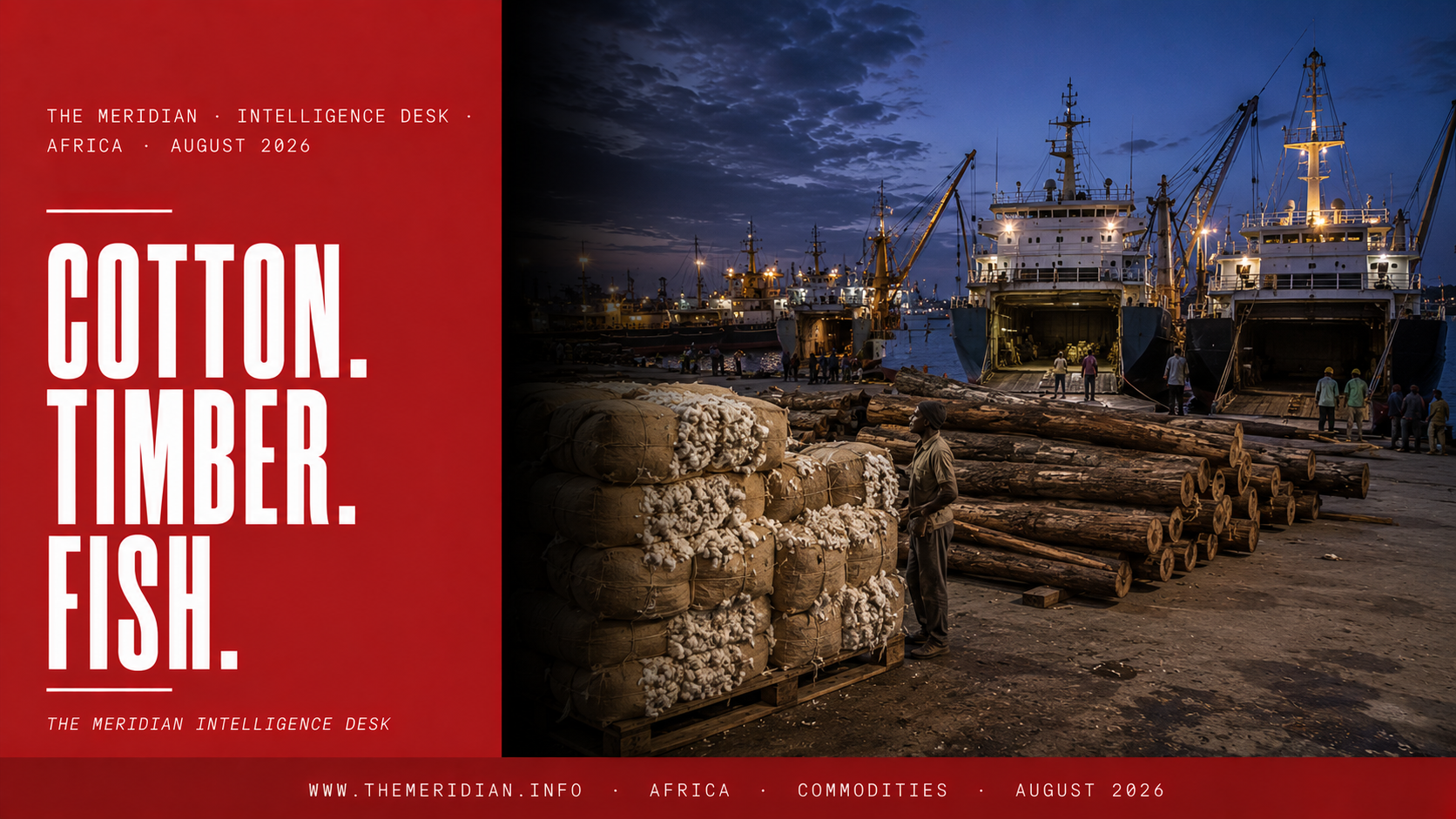
Around 98 per cent of West Africa's cotton is exported as raw fibre. African countries are estimated to lose $17 billion to illegal logging each year. West African nations lose an estimated $9.4 billion per year due to illegal, unreported and unregulated fishing. Three commodities. Three different sectors. Three different regulatory regimes. One architecture: the raw material leaves the continent at commodity prices, the value-adding process — spinning, weaving, cutting, processing, smoking, canning — happens in Asia or Europe, and the finished product returns to Africa at retail prices that bear no relationship to the farmgate, the forest, or the sea. This article examines the architecture that the three commodity chains share, the corrections that have been proposed for each, and what the evidence shows about why those corrections have not fundamentally changed the structure.
The structure of African commodity extraction is most visible in its most mundane form. A t-shirt in a European fast fashion outlet costs €5. The cotton in it was grown by a smallholder farmer in Benin, Mali, or Burkina Faso. It was exported as raw fibre — unspun, unprocessed — to a ginning facility in China or Bangladesh, spun into yarn, woven into fabric, cut and sewn into a garment, labelled with a brand, shipped to a European distribution centre, transported to a retail outlet, and sold for €5. Of that €5, the cotton farmer received approximately 3 to 6 cents. The furniture in a European flat-pack retailer contains wood harvested from a Cameroonian or Gabonese forest. It left Africa as rough-sawn timber or unprocessed logs, was processed in a Chinese or Vietnamese factory, shaped, finished, and shipped to Europe. The fishmeal in a European salmon farm feed was caught in West African waters by a Chinese industrial trawler, processed at sea or in a Chinese factory, and sold as agricultural input in a market the West African artisanal fisherman who previously fished those waters cannot enter. Three industries. One logic. The raw material goes. The value stays somewhere else.
The cotton sector represents one of the most promising levers for industrialisation in Africa, particularly in West and Central Africa. Currently, around 98 per cent of the region's cotton is exported as raw fibre. This figure, stated by Cameroon's Minister of Trade at the March 2026 WTO ministerial conference in Brussels, is the clearest possible statement of the extraction problem: an entire agricultural sector whose industrial potential — the spinning, the weaving, the garment manufacturing — is realised outside the continent that produced the raw material. Benin, West Africa's leading producer, exported $505 million worth of raw cotton in 2024, placing it fifth among the world's raw cotton exporters. Raw cotton was Benin's leading export product that year. Benin's leading export is a product it exports without processing.
The Cotton Four — Benin, Burkina Faso, Chad, and Mali, later joined by Ivory Coast — have raised at the WTO for more than twenty years a specific demand: an end to US, Chinese, and European subsidies in their cotton sectors, which create unfair competition. WTO Deputy Director-General Jean-Marie Paugam told AFP: "This request has never been met." Twenty years of formal, documented, multilateral advocacy on a specific, costed, legally articulable grievance. Not met. The WTO framework that was designed to provide a rules-based mechanism for resolving exactly this kind of structural trade distortion has not produced a resolution in twenty years of formal process. The cotton farmers of West Africa have been waiting longer than some of them have been alive.
African countries are estimated to lose $17 billion to illegal logging each year, part of a global market with an economic value of $30 to $150 billion. Africa's share of rosewood exports to China rose from 40 per cent in 2008 to 90 per cent in 2018, according to UNODC. The DRC presents the most precise evidence of the structural failure. Despite criminalising raw log exports — except for new concessions that can export up to 30 per cent of harvested wood as logs — between 2015 and 2023, 74 per cent of the DRC's wood was exported as unprocessed logs, with China as the primary destination. As of 2024, an estimated almost three million cubic metres of timber left the DRC for Chinese cities.
A law banning raw log exports. Three million cubic metres of raw logs exported in a single year, in violation of that law. The gap between legislation and implementation is the corruption and governance capture that the Africa Center for Strategic Studies has documented precisely: in Gabon, the Vice President and Minister of Forestry were implicated in a rosewood trafficking scandal in 2019. In Zambia, seized timber was found to have allegedly been facilitated by ministers and family members of the former president. Small-scale logging, most of which is illegal, is responsible for 90 per cent of the annual wood harvest in the DRC. The legal framework prohibits the extraction. The political economy that benefits from the extraction prevents enforcement of the prohibition.
98 per cent of West African cotton leaves as raw fibre. 74 per cent of DRC timber left as unprocessed logs despite a law banning it. $9.4 billion in fish is taken from West African waters illegally each year. Three different commodities. The same architecture: the raw material leaves and the value stays somewhere else. The law says otherwise. The evidence shows what happens to the law.
West African nations lose an estimated $9.4 billion per year due to illegal, unreported and unregulated fishing, according to a 2022 report by the Financial Transparency Coalition. This is the most precisely quantified of the three commodity extraction losses — and it is, by definition, a loss from activity that is prohibited rather than merely uncompensated. The cotton farmer receives a low price for a raw material legally exported. The logger may be violating a law but is extracting a resource that physically exists. The IUU fisherman is taking a fish that West African artisanal fishermen also need to catch, from waters that belong to the West African state, without payment, without record, and without the social licence that fishing access agreements nominally require.
The EU has signed fishing access agreements with multiple West African nations — Senegal, Mauritania, Guinea-Bissau, The Gambia, and others — that pay an access fee for European fleets to fish in their exclusive economic zones. These agreements are presented as partnerships. The evidence from scientists, NGOs, and West African fishing communities tells a more complicated story. For Aliou Ba, Greenpeace Africa's interim senior oceans campaign manager: "The main threat to the ocean and communities in West Africa is the unsustainable exploitation of marine and terrestrial resources, often facilitated by unfair agreements, neo-colonial practices and IUU fishing. These patterns of exploitation exacerbate socio-economic inequalities, driving many people to despair and emigration."
The Senegal case is the most precisely documented. In April 2024, Senegal's new president Bassirou Diomaye Faye — who had campaigned on reviewing the nation's fishing agreement with the EU — published a list of 132 vessels registered in Senegal and authorised to fish in the country. Of these, 26 appear to have ties to Spanish parent companies. European fishing companies registering their vessels under Senegalese flags to access Senegalese fishing rights at lower cost than a direct EU-Senegal access agreement would require: this is the legal architecture of extraction in the fisheries sector. The vessel flies an African flag. The profits flow to a Spanish parent company. The artisanal Senegalese fisherman whose nets are cut by the vessel's passage receives nothing.
The evidence across cotton, timber, and fish suggests a single structural finding that this edition has now documented across eleven articles: the extraction economy does not require malice. It requires architecture. The cotton farmer in Benin is not being robbed. They are being paid the market price for raw cotton. The market price for raw cotton reflects a market in which the processing capacity — the spinning mills, the weaving factories, the garment manufacturers — is located in Asia, not in Benin. The processing capacity is located in Asia because the historical investment in that capacity happened in Asia, enabled by Asian state industrial policy and cheap Asian labour, during a period when West African states were either colonial territories or newly independent nations without the capital, the infrastructure, or the institutional capacity to compete.
The timber logger in the DRC is violating the law. But the law is not being enforced because the officials responsible for enforcement are, in documented cases, participating in the illegal trade. The IUU fishing vessel in Senegalese waters is stealing fish. But it is able to steal fish because the monitoring, surveillance, and enforcement capacity of the Senegalese state is insufficient to detect, intercept, and prosecute it in waters covering hundreds of thousands of square kilometres.
The Cotton Four countries have raised their demand at the WTO for more than twenty years: an end to US, Chinese, and European subsidies in their cotton sectors, which create unfair competition in global markets. "This request has never been met," WTO Deputy Director-General Jean-Marie Paugam confirmed to AFP in March 2026.
The WTO Cotton Four case is the clearest available evidence that the international trade architecture is not designed to resolve structural extraction. The four countries have the legal standing. They have the evidence. They have a specific, costed demand. The WTO has a dispute resolution mechanism. Twenty years of formal process has produced no resolution.
Meanwhile, the C-4+ countries are focusing their efforts on developing the cotton sector by promoting the processing of cotton products — the pragmatic pivot from waiting for the multilateral system to deliver justice to building the processing capacity that would reduce dependence on the system's fairness. The WTO needs $12 billion in investment over ten years to unlock the cotton value chain in West Africa. That investment has not arrived. The subsidy demand has not been met. The raw fibre continues to leave at 98 per cent of the export volume. This is not a failure of advocacy. It is a demonstration of power.
Cotton, timber, and fish are three different commodities governed by three different regulatory regimes in three different sectors. They share one outcome: the raw material leaves the continent at commodity prices, and the value added by processing, manufacturing, and branding is captured by economies that did not grow the cotton, cut the tree, or catch the fish. The difference between the raw cotton price and the fast fashion retail price, between the log price and the furniture retail price, between the fish landing price and the fishmeal factory gate price, is the manufacturing margin that stays in Asia, Europe, and China rather than in Benin, the DRC, or Senegal.
The corrections proposed for each commodity are genuine. The C-4+ countries' demand for an end to subsidy distortions is legally correct and economically sound. The DRC's raw log export ban is environmentally necessary. Senegal's fishing registry publication is a genuine transparency measure. None of these corrections has changed the structure. The processing capacity is still in Asia. The illegal logging is still 74 per cent of exports. The IUU fish is still $9.4 billion per year.
The extraction does not require the permission of the extracted. It requires only that the extracted lacks the processing capacity, the enforcement infrastructure, and the trade negotiating leverage to prevent it. The evidence shows that across cotton, timber, and fish, Africa currently lacks all three. The question the evidence raises is not whether that can change. It is what building the capacity, the infrastructure, and the leverage actually requires — and who benefits from the current arrangement remaining as it is.
Add comment
Comments