The Dollar Monopoly: How the United States Controls the Global Reserve Currency and What It Costs the Global South
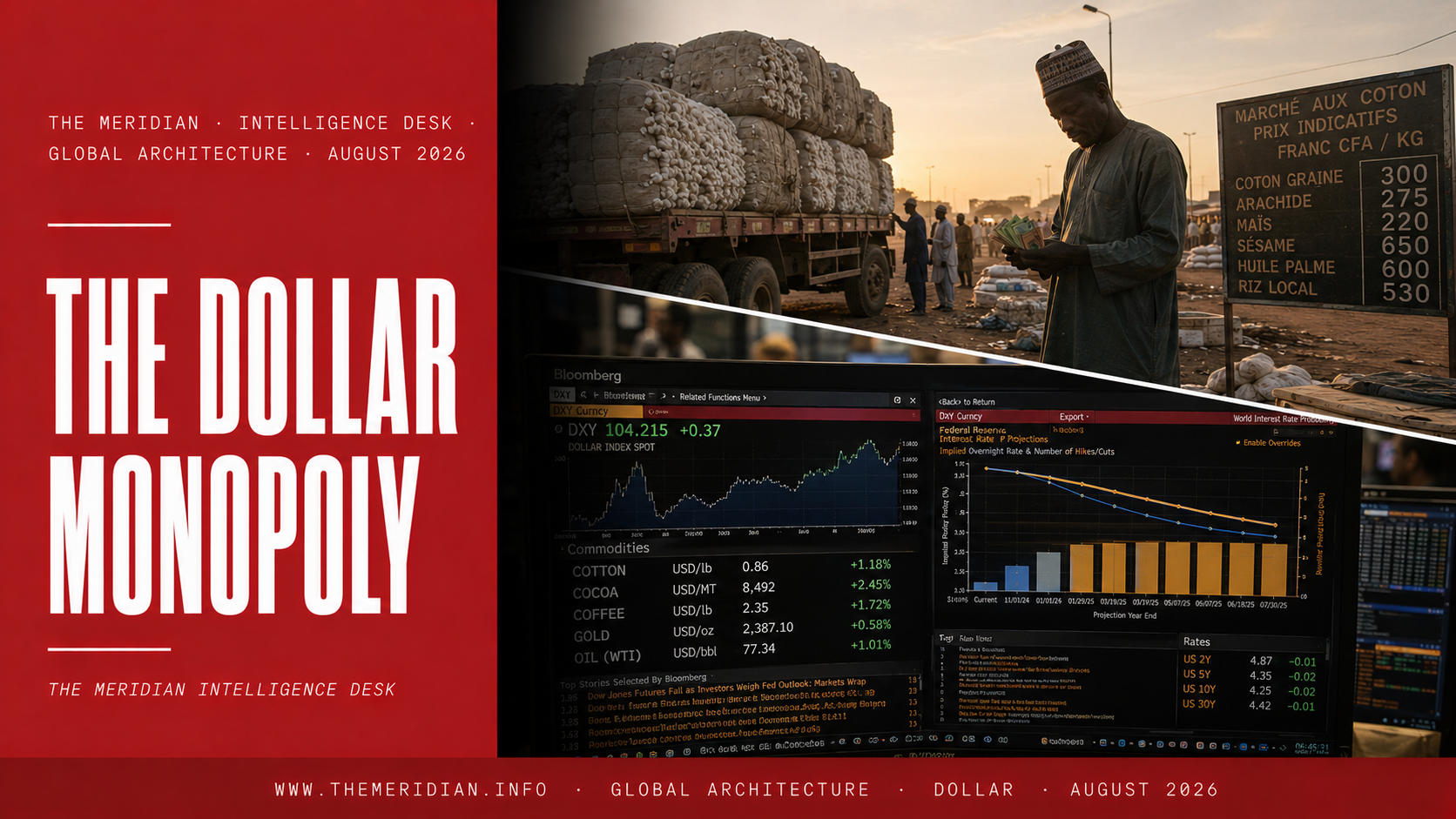
The US dollar accounts for 56.92 per cent of global foreign exchange reserves as of Q3 2025, according to IMF data. The dollar dominates foreign exchange transactions at 88 per cent and export invoicing at 54 per cent. Commodities are priced in dollars. Dollar-denominated debt is held by governments and corporations across the Global South. The Federal Reserve raised interest rates by 5.25 percentage points from March 2022 through July 2023 — the fastest tightening cycle since the early 1980s. The share of emerging markets and developing economies with sovereign spreads exceeding 10 percentage points jumped from 13 per cent in December 2021 to 26 per cent in May 2023. The July 2025 BRICS summit in Rio de Janeiro produced no concrete progress toward a shared currency or coordinated de-dollarisation strategy. The dollar's grip tightened. The Global South pays the interest.
The dollar's role in the global economy is not a natural condition. It is an institutional arrangement created at a specific historical moment — the Bretton Woods conference of 1944 — in which the United States, as the dominant economic and military power of the post-war order, established the dollar as the anchor of the international monetary system. The arrangement gave the United States what French Finance Minister Valéry Giscard d'Estaing called in 1965 an "exorbitant privilege": the ability to run persistent current account deficits — to consume more than it produces — because the rest of the world needs dollars to conduct international trade and hold foreign exchange reserves. The privilege is real. It is also the mechanism through which a monetary decision made in Washington — to raise or lower the federal funds rate — becomes a fiscal, debt, and exchange rate crisis in economies that had no part in making the decision and no institutional representation in the body that made it.
The observable contradiction is stated precisely by the Federal Reserve Bank of Kansas City: historically, a higher US federal funds rate has been associated with international investors withdrawing capital from emerging markets, which can lead to lower economic activity and depreciating exchange rates in these markets — and, in turn, greater financial vulnerability. To reduce capital outflows, central banks in emerging markets can tighten their own monetary policy rates to increase yields on debt securities. But raising interest rates comes with trade-offs. The trade-off is the core of the dollar monopoly problem. When the United States raises interest rates to address American inflation, every emerging market central bank faces the same coercive choice: raise your own rates to prevent capital flight and currency depreciation, at the cost of domestic growth; or hold rates down and watch your currency fall and your dollar-denominated debt become more expensive in local currency terms. The Federal Reserve does not consider this trade-off when making its decision. Its mandate is domestic price stability and maximum employment in the United States. The Global South's monetary sovereignty is not part of its mandate.
The 2022–23 cycle of Federal Reserve tightening raised concerns about spillover effects on smaller emerging market and developing economies. Historically, a higher federal funds rate has been associated with international investors withdrawing capital from emerging markets. The 5.25 percentage point increase in the federal funds rate from March 2022 through July 2023 far exceeds the 3 percentage points of Fed tightening in 1994 and is only eclipsed by the 10 percentage point increase in the first year-and-a-half of the Volcker Fed, 1979–80. Those earlier episodes of sizable Fed tightening preceded destabilising currency devaluations in emerging markets, precipitating sovereign debt and banking crises in many of those economies.
The first constraint is the network effect of the dollar's existing dominance. A reserve currency lowers exchange rate risk as the country does not need to exchange its currency for the reserve currency to accomplish the trade. A large portion of commodities is priced in the reserve currency, leading countries to hold this currency to pay for these items. The cobalt exported from the DRC is priced in dollars. The cocoa exported from Ivory Coast is priced in dollars. The coffee exported from Ethiopia is priced in dollars. The cotton exported from Benin is priced in dollars. Every commodity examined in this edition's Layer Two is priced in a currency that none of the producing countries issue. To receive payment for their commodities, they must accept dollars. To buy commodities they need to import — fuel, food, capital equipment — they must pay in dollars. To service their external debt, they must pay in dollars. The dollar is not an external imposition on the Global South's commodity economy. It is the internal medium through which that economy operates.
The second constraint is the Federal Reserve's mandate. The policy mandate of the United States does not include consideration of spillover effects on emerging market and developing economies. Emerging market and developing economies could nonetheless benefit if US monetary policy avoided abrupt changes. The Federal Reserve is a domestic institution with a domestic mandate. Its Board of Governors is appointed by the President of the United States and confirmed by the US Senate. No representative of any developing country has a seat on the Federal Open Market Committee. When the FOMC votes to raise the federal funds rate, it is voting on an American monetary policy question. The fact that the decision will affect the debt service costs, capital flows, exchange rates, and growth trajectories of 150 developing economies is not a factor in the decision. This is not a failure of the Federal Reserve to do its job. It is a structural feature of a system in which the reserve currency issuer's domestic monetary authority has global monetary consequences without global accountability.
The third constraint is the coercive dimension of the dollar's reserve status. In December 2024, Trump demanded BRICS members commit to neither creating a new currency nor backing alternatives to what he called "the mighty US dollar." The effect was immediate. Brazil's President Lula, previously one of the most vocal advocates for a common BRICS currency, quietly dropped the idea from Brazil's 2025 BRICS presidency agenda. The dollar's reserve status is maintained not only by network effects and institutional inertia. It is maintained, when necessary, by the explicit threat of economic retaliation from the issuing country against any collective attempt to reduce dependence on it. A reserve currency that the issuer is prepared to defend with 100 per cent tariff threats is not simply a monetary convenience. It is a geopolitical instrument.
The Federal Reserve raised rates 5.25 percentage points in 18 months. It was fighting American inflation. The share of developing countries with sovereign spreads above 10 percentage points doubled. The World Bank estimated 60% of lower-income countries were in or at risk of debt distress. The Fed's mandate does not require it to consider these consequences. This is the dollar monopoly: monetary sovereignty for one, monetary subordination for the rest.
The de-dollarisation movement is the correction. It has been building since the 2008 global financial crisis demonstrated that a system in which global financial stability depends on American financial stability is a system in which the entire world's balance sheet is exposed to Wall Street's risk management failures. The BRICS grouping — Brazil, Russia, India, China, South Africa, and now expanded to include Egypt, Ethiopia, Iran, Indonesia, the UAE, and others — has been the primary vehicle for the correction's ambition. The July 2025 BRICS summit in Rio de Janeiro produced no concrete progress toward a shared currency. The final declaration contained no mention of a common currency or coordinated de-dollarisation strategy.
The correction's failure at the July 2025 summit is explained by the Trump tariff threat of December 2024. After the 2024 US election, President Trump publicly warned BRICS members that he would impose up to 100 per cent tariffs if they backed a new currency or sought to replace the dollar. Even Russia's Vladimir Putin, who had displayed what appeared to be a prototype BRICS banknote at the 2024 Kazan summit, publicly stated in November 2024 that Russia was not seeking to abandon the dollar: "We have not sought to abandon the dollar and we are not seeking to do so." The most significant structural correction to dollar dominance proposed in the twenty-first century was effectively suspended by a single presidential statement from Washington. This is the constraint in its most precise form: the correction to dollar monopoly requires the cooperation of countries whose trade access to the United States — the world's largest consumer market — the United States can withdraw by executive order.
What has survived the summit failure is more modest but more durable. India's rupee trade mechanism has been extended to over 30 countries. China and Brazil are transacting in yuan and reais. Russia and Iran are expanding currency swaps. The BRICS Pay platform — intended as a blockchain-based alternative to SWIFT — is in pilot testing. China's Cross-Border Interbank Payment System has 1,467 indirect participants across 119 countries, linking 4,800 banks in 185 countries as of January 2025. These are genuine incremental shifts in the dollar's operational dominance. As of 2024, the dollar is used in almost 90 per cent of foreign exchange transactions and 48 per cent of SWIFT payments — actually an increase since 2014. The incremental shifts have not yet bent the trend line.
The evidence suggests three conclusions that the de-dollarisation debate rarely holds simultaneously. First, dollar dominance is declining but slowly and from a high base. The dollar's share of global reserves has fallen from approximately 71 per cent at its peak in 2000 to 56.92 per cent in Q3 2025. This is a 14 percentage point decline over 25 years. At this rate, the dollar will remain the dominant reserve currency for the foreseeable future. The renminbi accounts for 2 per cent of global reserves. No other currency is positioned to replace the dollar as the primary reserve currency within a decade.
Second, dollar dominance imposes measurable costs on the Global South that are not reflected in any international institution's mandate. Writing in May 2023, when he was still president of the World Bank, David Malpass estimated that some 60 per cent of lower-income countries are in or at high risk of entering debt distress. The primary driver of this debt distress is the combination of dollar-denominated debt and the Federal Reserve's 2022–23 tightening cycle. The countries in debt distress did not benefit from the American monetary policy that produced their distress. They had no vote in the Federal Open Market Committee. They have no institutional mechanism for seeking compensation for the spillover effects of decisions made in their creditor's currency.
Third, the correction faces a structural paradox. In May 2026, the US federal debt surpassed $39 trillion, with debt interest payments becoming one of the biggest burdens on public finances, further eroding the dollar's "risk-free asset" aura. The conditions that make the dollar vulnerable to eventual displacement are being created by the United States itself: unsustainable fiscal deficits, political dysfunction around the debt ceiling, and the weaponisation of dollar clearing through sanctions that give every country with geopolitical differences with Washington an incentive to reduce dollar dependence. But the correction that would address these vulnerabilities — a credible alternative reserve currency — faces the Trump tariff threat every time it approaches institutional reality. The dollar's hegemony is simultaneously eroding from within and being defended by political coercion from without. The Global South sits at the intersection of both forces, servicing dollar debt with commodity revenues it cannot price in its own currencies.
Since the end of 2021, there has been an increase in the share of emerging markets and developing economies with sovereign spreads exceeding 10 percentage points. This share jumped from 13 per cent of economies in December 2021 to 26 per cent of economies in May 2023. The interest rate facing corporate borrowers in an emerging market or developing economy rises with increases in that country's sovereign interest rate. The financial conditions in these economies have become more challenging with rising US interest rates.
The doubling of the share of developing countries in severe sovereign distress between December 2021 and May 2023 was produced by a single sequence of Federal Reserve decisions. The countries whose sovereign distress doubled had no representative on the committee that made those decisions, no institutional mechanism to object to the consequences, and no alternative currency in which to denominate the debt whose service costs made them distressed.
This is the dollar monopoly at its most precise: a monetary authority with domestic accountability makes domestic monetary policy decisions. Those decisions double the share of the world's poorest countries in sovereign financial distress within eighteen months. No international institution has the mandate to prevent this from happening. No compensation mechanism exists for the countries that absorbed the cost. The dollar's exorbitant privilege is real. Its exorbitant cost to those who do not print it is equally real. It is simply not counted.
The dollar monopoly is the most abstract element of the extraction economy this edition has documented. The cobalt miner in the DRC can see the mining truck. The cotton farmer in Benin can see the buyer. The artisanal fisherman in Senegal can see the industrial trawler cutting their nets. The dollar monopoly is invisible — it operates in the spread between the interest rate set in Washington and the debt service cost calculated in Nairobi, Lagos, or Port Louis. But its consequences are as concrete as any commodity price.
The Federal Reserve raised rates by 5.25 percentage points to address American inflation. The share of developing countries in severe sovereign distress doubled within eighteen months. The World Bank estimated that 60 per cent of lower-income countries were in or at risk of debt distress. The capital that had flowed into developing markets during the zero-rate era flowed back to American treasuries. The currencies of developing countries depreciated. The local currency cost of dollar-denominated debt rose. Growth slowed.
None of this was intended. None of it required any individual actor to behave badly. The system produced it as its normal output. The dollar monopoly does not require malice. It requires only that one country issues the world's reserve currency, that its monetary authority has a domestic mandate, that the currency in which the world's debts are denominated is the currency of one country's monetary policy decisions, and that the institutions designed to manage the international monetary system have no mandate to compensate the countries that absorb the cost of those decisions. The architecture is intact. The cost is real. The Global South pays it.
Add comment
Comments