Remittances: How Migrant Workers Send More Money to the Global South Than All Foreign Aid Combined, and Why It Does Not Count
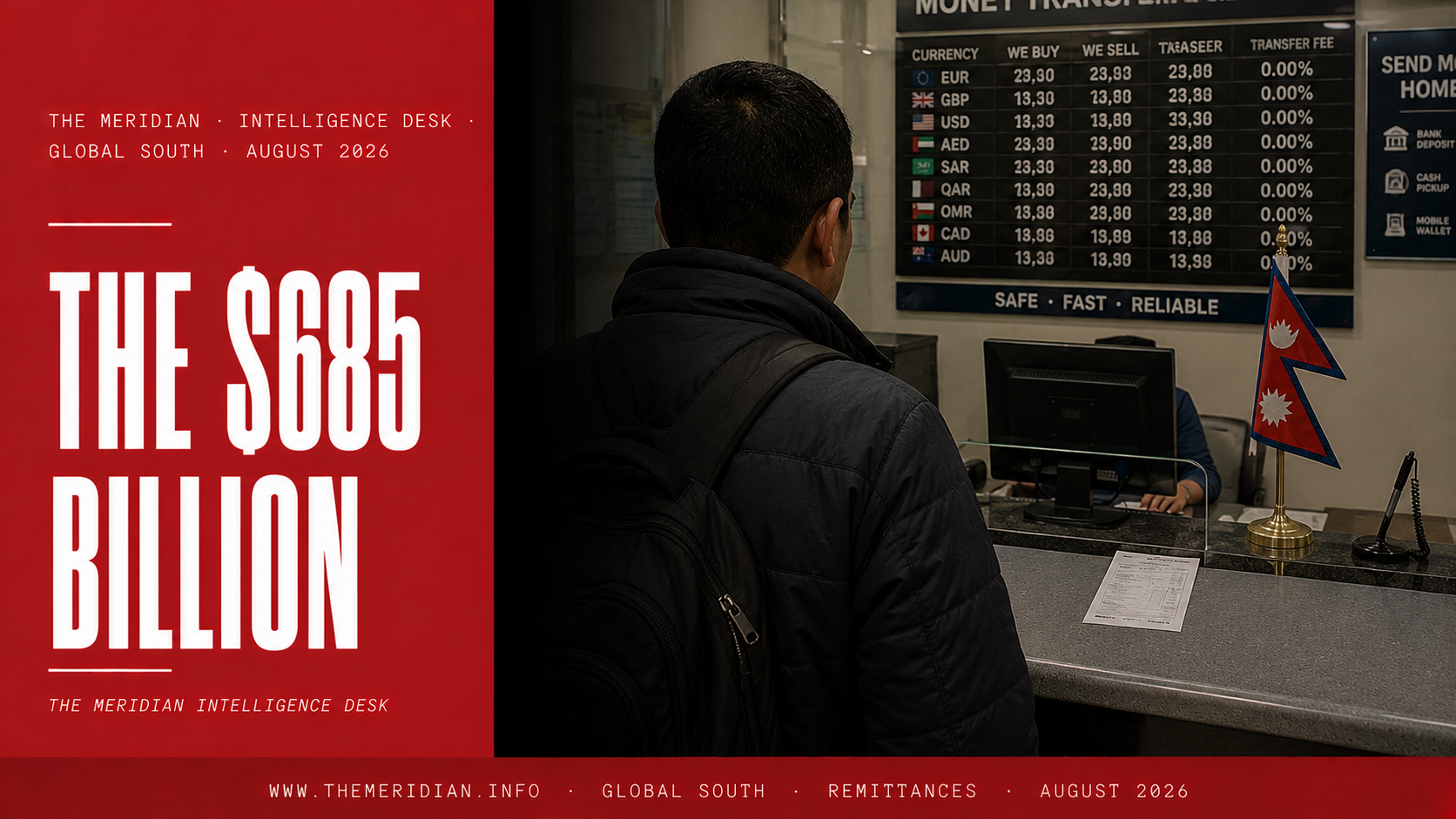
Remittance flows to low- and middle-income countries reached $685 billion in 2024, larger than foreign direct investment and official development assistance combined. Remittances have surpassed official development assistance in every World Bank estimate since 2000, and exceeded foreign direct investment flows to low- and middle-income countries by more than $270 billion in 2023. The global average cost of sending $200 was 6.49 per cent in Q1 2025, more than twice the United Nations Sustainable Development Goal target of 3 per cent. Sub-Saharan Africa remains the costliest region at 8.78 per cent, nearly triple the SDG target. At $685 billion and a 6.49 per cent average transfer fee, the annual extraction from remittance transaction costs amounts to approximately $40 billion: money that leaves the pockets of migrant workers and the families who depend on it, captured by the money transfer operators and banks that sit between the sender and the recipient. This is the development finance nobody counts properly. It is the largest single source of external finance to the Global South. It carries no conditionality, reaches families directly, and arrives counter-cyclically. It is also taxed by the financial infrastructure of the extraction economy at a rate that no official aid programme would tolerate.
A Mauritian nurse working in London sends £300 home to her mother in Rivière du Rempart each month. She goes to a money transfer office near her flat, hands over the cash, pays a fee, and her mother collects the rupees two days later at a local outlet. The transaction costs her approximately £18 to £20 in fees, roughly 6 per cent of the amount sent. Her mother receives the equivalent of roughly £280 in purchasing power after the exchange rate margin is applied. The £18 to £20 that did not arrive in Rivière du Rempart is the business model of the global remittance industry. Multiplied across hundreds of millions of transactions per year, it is a $40 billion annual extraction from the world's most direct and unconditional form of development finance. The nurse is not unusual. There are an estimated 281 million international migrants in the world. Most of them send money home. Taken together, they are the world's largest development finance mechanism. Nobody in the official development system counts them properly.
The observable contradiction is one of scale and accounting. Remittance flows to low- and middle-income countries reached $685 billion in 2024, a figure larger than foreign direct investment and official development assistance combined. Official development assistance, the foreign aid that governments, development banks, and multilateral institutions provide to developing countries, totalled approximately $220 billion in 2024. Remittances are more than three times the size of the entire official aid system. They are sent by individuals, not governments. They require no parliamentary approval, no donor conference, no conditionality negotiation, and no disbursement delay. They arrive monthly, quarterly, and in emergencies, counter-cyclically: when a natural disaster strikes, when a family member falls ill, when a harvest fails, the remittance increases rather than decreases, because the migrant worker responds to the need. No official aid architecture has ever replicated this responsiveness. None ever will.
The accounting problem compounds the scale problem. Remittances are classified as private transfers in the balance of payments accounts. They do not appear in official development finance statistics. The OECD's Development Assistance Committee, which tracks global aid flows, does not include remittances in its headline figures. The World Bank's development finance monitoring treats remittances as a separate category from official flows. The consequence is that the world's largest source of external finance to the Global South is systematically excluded from the conversations about development finance adequacy. When donors meet at G7 summits and pledge billions to development assistance, they are pledging to supplement a flow that dwarfs their pledge, using an architecture that is three times smaller than the private transfer system that migrant workers have built without institutional support.
The first constraint is market concentration. Western Union is present in 95 per cent of remittance corridors monitored by the World Bank's Remittance Prices Worldwide database. MoneyGram is present in 90 per cent. These two operators, together with a small number of major banks, dominate the physical and agent-based transfer infrastructure through which the majority of the world's remittances still flow. Sending remittances remains too costly due to limited competition among providers and inadequate cross-border interoperability. The market structure that produces 6.49 per cent average fees is not an accident of technology. It is a consequence of the capital requirements, regulatory licences, and agent network investments that create barriers to entry high enough to prevent the competitive pressure that would drive costs toward the SDG target.
The second constraint is the de-risking behaviour of correspondent banks. In recent years, major international banks have withdrawn from correspondent banking relationships in high-risk jurisdictions, a practice known as de-risking, to reduce their exposure to regulatory penalties for facilitating money laundering and terrorist financing. At the same time, remittance flows to sub-Saharan African countries remain volatile, affected by exchange rate dynamics, rising transaction costs, and political instability in some major sending and receiving countries. In Q1 2025, the cost of sending $200 to sub-Saharan Africa averaged close to 9 per cent, up from 7.7 per cent a year ago and well above the global average. The de-risking of African corridors by correspondent banks does not reduce the risk of money laundering. It reduces the availability of cheap, regulated, traceable transfer channels, pushing transfers toward less transparent operators whose fees are higher and whose compliance standards are lower. The regulation designed to prevent financial crime increases the cost borne by the nurse sending money home to Rivière du Rempart.
The third constraint is the informal channel problem. Recipient countries reported receiving $892 billion in remittances in 2024, a figure that far exceeds the $549 billion reported by sending countries. This significant discrepancy highlights the methodological challenges in producing accurate global remittance estimates. The gap between what sending countries report and what receiving countries report, $343 billion in 2024, represents the flows moving through informal channels: hawala networks, hand-carried cash, mobile money transfers that bypass formal reporting systems. These informal flows are cheaper than formal transfers and reach recipients in areas where no regulated money transfer operator has an agent presence. They are also invisible to the data systems that inform policy, excluded from the development finance statistics that undercount remittances even further than the formal figures suggest.
The nurse in London sends £300 home. She pays £18 in fees. Her mother receives £282 in value. The £18 that did not arrive in Rivière du Rempart is the business model of an industry handling $685 billion per year. At 6.49 per cent average fees, the annual extraction is approximately $40 billion. That is more than the entire GDP of many of the countries whose citizens pay it.
SDG 10.c was adopted in 2015 as part of the 2030 Agenda: reduce the transaction costs of migrant remittances to less than 3 per cent by 2030, and eliminate remittance corridors with costs higher than 5 per cent. The target has a deadline of four years from the time of writing. The global average cost in Q1 2025 was 6.49 per cent, more than twice the SDG target. Sub-Saharan Africa's average cost was 8.78 per cent, nearly triple the target, and rising. On the current trajectory, SDG 10.c will not be met in 2030. It will not be met in 2035. The cost of sending money to Sub-Saharan Africa has increased in the twelve months to Q1 2025, moving away from the target rather than toward it.
The fintech correction is partial and significant. Digital-only providers average 3.65 per cent, already below the SDG target. Wise, Remitly, WorldRemit, and similar digital money transfer operators have demonstrated that the 3 per cent target is technically achievable, not a theoretical aspiration but a commercially operating reality in digital corridors. The constraint is not technical. It is structural: digital transfers require the sender and recipient both to have bank accounts or mobile money wallets, reliable internet access, smartphones, and the digital literacy to navigate online platforms. In the corridors where remittance costs are highest, rural Sub-Saharan Africa, fragile states, remote Pacific islands, these prerequisites are least available. The fintech correction has reduced costs for the migrant workers with the most financial infrastructure. It has left largely unchanged the costs for those with the least.
The evidence suggests that remittances are simultaneously the Global South's most important development finance mechanism and its most systematically under-valued one. Three conclusions follow from the evidence base.
The first is about scale and visibility. The exclusion of remittances from official development finance accounting is not a technical oversight. It reflects a conceptual framework in which development finance means money that flows through official channels, governments, multilateral institutions, development banks, and in which private transfers between individuals are treated as a separate category outside the accountability architecture. This framework systematically understates the Global South's development finance position. A country receiving 20 per cent of its GDP in remittances, as Tajikistan, Tonga, Nicaragua, and Lebanon do, is not a country dependent on aid. It is a country with a substantial and resilient source of external income that happens to flow through channels the official system does not count. Correcting the accounting would not change the flows. It would change the political conversation about what the Global South actually receives and from whom.
The second is about the fee extraction's distributional character. The $40 billion extracted annually from remittance transfer fees falls entirely on migrant workers and their families. It is a regressive tax on the poorest participants in the global labour market. A Bangladeshi garment worker in Qatar, a Filipino domestic worker in Singapore, a Senegalese construction worker in France: each pays a fee to send the wages they have earned to the family that depends on those wages. The fee is not an investment. It produces no development return. It flows to Western Union's shareholders, to banks' correspondent fee income, and to the regulatory compliance apparatus of a financial system that treats the migrant worker's transfer as a compliance risk rather than a development asset.
The third is about the connection to the rest of this edition's extraction architecture. The IMF conditionality article documented how developing countries are required to remove agricultural subsidies while rich countries maintain their own. The TRIPS article documented how intellectual property rules keep medicine expensive for the people who need it most. The dollar monopoly article documented how Federal Reserve decisions impose fiscal costs on developing country governments without representation. The remittance fee structure adds a further layer: the migrant worker who has left their country because it cannot provide adequate wages, in part because of the commodity price architecture, the agricultural subsidy wall, and the dollar-denominated debt described in this edition's earlier layers, sends money home through a financial infrastructure that extracts 6.49 per cent of every transfer. The extraction does not end when the migrant leaves the country. It continues on the journey home.
In Q1 2025, the cost of sending $200 to sub-Saharan Africa averaged close to 9 per cent, up from 7.7 per cent a year ago and well above the global average. These evolving challenges call for targeted policies to sustain remittance flows and reduce transfer costs to less than 3 per cent as set in SDG target 10.c.
SDG 10.c was agreed in 2015. The deadline is 2030. In the ten years since 2015, the global average cost has fallen from approximately 7.5 per cent to 6.49 per cent: a reduction of roughly one percentage point per decade. At that rate of progress, the 3 per cent target would be reached sometime around 2050. Sub-Saharan Africa's cost has not fallen. It has risen. The region that most depends on remittances as a share of GDP, that faces the highest transfer fees, and whose informal transfer flows are largest relative to formal flows, is moving away from the SDG target as the deadline approaches.
The SDG target is not an aspiration. It is a commitment made by the governments of the world's largest remittance-sending countries, including the United States, Saudi Arabia, Switzerland, and Germany. Those governments have not regulated the industries operating in their jurisdictions, Western Union, MoneyGram, the correspondent banks, in a manner consistent with meeting the commitment they made. The nurse in London is paying the cost of that inconsistency, one transfer at a time.
Remittances are the extraction economy's most intimate layer. Every other extraction mechanism documented in this edition operates at the level of institutions: commodity markets, trade agreements, monetary policy, patent systems. The remittance fee operates at the level of the household. It extracts from the nurse, the construction worker, and the domestic labourer directly, in the act of trying to support the family they left behind when the extraction economy made staying at home an insufficient option.
The $685 billion that migrant workers sent home in 2024 is the largest single expression of solidarity in the global economy. It is distributed across hundreds of millions of transactions, driven by personal obligation and familial love, arriving in villages and cities across the Global South without press releases, conditionality reviews, or donor coordination meetings. It is also subject to a 6.49 per cent fee that transfers approximately $40 billion per year to the financial intermediaries who have positioned themselves between the sender and the recipient.
The correction is technically available: digital-only providers already operate at 3.65 per cent. The infrastructure is buildable: mobile money penetration in Sub-Saharan Africa has demonstrated that financial services can reach rural populations without bank branches. The regulatory will is absent: the governments that made the SDG 10.c commitment have not regulated the incumbents in their jurisdictions in a manner that would achieve it. The development finance nobody counts properly is the development finance nobody is reforming seriously. The nurse in London will pay 6.49 per cent next month. And the month after that.
Add comment
Comments