What the Global South Actually Needs From the G20: A Policy Agenda Built From the Evidence
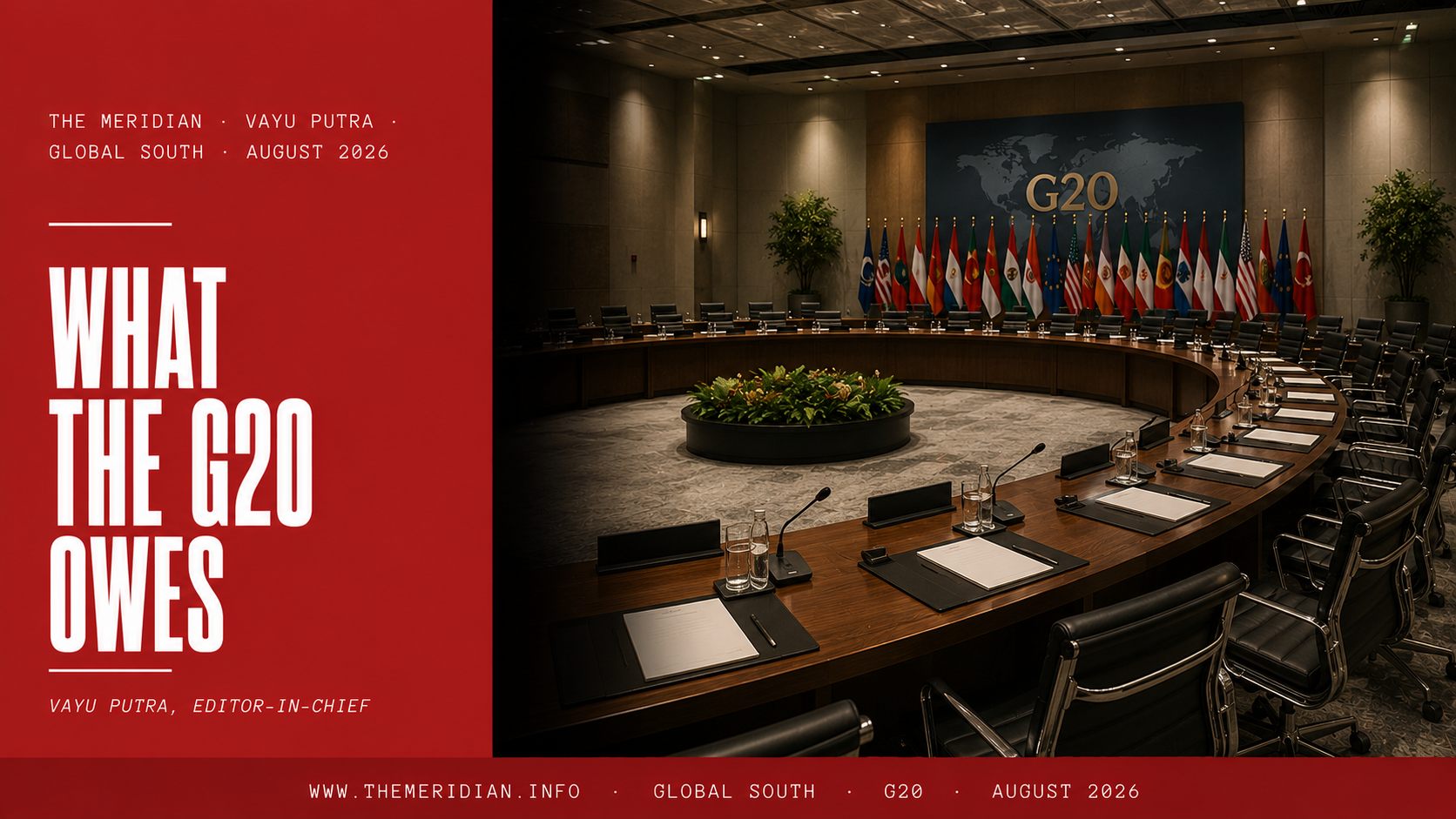
The G20 represents 85 per cent of global GDP, 75 per cent of world trade, and 67 per cent of the global population. South Africa's 2025 G20 presidency was the fourth consecutive Global South presidency, following Indonesia, India, and Brazil, and the first G20 Leaders' Summit held on African soil. The Johannesburg summit produced the Johannesburg Declaration. The G20 presidency then passed to the United States for 2026. On the day the United States obtained the G20 presidency, the Trump administration wiped the G20 website clean of all previous documents and replaced it with a single page bearing the G20 Miami 2026 logo and a photograph of President Trump. This article does not argue about symbolism. It builds, from the evidence of the seventeen articles preceding it in this edition, a specific policy agenda: five things the G20 has the institutional capacity to deliver, has not delivered, and whose delivery would materially alter the extraction architecture that this edition has documented.
The G20 is not a parliament. It passes no binding legislation. Its commitments are voluntary, its declarations non-enforceable, and its compliance mechanisms depend entirely on the political will of its members in their domestic legislative and regulatory processes. This is the central institutional constraint on any G20 policy agenda, and it must be acknowledged before the agenda is stated. The G20's power is not the power of law. It is the power of coordination: twenty economies representing 85 per cent of global GDP deciding simultaneously to move in the same direction is a coordination that the global financial system, the global trading system, and global regulatory institutions cannot ignore. That coordination power has been used, at its best, to stabilise global banking regulation after the 2008 financial crisis, to advance the OECD's global minimum corporate tax, and to expand G20 membership to include the African Union. It has not been used to reform the five pillars of the extraction architecture that the evidence of this edition has documented. This article argues that it should be, and specifies what that would require.
The Johannesburg Declaration signalled a significant shift towards the priorities of the developing world, from commitments on climate finance to rewriting the rules of the global economy. The South African presidency was genuine in its ambition. It centred inequality, food security, artificial intelligence governance, a green transition, and debt reform amid rising geopolitical fragmentation. The African Union's presence at the G20 table, secured by India's 2023 presidency, means that for the first time the institution that represents the continent most affected by the extraction economy described in this edition has a seat in the room where global economic decisions are taken. These are achievements of real institutional significance. They are not sufficient. The Johannesburg Declaration's commitments on debt restructuring are voluntary. The climate finance commitments remain largely unfunded relative to the scale of the need. The agricultural subsidy disciplines that would address the wall described in Article 17 of this edition were not on the agenda. The TRIPS reform that the September 2024 UN statement called necessary was not advanced. The remittance fee reduction that SDG 10.c targets was not given enforcement mechanisms. The room was full. The agenda was incomplete.
The G20's thematic areas of focus have expanded enormously: by South Africa's 2025 presidency the organisation had twenty-two working groups, three task forces, and thirteen engagement groups. The expansion of working groups is not the same as the delivery of outcomes. Thirty-eight working bodies discussing every global challenge simultaneously is not a governance architecture optimised for decisive action on the specific, costed, legally articulable demands that the Global South's situation requires. It is a governance architecture optimised for the production of declarations. The Global South does not need more declarations. It needs fewer working groups and more binding commitments on the five areas where the evidence of this edition shows that G20 coordination would produce measurable change.
Article 13 documented that the top ten container carriers control 85 per cent of global capacity, with the top three holding over 45 per cent. MSC is acquiring port terminal infrastructure on a scale that integrates shipping and port ownership in a single entity across the world's major trade routes. The alliance exemptions from competition law that permit coordinated capacity management among the largest carriers were granted on the premise that they enabled more reliable services. The evidence of the 2021 supply chain crisis and the 2024 Red Sea freight rate spike shows that those exemptions also enable coordinated pricing during disruptions that disproportionately affects the Global South.
What the G20 can do: Coordinate simultaneous review of shipping alliance competition exemptions across major jurisdictions, specifically the EU Block Exemption Regulation and the US Ocean Shipping Act, with the explicit objective of capping single-carrier market share at 20 per cent and ending alliance exemptions that permit coordinated capacity reduction. Mandate the International Maritime Organisation to establish a freight rate transparency mechanism that provides real-time public data on the cost differential between Global South and Global North trade corridors. Instruct the World Bank to establish a Shipping Access Fund capitalised at $5 billion to subsidise freight costs in the most isolated SIDS corridors where the 0.9 per cent consumer price impact documented by UNCTAD is most severe.
Article 14 documented that the Federal Reserve's 5.25 percentage point tightening cycle between March 2022 and July 2023 doubled the share of developing countries with sovereign spreads above 10 percentage points, from 13 per cent to 26 per cent, within eighteen months. The Federal Reserve's mandate does not include consideration of spillover effects on developing economies. No international institution has the mandate to require it to do so. Article 16 documented that IMF conditionality consistently produces adjustment costs that fall on the poorest populations while corporate tax exemptions remain intact, and that approximately 20 African nations are currently under IMF programmes in a relationship that has become permanent economic governance rather than temporary crisis support.
What the G20 can do: Mandate the IMF to publish a Spillover Impact Assessment alongside every major central bank policy decision by G20 members, quantifying the expected effect on developing country debt service costs, capital flows, and exchange rates. This does not constrain the Federal Reserve's domestic mandate. It makes the spillover visible. Simultaneously, reform IMF voting weights to reflect current economic realities: sub-Saharan Africa, with the world's fastest-growing population and the largest share of IMF programme borrowers, holds a combined voting share that does not reflect either its population or its use of the institution. A rebalancing that increases African and South Asian voting shares by five percentage points, funded by a proportional reduction in European over-representation, would not change the IMF's technical analysis. It would change whose interests that analysis is designed to serve.
Article 15 documented that 1.5 million people died in 2023 from preventable HIV, tuberculosis, and hepatitis because they could not afford treatment. The June 2022 COVID vaccine TRIPS waiver covered vaccines only, not diagnostics, treatments, or future pandemics. Only 12 facilities in 8 countries have produced under the waiver. The September 2024 UN pandemic preparedness meeting declared TRIPS broken. Compulsory licensing reduced HIV drug prices by 92 per cent when used. The barrier is not legal impossibility but bilateral pressure from the United States and European Union against developing countries that attempt to exercise the right.
What the G20 can do: The G20 includes the United States, the European Union, and the United Kingdom: the three jurisdictions whose bilateral pressure most consistently prevents developing countries from issuing compulsory licences. A G20 commitment that member states will not impose trade penalties on developing countries that issue compulsory licences in compliance with the Doha Declaration would remove the primary constraint on the exercise of a legal right that already exists. This requires no new law. It requires a political commitment from the major pharmaceutical-exporting economies to stop using their bilateral trade leverage to prevent the exercise of WTO-recognised flexibilities. A simultaneous G20 agreement to extend the COVID vaccine waiver to all pandemic health technologies, in perpetuity rather than until 2027, would provide the legal architecture that the September 2024 UN statement called necessary.
Article 17 documented that G20 members collectively account for the overwhelming majority of the $842 billion in annual agricultural support that distorts world commodity prices. The Doha Round collapsed in 2006 because the United States and the European Union refused to reduce agricultural subsidies. The Cotton Four have been waiting twenty years for a resolution. The WTO's own 2025 assessment found that persistent trade distortions threaten global food security.
What the G20 can do: Establish a binding G20 Agricultural Subsidy Peer Review Mechanism under which each member annually reports its total agricultural support by OECD category, subject to independent audit and peer challenge by other members. The mechanism does not require subsidy reduction. It requires transparency and justification. In a room where China, the United States, the European Union, India, and Brazil are simultaneously required to justify their $842 billion in annual agricultural support to the African Union, to Indonesia, to South Africa, and to the other G20 members whose farmers compete against those subsidies without equivalent support, the political dynamic of the agricultural subsidy question changes. Transparency is not a substitute for reform. It is the precondition for reform. The Doha Round collapsed in secret negotiations. A G20 peer review mechanism would make the political choices visible to the publics in every member country.
Article 20 documented that global remittances to low- and middle-income countries reached $685 billion in 2024, three times the size of all official development assistance, at an average transfer cost of 6.49 per cent that is more than twice the SDG 10.c target. Sub-Saharan Africa's average cost was 8.78 per cent, rising rather than falling. The SDG 10.c target of 3 per cent by 2030 will not be met on the current trajectory. The G20 members include the United States, Saudi Arabia, Germany, and the United Kingdom: the four largest remittance-sending countries in the world. They have the regulatory jurisdiction over the money transfer operators and correspondent banks that set the fee structure in those corridors.
What the G20 can do: Coordinate simultaneous domestic regulatory action in the five largest remittance-sending jurisdictions to require that money transfer operators operating in those jurisdictions charge no more than 3 per cent on transfers to low-income countries by January 2028. This is not a new regulatory innovation. The UK's Payment Systems Regulator, the US Consumer Financial Protection Bureau, and the European Banking Authority all have existing jurisdiction over money transfer operators. They have not exercised it to enforce the fee cap that their governments committed to in the SDG framework. A G20-coordinated directive to those regulators to enforce the cap simultaneously would eliminate the competitive disadvantage that any single jurisdiction faces by acting alone. The digital technology to deliver transfers at 3.65 per cent already exists. The regulatory will to require it does not. The G20 can provide the will.
The G20 has the institutional capacity to deliver every one of these five demands. It has not delivered them because the members whose domestic industries would bear the cost of delivery have chosen not to. That is not an institutional failure. It is a political choice. Naming it as a political choice is the first step toward changing it.
The G20 agenda is shifting from the Global South to America First. On the very day that the United States obtained the G20 presidency, the Trump administration wiped the website clean of all previous documents and announced that South Africa would be barred from the next year's summit and replaced by Poland. The Carnegie Endowment's assessment, written in March 2026, is precise: the US 2026 G20 presidency will be characterised by transactional diplomacy, recurrent threats of tariffs, and disregard for institutional continuity.
This is the political context in which the five demands above must be assessed. None of them will be advanced by the US 2026 G20 presidency. Trump's America First agenda is structurally opposed to every item on this list: shipping regulation reduces American logistics company profits, IMF spillover accountability constrains Federal Reserve autonomy, TRIPS waiver extension reduces American pharmaceutical revenues, agricultural subsidy peer review exposes American farm policy to international scrutiny, and remittance fee caps impose costs on American money transfer operators. The Miami 2026 summit will not deliver this agenda.
The relevant question is not whether Miami 2026 will deliver the agenda. It is whether the Global South can use the period of the US presidency to build the political coalition that would make the agenda deliverable by the next Global South presidency, or by the multilateral institutions in whose governance the Global South's recently increased representation creates new possibilities. The African Union is now at the G20 table. Brazil, India, Indonesia, South Africa, and the expanded BRICS grouping collectively represent a majority of the world's population and a growing share of its economic output. The coordination capacity that has historically produced G20 outcomes exists among Global South members as well as among G7 ones. Using it requires precisely the kind of political leadership that South Africa's Johannesburg presidency demonstrated was available.
The Johannesburg Declaration included significant commitments on climate finance and debt relief and signalled a shift towards the priorities of the developing world. However, the promises made regarding climate finance and debt relief are voluntary commitments, not binding laws. The challenge for the African Union and its allies will be to hold the G20 accountable in the months and years ahead.
The Time Africa assessment is the correct one. Voluntary commitments at G20 summits have a documented implementation record. The 2009 Pittsburgh G20 committed to phase out fossil fuel subsidies. Fifteen years later, fossil fuel subsidies have increased. The 2014 Brisbane G20 committed to lift global GDP by an additional 2 per cent through structural reforms. The commitment was not met. The Johannesburg Declaration's commitments join a long line of aspirations that the political will of the moment could not sustain against the institutional inertia of subsequent months.
The five demands in this article are not aspirational. They are operational. Each has a specific mechanism, a specific regulatory body, a specific legal instrument, and a specific timeline. The difference between an aspirational G20 commitment and an operational one is the specificity of the mechanism and the accountability of the actors responsible for delivering it. Aspirational commitments produce declarations. Operational commitments produce change. The Global South needs the latter.
The policy agenda in this article is built from the evidence of the seventeen articles that precede it. Every demand corresponds to a documented extraction mechanism. Every mechanism the demand addresses has been quantified. Every reform proposed uses institutional instruments that already exist and does not require the creation of new ones. The demands are not radical. They are the minimum corrections that the evidence requires.
The Global South's needs from the G20 are not abstract aspirations about a fairer world. They are specific operational requirements. Cap shipping market concentration and the SIDS consumer price impact of freight rate spikes falls. Publish Federal Reserve spillover assessments and the doubling of developing country sovereign distress after a Fed tightening cycle becomes politically visible. Commit not to penalise compulsory licensing and 92 per cent HIV drug price reductions can be replicated for the next pandemic's treatment. Require agricultural subsidy transparency and the political cover for the $842 billion annual distortion is removed. Enforce the remittance fee cap and $40 billion per year stays in the hands of migrant workers and their families rather than in money transfer operator revenues.
The G20 has the capacity to deliver all five. It has chosen not to deliver any of them in the form that would produce measurable change. The Miami 2026 presidency will not advance this agenda. The work of building the coalition that will advance it in 2027 and beyond begins in the year that the G20's attention is elsewhere. The Global South has learned, from thirty years of evidence, that the institutions of global governance do not change their priorities unless the people most affected by those priorities change the political conditions under which the institutions operate. The African Union is at the table. The evidence is documented. The agenda is written. The political work is the work that remains.
Add comment
Comments