The UN Just Told Mauritius It Still Cannot Define Torture Properly
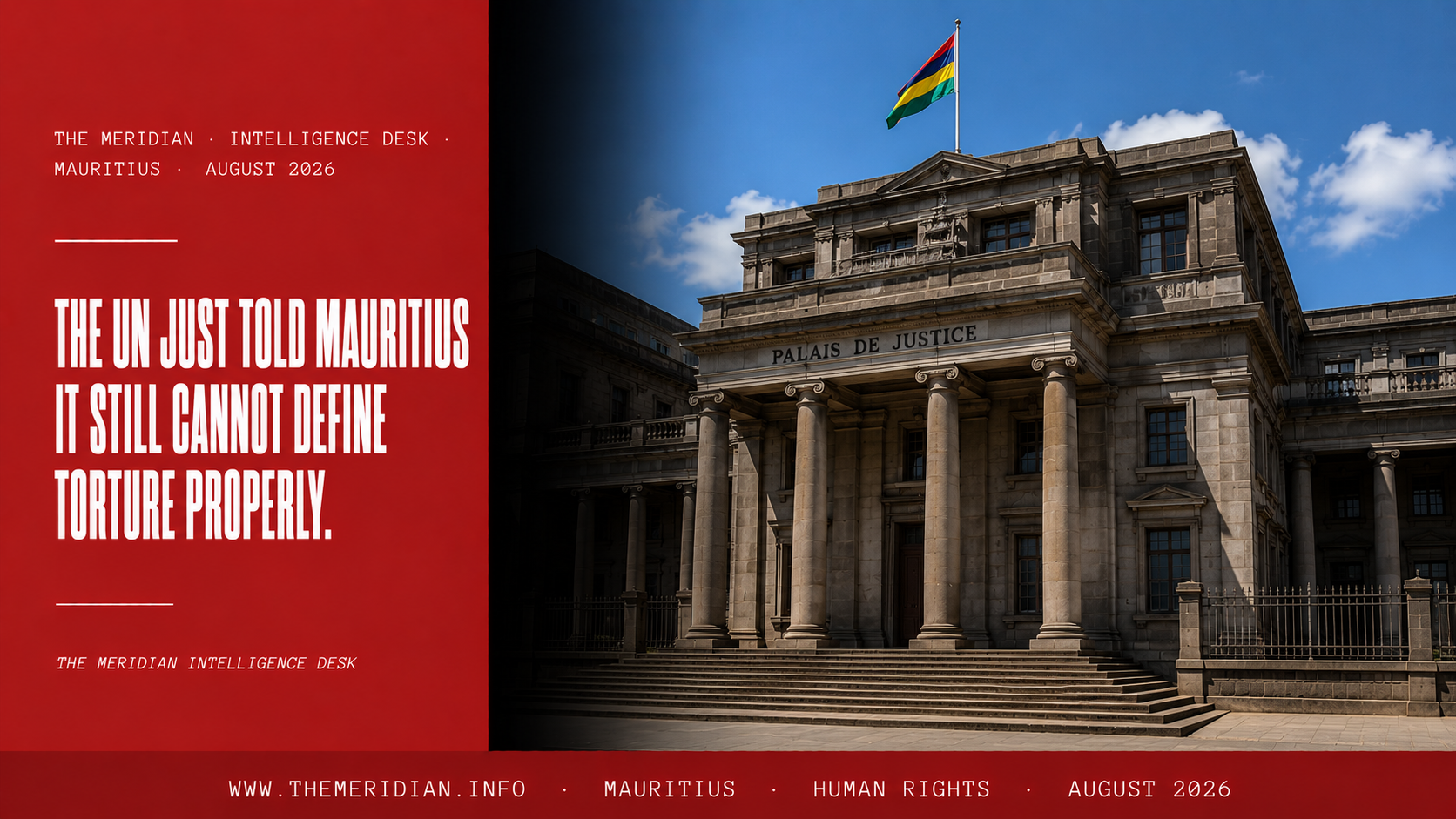
On 9 and 10 April 2025, the United Nations Committee Against Torture reviewed Mauritius's fifth periodic report at its 82nd session in Geneva. The Mauritius delegation was led by Attorney-General Gavin Glover. The Committee adopted its concluding observations on 28 April 2025. The findings are documented in a primary source document published by the UN Office of the High Commissioner for Human Rights. They establish, in the Committee's own language, that torture is not fully criminalised in Mauritius law, that 48.7 per cent of the prison population is held on pre-trial detention, that the body responsible for investigating police misconduct is appointed and dismissed by the executive branch it is supposed to investigate, that journalists and human rights defenders experienced arbitrary arrest and harassment during the reporting period, that Chagossians continue to experience discrimination, poverty, and inhuman and degrading treatment as a result of their forced displacement, and that marital rape is not yet a specific criminal offence in Mauritius. The Committee set a follow-up deadline of 2 May 2026 for three priority recommendations. The Meridian examines every finding against what the government told the Committee and what the primary document records.
The UN Committee Against Torture is not a political body in the partisan sense. It is a treaty monitoring body of ten independent experts whose mandate is the oversight of state compliance with the Convention Against Torture and Other Cruel, Inhuman or Degrading Treatment or Punishment, which Mauritius ratified in 1992. The Committee does not issue findings based on political preference or external pressure. It issues findings based on what states report, what civil society submits in parallel, and what governments say in the dialogue with the Committee during the review session. The Mauritius review of April 2025 involved a formal dialogue between the Committee and the Mauritius delegation, led by Attorney-General Gavin Glover. What the Committee found, and what it recommended, is on the public record. The Meridian reads the primary document and reports what it contains.
The most fundamental finding of the entire review is the one that requires the least elaboration. Mauritius has ratified the Convention Against Torture. Article 4 of the Convention requires every state party to ensure that all acts of torture are criminal offences under its national law, punishable by appropriate penalties which take into account their grave nature. Mauritius has not done this.
Section 78 of the Criminal Code provides for penalties of a fine of up to 150,000 rupees and imprisonment of up to 10 years for torture. Section 259 of the same Code, for the offence of unlawful arrest accompanied by physical torture, provides for penal servitude for up to 20 years. The Committee noted with concern that neither section specifies a minimum penalty, leaving the determination entirely to prosecutorial and judicial discretion, creating the risk that the penalty imposed for torture in a particular case will not be commensurate with the grave nature of the crime. The Probation of Offenders Act may apply to the offence of torture, meaning a court could in principle order probation for an act of torture rather than a custodial sentence. Neither section explicitly covers complicity in torture or attempts to commit torture. Domestic courts have not been invoking or applying the Convention's provisions to fill these gaps.
On 4 April 2025, the Cabinet approved the introduction of the Constitution (Amendment) Bill and the Criminal Code (Amendment) Bill in the National Assembly, which would repeal section 7(2) of the Constitution and amend section 245 of the Criminal Code, removing provisions that undermine the absolute prohibition of torture. The Committee acknowledged this and welcomed the commitment. It also placed it in the follow-up procedure, requiring Mauritius to report back by 2 May 2026 on whether the criminalisation of torture had actually been achieved in national legislation. The bills were approved by Cabinet in April 2025. They were in the National Assembly process as of the review. Whether they have been enacted and proclaimed is the compliance question the follow-up deadline was designed to answer.
The Committee found that 48.7 per cent of the prison population is held on pre-trial detention. Nearly half of every person currently detained in Mauritius has not been convicted of any offence. The Committee expressed concern at reported delays in police investigations, which it identified as having a negative impact on the length of pre-trial detention, and at the lack of comprehensive information on the use of alternative and non-custodial measures.
The provisional charge system received specific attention. The Committee took note of the information provided by the State party that the Police and Criminal Justice Bill, once enacted, would abolish the system of provisional charges, under which a person may be detained on suspicion of having committed a serious offence. The Committee identified the provisional charge system as one that may result in abusive and arbitrary practices and which has been an area of concern. The Cannabis Edition of The Meridian documented the provisional charge mechanism in detail in June 2026: a charge is opened before any conviction, civil service eligibility is suspended, professional licences are frozen, international travel is restricted, and the case can run for four years. The UN Committee Against Torture has now placed the same mechanism on the international human rights record as an area of concern warranting abolition.
The Police and Criminal Justice Bill, formerly known as the Police and Criminal Evidence Bill, has been pending for many years according to the Committee's own language. The delegation confirmed it would likely be adopted within a year of the April 2025 review. Whether it has been adopted and whether the provisional charge system has been abolished within the follow-up timeline is a question the May 2026 deadline was designed to answer.
The Independent Police Complaints Commission is Mauritius's body for investigating complaints of police misconduct, including allegations of torture, ill-treatment, and deaths in custody. The Committee found that the members of the IPCC continue to be appointed and dismissed by the Executive, under sections 3(5) and 3(7) of the Independent Police Complaints Commission Act. The Committee acknowledged the State party's explanation that independence is guaranteed under section 3(2) of the same Act, but found the structural position, appointment and dismissal by the executive of the body mandated to investigate the executive's own police force, to be incompatible with the independence the Convention requires.
Between April 2018 and February 2025, the IPCC received 4,674 complaints. Of those, 2,698 investigations were completed and 1,976 remain pending. The Committee found a lack of comprehensive details about the outcome of the completed investigations. It expressed concern at the high number of allegations of torture, deaths in police custody, police violence, and abuse received by the Commission. It noted reports that police officers interfere in the investigation of complaints of their misconduct and that victims withdraw their complaints for fear of reprisals. Existing protective measures were found to be ineffective.
A body whose members are appointed and dismissed by the executive, and that has 1,976 investigations pending after receiving 4,674 complaints over seven years, with victims withdrawing complaints for fear of reprisals, and with reports of police interference in the investigation of police misconduct, is not functioning as an independent complaints commission in any meaningful operational sense. That is the Committee's finding. It is also The Meridian's reading of the same document.
The Committee's finding on journalists and human rights defenders is contained in paragraph 34 of the concluding observations and is worth quoting directly in substance. The Committee expressed concern about information before it regarding instances of arbitrary arrest, threats and attacks experienced by human rights defenders, a worsening environment for lawyers working on human rights cases, their difficulties in accessing detainees in prisons, and the intimidation and harassment experienced by journalists during the reporting period.
This finding connects directly to the analytical framework The Meridian has applied to institutional developments in Mauritius since the November 2024 election. The Bermeo-Laebens framework, applied in The Unfinished Ambition article and The Constitutional Convergence article in this edition, identifies the conditions under which democratic backsliding produces concentration of executive power. The Committee Against Torture's finding that journalists and lawyers experienced arbitrary arrest, harassment, and a worsening operating environment during the reporting period is not a finding about political preference. It is a finding about the conditions under which the accountability journalism and legal representation that constrain executive overreach are able to function. A worsening environment for lawyers working on human rights cases and for journalists during the reporting period is a structural data point, not an editorial opinion.
The Mauritius delegation to the April 2025 UN CAT review was led by Attorney-General Gavin Glover. The Meridian has previously documented the institutional significance of Gavin Glover's position: he was Prime Minister Ramgoolam's personal criminal defence counsel before becoming Attorney-General in the current government, a relationship that the Bermeo-Laebens analysis in The Constitutional Convergence article identified as a data point regarding institutional independence.
Glover's appearance before the Committee Against Torture as the head of the government delegation is procedurally standard: the Attorney-General is the appropriate senior official to lead a human rights treaty body review. What is analytically notable is that the government he represents was reviewed for, among other things, the independence of the body responsible for investigating police misconduct from executive control, and the protection of journalists and human rights defenders from arbitrary arrest and harassment. The Attorney-General's institutional position at the intersection of these findings is not an accusation. It is a structural observation that The Meridian places on the record.
The Committee found these recommendations partially implemented from the previous review cycle. It placed three of them in the formal follow-up procedure with a deadline of 2 May 2026: the criminalisation of torture, the independence of the IPCC, and the conditions of detention. The May 2026 deadline has passed. The government's response to the Committee is the document that will determine whether Mauritius has moved from partial to full compliance on the findings that the international human rights system has identified as most urgent.
Three additional findings warrant specific attention because they illuminate the gap between Mauritius's self-presentation as a rights-respecting Small Island Developing State and the documented conditions that the Committee's review records.
On the Chagossians, the Committee found concern at the situation of discrimination, poverty, and inhuman and degrading treatment to which Chagossians have been subjected as a result of their forced displacement. The Committee noted the government's welfare fund and other support measures but expressed concern at the lack of information about consultation with Chagossians in the ongoing negotiations with the United Kingdom, particularly regarding their return, redress, and rehabilitation. The Chagos sovereignty agreement between the UK and Mauritius, which has been discussed and partly concluded during the reporting period, is a matter of significant national importance. The Committee's finding that the people most directly affected by the displacement, the Chagossians themselves, lack documented evidence of meaningful consultation in the process that will determine their future, places a human rights dimension on a diplomatic achievement that Mauritius has presented primarily in sovereignty terms.
On marital rape, the Committee noted that the State party proposed amendments to criminalise marital rape as a specific offence and to repeal section 242 of the Criminal Code, which made manslaughter committed against a spouse caught in the act of adultery a non-excusable offence. These amendments were proposed but not yet enacted as of the April 2025 review. This gap has since been closed. On 21 July 2026, the Mauritius National Assembly voted unanimously to criminalise marital rape as a specific criminal offence under the Criminal Code, with sentences of 10 to 45 years imprisonment. The Domestic Abuse Act was passed on 10 July 2026. Attorney-General Gavin Glover, who led the Mauritius delegation to the April 2025 CAT review, told parliament that the reforms ensure that the most horrific and despicable crimes are punished for what they are. The section 242 adultery manslaughter excuse was also addressed in the same legislative package. This is a material and significant development that directly responds to one of the Committee's documented concerns. The Meridian records it as such.
On legal aid, the Committee noted that the current threshold for legal aid eligibility is an income of less than 15,000 rupees per month, despite the minimum wage being 20,000 rupees per month. A person earning the legal minimum wage in Mauritius does not qualify for legal aid. The government acknowledged during the dialogue that current thresholds for legal aid were "ridiculous" and stated it was reviewing legislation to address this. The acknowledgement is on the international record. Whether the review has produced amended thresholds is not yet documented in public sources available to The Meridian.
The UN Committee Against Torture's concluding observations on Mauritius are not a political attack on the Ramgoolam government. They are the international human rights system's assessment of the conditions that the treaty monitoring body found documented, by the government's own reports, by civil society parallel submissions, and by the dialogue between the Committee's experts and the delegation that Mauritius sent to Geneva. The findings span multiple governments and multiple reporting periods. The Committee acknowledged genuine progress: the adoption of the Children's Act, the prohibition of corporal punishment, the digital interview recording system in eight police stations, the juvenile justice reforms, and the Cabinet approval of the constitutional and criminal code amendment bills in April 2025.
The unresolved findings are equally documented. Torture is not yet fully criminalised in national law in a country that ratified the Convention Against Torture in 1992, thirty-three years ago. Nearly half the prison population has not been convicted of anything. The body responsible for investigating police misconduct is appointed by the executive. Journalists and lawyers experienced arbitrary arrest and a worsening operating environment. The Chagossians, whose forced displacement the international community has called a historical injustice, experience discrimination and inhuman treatment in the country that claims sovereignty over their homeland in their name. Marital rape was not yet a specific criminal offence at the time of the April 2025 review. On 21 July 2026, the National Assembly voted unanimously to criminalise it, with sentences of 10 to 45 years. The legal aid threshold is below the minimum wage.
The follow-up deadline of 2 May 2026 has passed. The government's response on the three priority items, torture criminalisation, IPCC independence, and conditions of detention, is the document that will tell the Committee whether Mauritius has closed the gap between the bills approved by Cabinet in April 2025 and the enacted, proclaimed, and operational legislation that the Convention requires. That document is the next chapter of this story. The Meridian will read it when it is published and report what it says.
Add comment
Comments